Water Conservation and Management (WCM)

Water Conservation and Management (WCM)

wcm.04.2024.475.479

GROUNDWATER QUALITY MAPPING BASED ON GEOSPATIAL ANALYSIS OF QUALITY STANDARD WITH GEOLOGICAL REVIEW IN SOUTH COASTAL JEMBER

Journal: Water Conservation and Management (WCM)
Muammar Kadavi, Yushardi, Ana Susiati, Sri Astutik, Muhammad Asyroful Mujib, Bejo Apriyanto
Print ISSN : 2523-5664
Online ISSN : 2523-5672

This is an open access article distributed under the Creative Commons Attribution License CC BY 4.0, which permits unrestricted use, distribution, and reproduction in any medium, provided the original work is properly cited

Doi: 10.26480/wcm.04.2024.475.479

Abstract
Observation results on the south coast of Jember show that there are differences in the characteristics of groundwater in several residents’ dug wells, namely some are fresh and brackish. Based on the findings of these problems, the aim of this research is to analyze and map soil quality based on quality standards with geological observations on the south coast of Jember. This research uses quantitative methods through surveys to determine the quality of groundwater used for drinking water in the Jember South Coastal Area with the parameters tested including TDS, odor, taste, pH, sulfate, chloride and hardness. The results of groundwater quality on the southern coast of Jember Regency show that based on the test results of physical parameters and chemical parameters, most of the air samples are of drinking quality. The results of groundwater quality mapping with geological observations based on the Jember geological map sheet show that 47 km2 (17,8%) of non-drinkable areas are located on alluvial plains interspersed with puger formations in the form of limestone which has high porosity and permeability and 227 km2 (82,2%) the potable area is located in geological interbeds of sandstone and clay with low porosity and permeability.

Keywords

Mapping, Groundwater Quality, South Coast of Jember

1. INTRODUCTION

Groundwater is a medium that can change and absorb substances from every rock it passes through. In addition, it is an important part of the survival of humans and living things around it (Fetter, 2014). The nature of groundwater dissolves minerals from the rocks it passes through (Arivoli et al., 2018). Therefore, the mineral content of an aquifer is strongly influenced by the type of rock it passes through, or the type of groundwater based on the chemical elements contained therein (Singhal, and Gupta, 2010). Groundwater quality can also be affected by proximity to the sea. Locations closer to the sea tend to have more brackish or salty groundwater. Groundwater in coastal areas, which is generally brackish, has a relatively high electrical conductivity value and a salty taste (Febriarta, 2020). Groundwater that has electrical conductivity can also be supported by the physical properties of rocks in the form of resistance types (Susiati et al., 2024). The composition of groundwater can be seen, among others, through the use of physical parameters in the form of TDS so that the total solute content can be known (Indartin and Mujib, 2020).

Groundwater in coastal areas can vary, and this is influenced by various factors, including distance to the sea, groundwater depth, rock porosity, and overlying human activities (Purnama, 2010). According to Hounsinou 2020, changing groundwater dynamics are also influenced by the season, as seawater intrusion is more likely to occur in the dry season than in the rainy season (Hounsinou, 2020). Seawater intrusion occurs when seawater enters fresh groundwater aquifers due to seawater pressure or thrust, this can occur due to empty freshwater aquifer cavities. Aquifers that consist of impermeable rocks or consist of saline layers underground can cause groundwater to become saline (Dhal and Swain, 2022). Rock conditions with rock lithology characteristics in the form of porosity and permeability greatly affect groundwater conditions through absorption (Pratiwi et al., 2022).

The phenomenon of seawater intrusion and the complex geological characteristics of the region can cause differences in groundwater quality between fresh and brackish groundwater (Damayanti et al., 2020) [11]. On the south coast of Jember Regency, the study area covers ten villages with an area of approximately 1244 km2, including Paseban, Kepanjen, Mayangan, Mojomulyo, Mojosari, Puger Kulon, Lojejer, Sabrang, Sumberejo, and Curah Nongko villages. Geologically, based on the geological map of the Jember sheet, the research area is composed of three main rock formations, namely from the youngest of which are alluvial deposits, the Puger Formation, and the Batu Ampar Formation with rock lithology dominated by sandstone and limestone. The Puger and Batu Ampar formations consist of rocks with high porosity and permeability, such geological conditions are considered to encourage seawater intrusion. Based on observations, there are findings of differences in groundwater characteristics in one of the residents’ dug wells, namely in Sabrang Village with fresh characteristics with a well depth of 4.5 and in Sumberejo Village with brackish characteristics at a well depth of 4 meters. It is also known that residents there are very dependent on the existence of groundwater for their daily needs. Based on these findings, it is necessary to conduct research on groundwater quality mapping for drinking water considering the importance of groundwater quality information in order to meet life needs, water use patterns, and water being a basic need.

Based on previous research, a similar study was conducted by Sutrisno 2022, namely in residential areas in the coastal area of Pancer Beach, Puger Kulon Village, Jember (Sutrisno et al., 2022). The purpose of this research is to see the distribution of water quality due to seawater intrusion in residential areas around Pancer Beach. Some of the things done in this study are measuring pH, TDS, color, taste, and odor of water in settlements around Pancer Beach. The results showed that seawater intrusion occurred in the settlements around Pancer Beach, this is evidenced by the pH and TDS values which are below the water quality standards.
Another study was conducted by Apriansyah, The purpose of this study was to provide an overview of groundwater quality in the coastal area of Majene Regency, with particular emphasis on hardness, dissolved oxygen (DO) levels, and salinity levels. The results show that seawater intrusion and geological conditions affect water quality in the coastal area of Majene Regency. The hardness analysis showed that Banggae Timur sub-district has the highest level of hardness at 1509.2 ppm, which is caused by the type of soil and limestone present there. In addition, salinity analysis found that East Banggae sub-district has the highest salinity of 3.6‰, which is caused by the sloping contour of the land, which allows for seawater intrusion (Yusman et al., 2019).

Compared to some previous studies, there are still not many previous studies that focus on mapping and analyzing groundwater quality for drinking water and reviewing the condition of the rock formation. This research uses parameter tests including physical parameters including TDS, odor, and taste, and chemical parameters including pH, sulfate, chloride, and hardness. The research location was chosen with the urgency of considering the feasibility of groundwater quality for drinking water. The purpose of this study is to assess and map the quality of groundwater based on standard standards with geological reviews on the south coast of Jember.

2. METHODOLOGY

This study used a quantitative method through a survey to determine the quality of groundwater used for drinking water in the South Coastal Area of Jember. This study used descriptive analysis to describe the data collection of field test results. Furthermore, water quality was measured by measuring indicators of research parameters. This research was conducted using the survey method as a primary data source from water samples in the South Coastal Area of Jember Regency.

2.1 Research sample

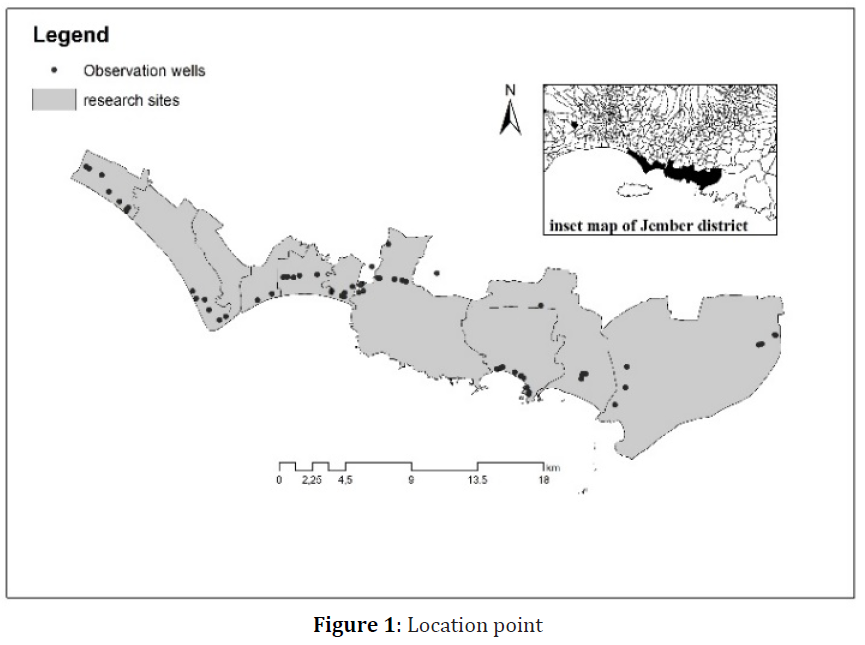
The research area is located in the southern coastal area of Jember Regency which administratively includes 10 villages namely Paseban, Kepanjen, Mayangan, Mojomulyo, Mojosari, Puger Kulon, Lojejer, Sabrang, Sumberejo, and Curahnongko. This research uses quantitative methods through surveys to determine the quality of groundwater used for drinking water in the South Coastal Area of Jember. As for the determination of water sampling location points using purposive sampling method with consideration that the location represents geological formations and is in the coastal area with a radius of less than 8 km from the coastline inland. The total samples taken for the determination of water quality at the research site were 66 water samples for the test of physical parameters (TDS, odor, and taste), then from the 66 water samples, 11 water samples were taken with the criteria for the highest TDS value in each sample representing each village for the purpose of testing chemical parameters (pH, Sulfate, Chloride, and Hardness). Data collection techniques used in this research are field survey and documentation.
2.2 Data analysis

Data analysis techniques on the determination of drinking water quality using drinking water quality standards Permenkes No 492/Menke/Per/Iv/2010 to explain the value of groundwater quality findings and its feasibility for drinking water. Related to the findings of groundwater quality, the results of soil quality measurements will then be analyzed and classified into two categories, namely feasible or not feasible for drinking as in Table 1.

The mapping analysis was analyzed using the Kriging Interpolation method, namely ordinary kriging with consideration of the advantages of being able to produce estimates of values at unmeasured locations by considering their distance from known data points, so as to provide a good representation for areas not covered by measurement data. The ordinary kriging method, also known as linear kriging, involves using a weighted linear combination of available data to estimate values at unsampled points (Isaaks et al., 1989). This method assumes that the regional variable 𝑍 𝑥 is stationary, with unknown and constant mean values. To estimate the value at point 𝑥0, ordinary kriging uses a linear combination of the random variable 𝑍 𝑥𝑖 and the kriging weight 𝜆𝑖, which can be expressed mathematically as follows:

Z(s0) = ∑_(0=1)^N▒λi Z(si)
Description:
Z(s0) : Interpolated value of two locations s0
Z(si) : Measured value at location si (i = 1, 2,…N).
Λi : Kriging weights determined based on the distance and spatial distribution of the data.
N : Number of measured points used in the interpolation.

The analysis of the Geology review is measured using the rock type method in the form of a review of permeable conditions and porosity and later the results will be studied for their correlation to groundwater quality.

3. RESEARCH RESULTS

3.1 Physical and chemical parameter test results

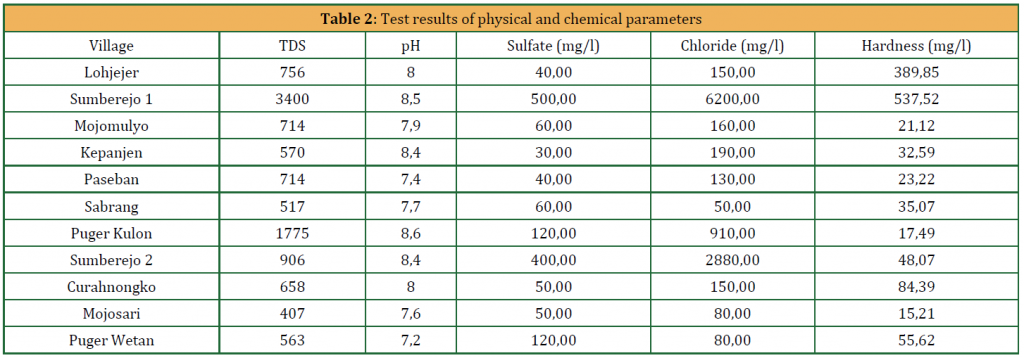
The results of groundwater quality research in the south coast from 11 villages showed significant variations in physical parameters such as TDS and chemistry including pH, Sulfate, Chloride, and Hardness. Total Dissolved Solids (TDS) varied between 407 mg/L in Mojosari to 3400 mg/L in Sumberejo 1. The pH values ranged from 7.2 in Puger Wetan to 8.6 in Puger Kulon, with the majority of villages having pH within a range that supports drinking water quality. The highest sulfate content was found in Sumberejo 1 with 500 mg/L, while other villages such as Lohjejer, Kepanjen, and Paseban showed lower levels of 40 mg/L, 30 mg/L, and 40 mg/L, respectively. Chloride levels also varied significantly, from a low of 50 mg/L in Sabrang to a high of 6200 mg/L in Sumberejo 1.
Water hardness, measured as CaCO₃ concentration, also showed wide variations. Lohjejer and Sumberejo 1 have the highest hardness values, 389.85 mg/L and 537.52 mg/L respectively, while Mojosari shows the lowest value of 15.21 mg/L. Curahnongko and Puger Wetan had moderate hardness, 84.39 mg/L and 55.62 mg/L respectively. The variation in measurement results reflects the different local geological and environmental conditions in each village where based on the Jember geological map of the south coast of Jember, there are seven geological formations including alluvium, argopuro tuff, puger, merubetiri, sukamade, and ampar stone formations. Villages that have high TDS, sulfate and chloride are likely affected by their proximity to the sea, which causes salt and minerals to enter the groundwater. In addition, human activities in the study area may contribute to the high chemical contaminants (Table 2)
3.2 Parameter classification results

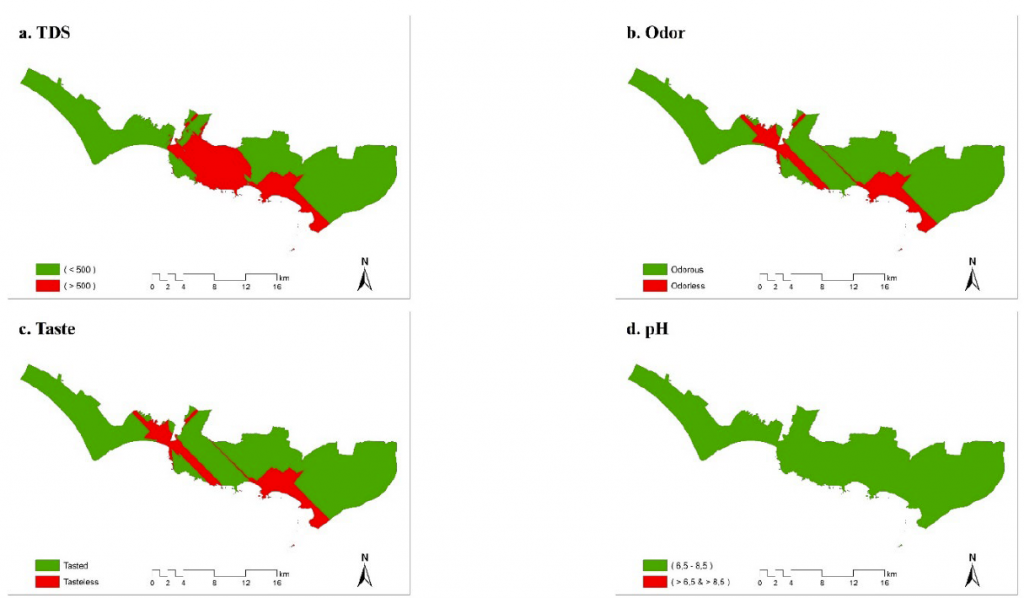
The parameter classification results obtained from the measurement of physical (TDS, odor, and taste) and chemical (pH, sulfate, chloride, and hardness) parameters in accordance with PERMENKES No. 492/MENKE/PER/IV/2010 respectively i.e. TDS evaluation found that 47 water samples, covering an area of 205 km², met the quality standard for drinking water (< 500 ppm), while 19 samples in another 69 km² exceeded this limit (> 500 ppm). In addition, odorless (63 samples, 230 km²) and tasteless (63 samples, 230 km²) water dominated the potable area, with only a few odorous (3 samples, 44 km²) and tasteless (3 samples, 44 km²)
samples not meeting the standard.

Chemical parameters including pH analysis showed that most samples (10 samples, 274 km²) had values within the range of 6.5-8.5 which is suitable for drinking water, while only 1 sample was outside this range (0 km²). For sulfate and chloride parameters, most samples met the quality standards (< 250 mg/L for sulfate and chloride), but some samples showed higher concentrations, especially for chloride (> 250 mg/L, 3 samples, 169 km²). Water hardness also showed similar results, with most samples (10 samples, 274 km²) meeting the standard (< 500 mg/L), although one sample showed high values (1 sample, 0 km²). This groundwater quality results data is presented in (Table 3).

3.3 Parameter Statistics

Statistical data on parameters in this study include water quality measurements, including Total Dissolved Solids (TDS), pH, sulfate, chloride, and hardness. TDS values ranged from 165-3400 mg/L with an average of 502.07 mg/L and a standard deviation of 1095.86 mg/L. pH ranged from 7.2-8.6 with an average of 7.97 and a standard deviation of 0.445. Sulfate ranged from 30-500 mg/L with a mean of 133.64 mg/L and a standard deviation of 153.34 mg/L. Chloride ranged from 50-6200 mg/L with a mean of 998.18 mg/L and a standard deviation of 168.65 mg/L. The hardness ranges from 15.21-537.52 mg/L with an average of 114.56 mg/L and a standard deviation of 168.65 mg/L. Based on the statistical data, it shows that the groundwater quality in the studied area has significant variations in each parameter measured. The majority of pH values are within the range that supports drinking water quality, but high values of TDS and chloride in some locations indicate contamination, indicating unsafe groundwater quality. High water hardness was also found in some villages indicating the water is not good for consumption.

3.4 Groundwater quality results

Based on tabel 3, The parameter classification results obtained from the measurement of physical (TDS, odor, and taste) and chemical (pH, sulfate, chloride, and hardness) parameters in accordance with PERMENKES No. 492/MENKE/PER/IV/2010 respectively i.e. TDS evaluation found that 47 water samples, covering an area of 205 km², met the quality standard for drinking water (< 500 ppm), while 19 samples in another 69 km² exceeded this limit (> 500 ppm). In addition, odorless (63 samples, 230 km²) and tasteless (63 samples, 230 km²) water dominated the potable area, with only a few odorous (3 samples, 44 km²) and tasteless (3 samples, 44 km²) samples not meeting the standard. Chemical parameters including pH analysis showed that most samples (10 samples, 274 km²) had values within the range of 6.5-8.5 which is suitable for drinking water, while only 1 sample was outside this range (0 km²). For sulfate and chloride parameters, most samples met the quality standards (< 250 mg/L for sulfate and chloride), but some samples showed higher concentrations, especially for chloride (> 250 mg/L, 3 samples, 169 km²). Water hardness also showed similar results, with most samples (10 samples, 274 km²) meeting the standard (< 500 mg/L), although one sample showed high values (1 sample, 0 km²). This groundwater quality results data is presented in.

Based on table 4, statistical data on parameters in this study include water quality measurements, including Total Dissolved Solids (TDS), pH, sulfate, chloride, and hardness. TDS values ranged from 165-3400 mg/L with an average of 502.07 mg/L and a standard deviation of 1095.86 mg/L. pH ranged from 7.2-8.6 with an average of 7.97 and a standard deviation of 0.445. Sulfate ranged from 30-500 mg/L with a mean of 133.64 mg/L and a standard deviation of 153.34 mg/L. Chloride ranged from 50-6200 mg/L with a mean of 998.18 mg/L and a standard deviation of 168.65 mg/L. The hardness ranges from 15.21-537.52 mg/L with an average of 114.56 mg/L and a standard deviation of 168.65 mg/L. Based on the statistical data, it shows that the groundwater quality in the studied area has significant variations in each parameter measured. The majority of pH values are within the range that supports drinking water quality, but high values of TDS and chloride in some locations indicate contamination, indicating unsafe groundwater quality. High water hardness was also found in some villages indicating the water is not good for consumption.
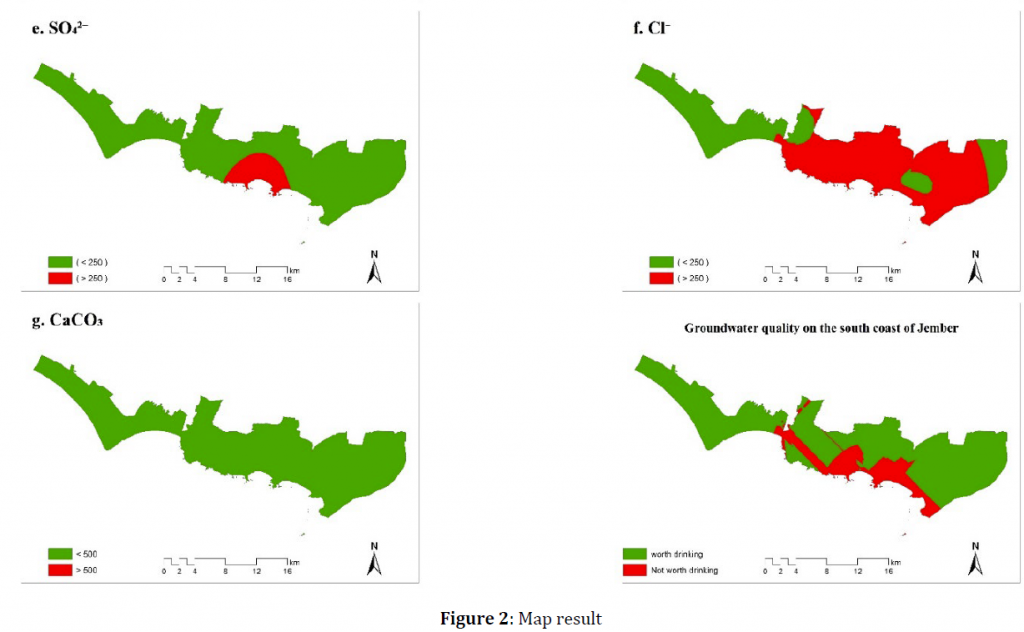
The results of the groundwater quality classification map on the south coast of Jember are the result of overlaying seven parameter maps including TDS, odor, taste, pH, Sulfate, Chloride, and Hardness. Based on the results of groundwater quality area in the southern coastal region of Jember shows that 47 km2 (17.8%) area is not suitable for drinking and 227 km2 (82.2%) area is suitable for drinking, it indicates that the majority of coastal areas have good water quality. The results of groundwater quality mapping with a geological review based on the geological map of the Jember sheet show that 47 km2 (17.8%) of non-drinkable areas are on alluvium plains interspersed with puger formations in the form of gampingan with rock lithology conditions that have a porosity level of 25-40% and permeability with a range of (10-10 – 10-7) which indicates that the material has a better ability to allow fluid flow. Materials with this permeability can allow water to flow more easily through their pores. While most of the other areas with a value and 227 km2 (82.2%) of potable areas are in the geology of sandstone and clay inserts with rock lithology characterized as having a porosity level of 5-35% and permeability with a range of 10-20 – 10-17 which indicates that the material is very difficult to pass through by the fluid. Rock lithologies with low porosity and permeability allow more time for natural filtration processes in the soil, which can help reduce contaminants such as solid particles, bacteria, and some chemicals (Ayuningrum et al., 2023).

4. CONCLUSION

Based on PERMENKES NO 492/MENKE/PER/IV/2010, physical and chemical testing of water showed that most samples were fit for drinking. Of the 66 samples, 47 samples were potable based on TDS, and 63 samples were potable based on odor and taste. Chemical test results also showed that the majority of samples met the quality standards. Groundwater quality in the southern coastal area of Jember showed 47 km² (17.8%) of areas not fit for drinking and 227 km² (82.2%) fit for drinking, indicating the majority of coastal areas have good water quality. Based on a geological review, the non-drinkable areas are located in alluvium plains and puger formations that have high porosity and permeability, while the drinkable areas are located in sandstone and clay with low porosity and permeability.

REFERENCES

Fetter, C.W., 2014. Applied Hydrogeology Fourth Edition. Pearson New Interbational Education: England.

Arivoli, S., Dhinamala, K., Persis, D., Meeran, M., and Pandeeswari, M. (2018). Analysis of physicochemical water quality parameters of Buckingham Canal, Chennai, Tamil Nadu, India. International Journal of Zoology Studies, 3(1), Pp 226-231.

Singhal, B.B.S. and Gupta, R.P., 2010. Applied Hydogeology of Fracture Rock. Springer Dordrecht Heidelberg, London: Springer.
Febriarta, E., 2020. Kajian kualitas air tanah dampak intrusi di sebagian pesisir Kabupaten Tuban. Jurnal Geografi: Media Informasi Pengembangan Dan Profesi Kegeografian, 17(2), Pp. 39-48.

Susiati, A., Hidayatullah, D., and Hidayatulloh, M. F., 2024. Perbandingan Berbagai Metode Pengukuran Geolistrik untuk Eksplorasi Air Tanah. Jupiter,Jurnal Pendidikan Teknik Elektro, 9(1), Pp. 48-54.

Indartin, T. R., and Mujib, M. A., 2020. Penilaian Kerentanan dan Resiko Pencemaran Air Tanah di Wilayah Karst. Jurnal Geografi UNESA, 11, 22.
Purnama S., 2010. Hidrologi Airtanah. Yogyakarta: Penerbit Kanisius.

Hounsinou S.P., 2020.Assessment of potential seawater intrusion in a coastal aquifer system at Abomey – Calavi, Benin.Heliyon.6(2).

Dhal, L., and Swain, S., 2022. Understanding and modeling the process of seawater intrusion: a review. Advances in remediation techniques for polluted soils and groundwater, Pp. 269-290.

Pratiwi, I. N. T., Yushardi, Y., Kurnianto, F. A., Astutik, S., and Apriyanto, B., 2022. Evaluasi dan Sebaran Kualitas Air Tanah Berdasarkan Parameter Litologi, Tekstur Tanah, dan Limbah di Kecamatan Kaliwates Kabupaten Jember. Majalah Pembelajaran Geografi, 5(2), Pp. 82-102.

Damayanti, C., Amukti, R., and Suyadi, S., 2020. Potensi vegetasi hutan mangrove untuk mitigasi intrusi air laut di pulau kecil. OLDI (Oseanologi dan Limnologi di Indonesia), 5(2), Pp. 75-91.

Sutrisno, C. Y., Purnomo, M. G. P., Saullah, D., Khunainin, R., Ramadhani, B., Lestari, C. N. I., and Pangastuti, E. I. Distribution Of Water Quality As A Result Of Seawater Intrution In Settlement Area Around Pancer Beach. In Social, Humanities, and Educational Studies (SHES): Conference Series (Vol. 5, No. 4, pp. 31-36).

Yusman, Y., Palippui, H., and Apriansah, A., 2019. Pemetaan Kualitas Air Tanah Wilayah Pesisir Kabupaten Majene. Riset Sains dan Teknologi Kelautan, Pp. 128-132.

Departemen Kesehatan Republik Indonesia. Peraturan menteri kesehatan republik indonesia nomor 492/menkes/per/IV/2010 tentang persyaratan kualitas air minum. Jakarta: Depkes RI; 2010.

Isaaks, Edward H. and Srivastava, R.M. 1989. Applied Geostatistics. Oxford University Press: New York.

Ayuningrum, V. R., Nurdin, E. A., Astutik, S., and Ikhsan, F. A., 2023. Pemetaan Persebaran Kualitas Air Sungai Irigasi pada Lahan Pertanian di Lereng Karst Gunung Sadeng Kecamatan Puger Kabupaten Jember. JPIG (Jurnal Pendidikan dan Ilmu Geografi), 8(1), Pp. 1-11.

Pages 475-479
Year 2024
Issue 4
Volume 8

Download

Water Conservation and Management (WCM)

wcm.04.2024.466.474

IMPACTS OF CLIMATE CHANGE ON GROUNDWATER QUALITY AND RECHARGE IN
THE TENSIFT BASIN, MOROCCO

Journal: Water Conservation and Management (WCM)
Ghizlane Fahdi, Jamal Mabrouki, Aziza Lamchaimech, Driss Azdem, Mounia Benrhanem, Souad El hajjaji
Print ISSN : 2523-5664
Online ISSN : 2523-5672

This is an open access article distributed under the Creative Commons Attribution License CC BY 4.0, which permits unrestricted use, distribution, and reproduction in any medium, provided the original work is properly cited

Doi: 10.26480/wcm.04.2024.466.474

Abstract

This study examines the impacts of climate change on groundwater quality and recharge in the Tensift Basin,
focusing on the Haouz, Bahira, and Essaouira aquifers. Analysis of data collected from 2013 to 2017 reveals significant spatial and temporal variability in water quality, driven by both natural and anthropogenic factors.
In the Haouz aquifer, the proportion of water classified as “Excellent” quality dropped from 7% in March 2013 to 0% by July 2017, while “Good” quality water increased from 47% to 60%. The Bahira aquifer consistently showed 45% to 64% of water samples falling under “Average” quality, with occasional increases in “Poor” quality water up to 45%. The Essaouira aquifer exhibited a consistent presence of “Average” quality water at 75%, with “Poor” quality water observed in some instances. These trends indicate a decline in water quality exacerbated by climate change effects such as increased evapotranspiration, altered precipitation patterns, and rising sea levels. The study underscores the urgent need for comprehensive groundwater management strategies, including improved monitoring, sustainable water use practices, and adaptive measures to mitigate the impacts of climate change. These efforts are crucial for ensuring safe drinking water, protecting public health, and sustaining groundwater resources in the region.

Keywords

Groundwater quality, Climate change, Water recharge, Groundwater management, Morocco.

1. INTRODUCTION

The Tensift Basin, located in central Morocco, is a vital region for both agricultural and urban water supplies. Groundwater resources in this basin are crucial for sustaining agriculture, drinking water, and industrial activities. However, observations indicate that groundwater quality in the basin is under significant pressure due to natural processes, anthropogenic activities, and climate change (Marwan et al., 2022; Mohammed et al., 2020).

Historically, groundwater quality in the Tensift Basin has shown considerable variability, influenced by natural factors such as geological composition and hydrological processes. The basin’s diverse aquifers, including the Haouz, Bahira, and Essaouira aquifers, exhibit distinct characteristics and water quality issues. Factors such as salinity, nitrate contamination, and the presence of coliform bacteria have been identified as key concerns, reflecting a complex interplay between natural and human-induced influences. The region’s geology may contribute to variations in groundwater quality. High mineral content and salinity are often observed, particularly in coastal and alluvial aquifers, due to natural saline intrusions and mineral dissolution. The presence of chloride and nitrate levels in some aquifers suggests that both natural processes and human activities contribute to water quality degradation (Baccouche et al., 2022).

Furthermore, agricultural practices, particularly the use of nitrogen- based fertilizers, significantly impact groundwater quality by increasing nitrate concentrations. Urbanization and wastewater discharge further exacerbate the issue, leading to contamination from faecal coliforms and other pollutants. In the Haouz aquifer, for instance, the presence of untreated wastewater and industrial discharges has been linked to poor water quality, with elevated levels of salinity, nitrates, and faecal coliforms. Also, the impacts of climate change are increasingly recognized as a major factor affecting groundwater quality. Changes in precipitation patterns, increased frequency and severity of droughts, and altered recharge rates can exacerbate existing water quality issues. Climate change may intensify the salinization of groundwater resources, reduce natural recharge, and increase the concentration of contaminants (Asaad et al., 2016; Arifullah, et al., 2022).

Understanding groundwater conditions about climate change is crucial for several reasons. Groundwater is a primary source of drinking water in many communities, making its quality essential for public health. Contaminants such as nitrates and coliform bacteria pose significant health risks, especially in regions with limited access to clean water. Regular monitoring and management of groundwater quality are vital to safeguard public health and prevent waterborne diseases. Moreover, groundwater plays a critical role in agricultural productivity, particularly in the Tensift Basin. The quality of irrigation water directly impacts crop yields and soil health. High levels of nitrates and salinity can impair agricultural productivity and undermine the sustainability of farming practices. Effective groundwater management is therefore necessary to support agricultural activities and ensure long-term food security. In addition to public health and agriculture, a comprehensive understanding of groundwater quality trends and influencing factors is essential for effective water resource management. This includes evaluating the impacts of human activities and climate change on water availability and quality. Studying groundwater conditions in the context of climate change also offers valuable insights into how changing climatic patterns affect water resources, which is critical for developing adaptive management strategies and mitigating the impacts of climate change on water availability and quality (Benchrifa et al., 2022; Purnima et al., 2024; Ghizlane et al., 2022 ).

This work aims to assess the conditions of groundwater in the Tensift Basin, focusing on the impact of climate change on water quality. Specifically, it seeks to evaluate the spatial and temporal variability in groundwater quality across the Haouz, Bahira, and Essaouira aquifers; Analyze the influence of natural factors, anthropogenic activities, and climate change on groundwater quality; Identify key contaminants, such as nitrates and coliform bacteria, and their sources and propose recommendations for improving groundwater management and mitigating the impacts of climate change.

Therefore, this study offers significant novelty by integrating a comprehensive assessment of groundwater conditions in the Tensift Basin with a focus on the impacts of climate change by providing a holistic analysis of how shifting climatic patterns interact with both natural and anthropogenic factors to influence groundwater quality. By employing a multi-year dataset and assessing seasonal and spatial variations in key parameters such as conductivity, nitrate levels, and coliform bacteria, the study unveils intricate dynamics between climate variables and groundwater quality. This approach not only highlights the direct impacts of climate change but also examines how these impacts are compounded by local agricultural practices, urban development, and natural processes. Furthermore, the study’s emphasis on linking groundwater quality trends with climate-induced changes offers a novel perspective on adaptive
management strategies, addressing both current and future challenges in water resource management. This comprehensive and integrated approach provides new insights into the sustainability of groundwater resources in the region and contributes valuable information for developing effective climate adaptation strategies.

2. MATERIALS AND METHODS

2.1. Study Area Description

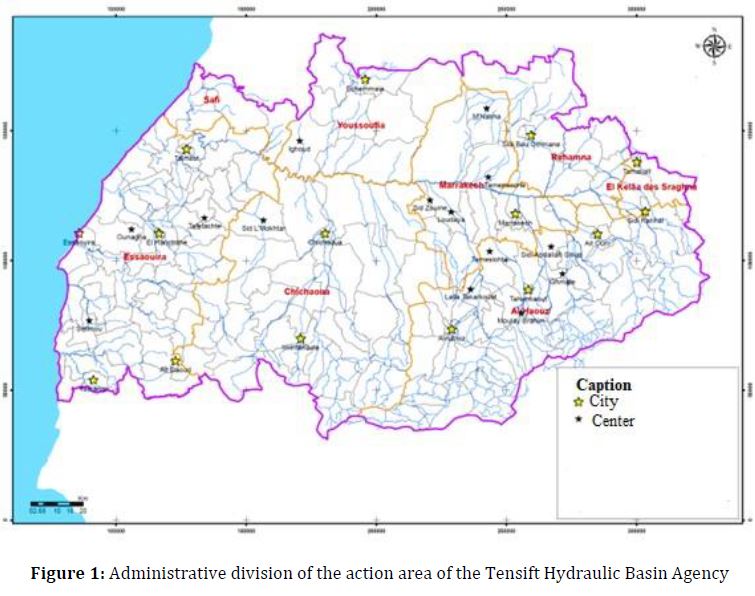
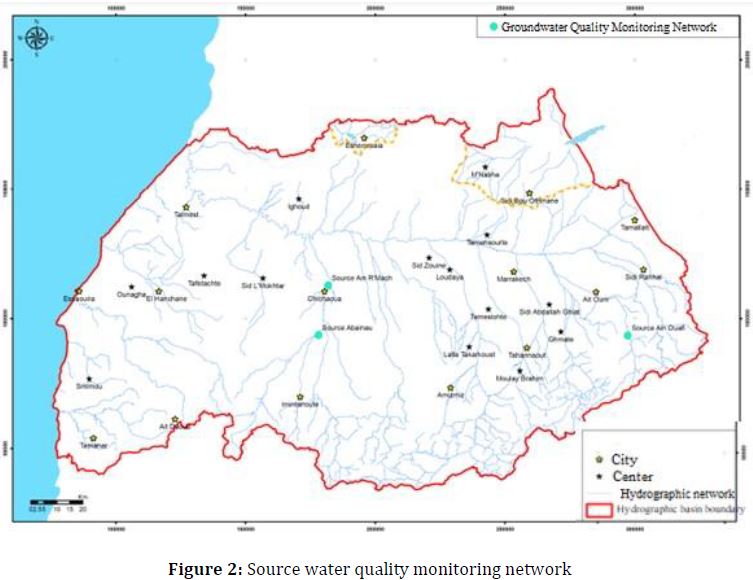
The study area has different types of groundwater resources. The TWBA carried out monitoring of the water quality of these resources between 2013 and 2017. The study area is characterized by significant geographical diversity, ranging from the rugged reliefs of the High Atlas to the vast alluvial plains of the Haouz of Marrakech, passing through the endorheic depressions of the Bahira, and extending to the coastal strip of Essaouira and including also Jbilets and the ancient massif of the High Atlas. This region covers an area of approximately 26,000 km2 and includes the following geographical entities: Haouz of Marrakech, Essaouira – Meskala – Korimat, and Western Bahira. Administratively, this area encompasses eight prefectures and provinces. It entirely covers the prefecture of Marrakech, predominantly the provinces of Al Haouz, Chichaoua, Essaouira, and Youssoufia, as well as parts of the provinces of Rehamna, Kelâa des Sraghna, and Safi. Figure 1 illustrates the current boundary of the TWBA’s (Tensift Water Basin Agency) area of action.

In the TWBA’s action area, surface water resources are very irregular and unevenly distributed. The High Atlas, acting as a reservoir for surface flows, is the source of the main rivers, while the plain serves as a transition and utilization zone for water. The region can be divided into three planning units, each with unevenly distributed surface water resources:

– The Upper Tensift unit (11,900 km²) extends to the confluence of the Tensift River with the Assif Al Mal River and includes the Haouz-Mejjat and western Bahira aquifers. This unit represents the hydrologically active part of the basin, comprising the Tensift River and its tributaries (the N’fis, Rheraya, Ghmat, and R’Dat rivers, as well as the upper part of the river known as the Lahr River).

– The Lower Tensift unit (7,900 km²) stretches from the confluence of the Tensift and Assif Al Mal rivers to the river mouth. It includes the Tensift River and its tributaries (the Assif Al Mal and Chichaoua rivers), the Bousbaâ aquifer, and the alluvial aquifer of Tensift. Its hydrological activity is highly variable.

– The Ksob-Iguezoullen unit (5,000 km²) encompasses the Akermoud aquifer, the Meskala-Kourimat aquifer, and the coastal aquifer of Essaouira.

2.2. Water quality assessment system

To assess the state of water quality, the Quality Index (IC) is based on Joint Decree No. 1275-01 of 10 Chaâbane 1423 (October 17, 2002) issued by the Minister of Equipment and the Minister in charge of Territorial Development, Urban Planning, Housing, and Environment. This decree defines a quality scale for surface waters. The system includes a general grid applicable to areas influenced by pollution sources, with quality thresholds for each parameter based on potential water uses, such as drinking, agriculture, aquaculture, and industry. It also includes a simplified grid intended for areas not influenced by pollution sources, allowing for a quick and comprehensive assessment of water quality and pollution status. This simplified grid focuses on a limited number of parameters considered the most critical.

The selected parameters include indicators of organic, nitrogen, phosphorus, and bacterial pollution, such as dissolved oxygen content, BOD5 and COD, NH4+, and total phosphorus (TP), as well as faecal coliforms. These parameters are essential for evaluating ecological balance, pollution from oxidizable materials, eutrophication of waters, and faecal contamination. The evaluated parameters also include dissolved oxygen, total phosphorus, nitrates (NO3-), and chlorophyll “a”. The overall water quality is determined based on the most unfavorable parameter according to the simplified quality grids (Table 1).

3. RESULTS AND DISCUSSIONS

3.1 Status of groundwater quality in the TWBA area of operation

The study area contains various types of groundwater resources. The TWBA conducted monitoring of the water quality of these resources from 2013 to 2017. The findings from this monitoring are presented below.

3.1.1 Quality Of Aquifer Waters

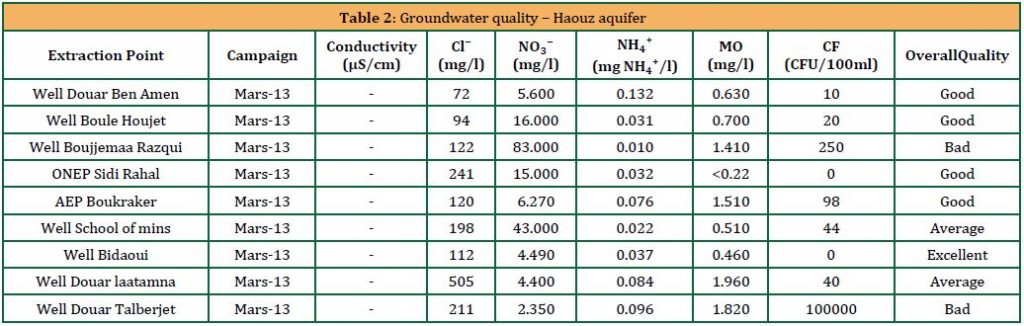
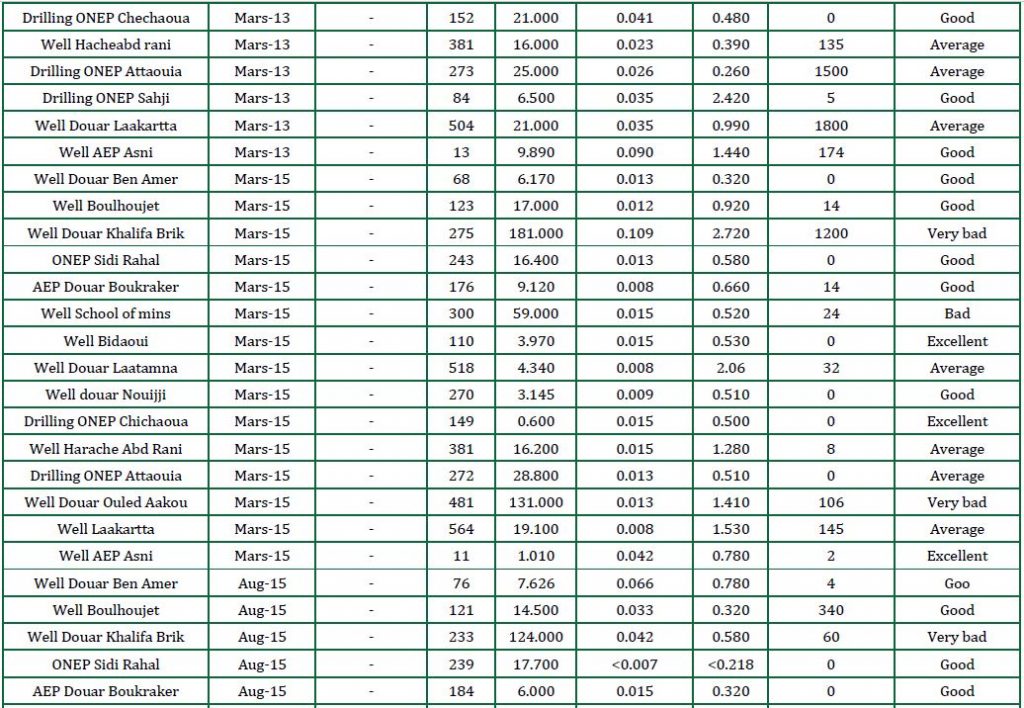
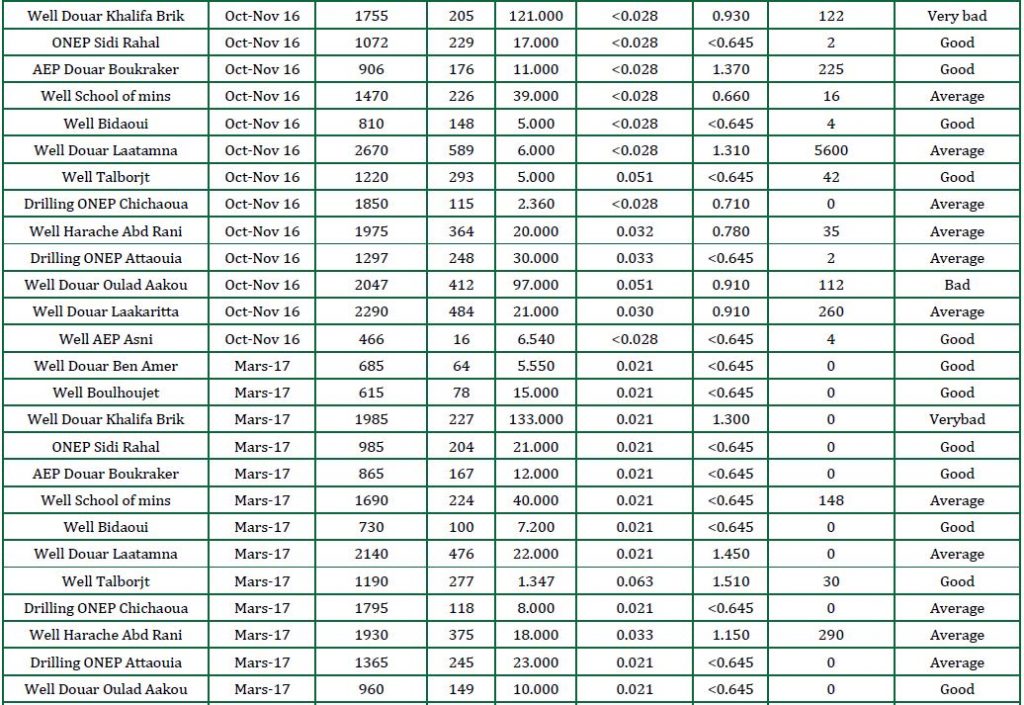
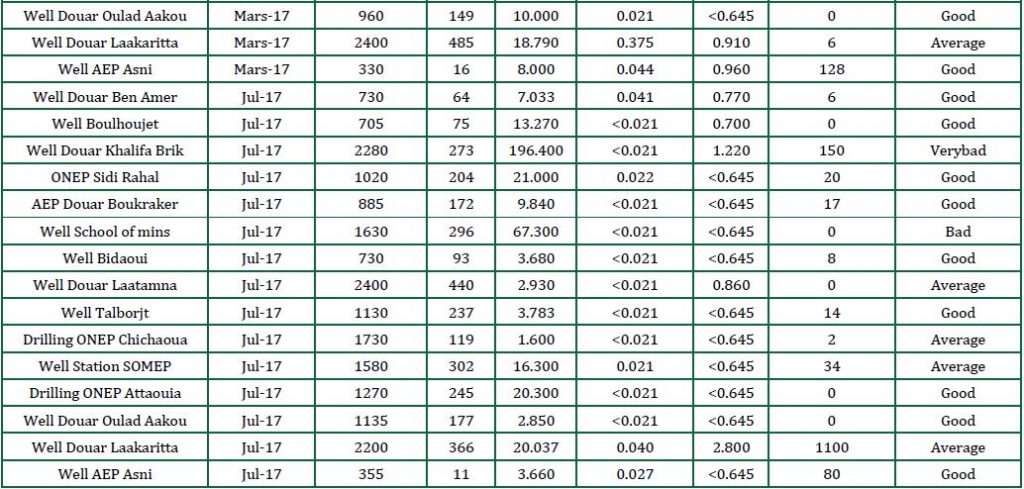
The following tables present the results of the quality monitoring campaigns for the aquifers tracked by the TWBA. Table 4 represents the results of Haouz aquifer quality. The groundwater quality in the Haouz aquifer, as assessed from various wells and drilling sites over multiple campaigns (March 2013, March 2015, August 2015, July-August 2016, October-November 2016, March 2017, and July 2017), demonstrates notable variability in key water quality parameters. Conductivity values fluctuate significantly, reflecting varying levels of dissolved solids. Some locations, such as Well Douar Laatamna, exhibit high conductivity, indicating elevated mineral content and potential salinity issues (Sarah et al., 2017).

Chloride (Cl⁻) levels also show a wide range, from as low as 0.252 mg/l at Drilling National Office of Drinking Water Chichaoua to as high as 589 mg/l at Well Douar Laatamna in October-November 2016, suggesting differing degrees of salinity that may affect the water’s suitability for agricultural and drinking use. Nitrate (NO₃⁻) concentrations vary considerably, with some sites like Well Douar Khalifa Brik experiencing extremely high levels, up to 196.4 mg/l, likely due to contamination from agricultural runoff or other human activities. While ammonium (NH₄⁺) levels are generally low, occasional spikes, such as 0.375 mg/l at Well Douar Laakaritta in March 2017, could indicate localized pollution. Organic matter (MO) and coliform bacteria (CFU/100ml) levels further illustrate the variability in water quality. Organic matter levels are elevated at some sites, suggesting possible organic pollution (Mabrouki et al., 2022). Coliform bacteria counts range from 0 CFU/100ml in several wells to extremely high levels, such as 100,000 CFU/100ml at Well Douar Talberjet in March 2013, highlighting differences in microbiological contamination across the aquifer. The overall water quality classification varies from “Excellent” to “Very Bad,” with wells like Well Bidaoui generally showing good to excellent quality, while others, such as Well Douar Khalifa Brik and Well Douar Laatamna, frequently fall into the “Very Bad” category.

The variations in groundwater quality across the Haouz aquifer underscore the complex interplay of natural and anthropogenic factors. Significant fluctuations in chloride and nitrate levels, along with the presence of coliform bacteria, suggest localized pollution sources. These sources likely include agricultural activities, improper waste disposal, and possibly natural saline intrusions. Natural geology and hydrology contribute to variations in mineral content, as seen in conductivity and chloride levels. High levels of these parameters might result from natural saline water or mineral dissolution from geological formations. Meanwhile, elevated nitrate levels, particularly in certain wells, point to agricultural runoff, likely from fertilizers. The presence of coliform bacteria indicates potential contamination from sewage or animal waste, posing health risks if the water is used for drinking purposes (Al-Aizari et al., 2023).

Temporal variations in water quality, potentially due to seasonal changes, varying human activities, or changing land use patterns, further complicate the situation. Persistent high nitrate and coliform levels at certain sites highlight ongoing pollution issues (Jeerapong et al., 2023).

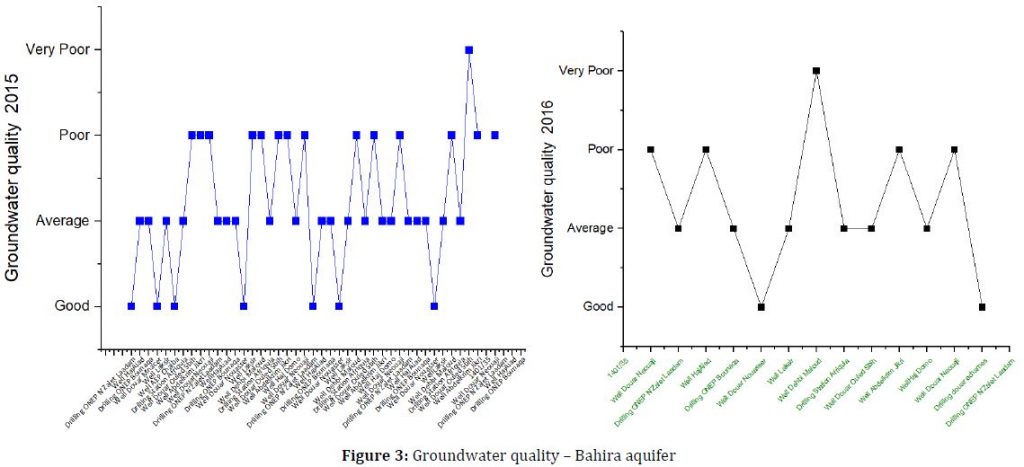
For the Bahira aquifer, the data from Table 5 provides an overview of the groundwater quality in the Bahira aquifer, based on measurements taken at various extraction points during several campaigns from 2013 to 2017. The parameters analyzed include conductivity, chloride (Cl⁻), nitrate (NO₃⁻), ammonium (NH₄⁺), organic matter (MO), coliform bacteria (CF), and an overall quality assessment.

The data reveals a range of water quality indicators across various sites and periods. Conductivity levels, although not consistently reported, fluctuated, reflecting varying levels of dissolved ions (Ouharba et al., 2024). For instance, Well Dehbi Maloud exhibited very high conductivity (4690 μS/cm) in March 2017, indicating significant mineralization. Chloride (Cl⁻) concentrations also varied widely, with higher levels often linked to poorer water quality. A notable example is Well Abdelkrim Jikri, which consistently displayed high chloride levels, peaking at 655 mg/l in July 2017 and corresponding with a “Poor” quality rating.

Nitrate (NO₃⁻) levels were elevated in several locations, such as Well Douar Neouaji, where it reached 80.0 mg/l in August 2015, raising concerns about potential agricultural runoff or contamination. Ammonium (NH₄⁺) levels were generally low, indicating minimal recent organic pollution, though there were spikes, such as 9.600 mg NH₄⁺/l in Well Laksir in March 2015. The Organic Matter (MO) content varied, with some samples, like Drilling ONEP Bounaqa (3.970 mg/l in July-August 2015), suggesting either organic pollution or natural organic content in the aquifer (Yulu and Luyao, 2020).

The presence of Coliform Bacteria (CF) in several samples indicated possible contamination, as seen in Well Douar Ouled Sbih with a high count of 1900 CFU/100ml in October-November 2016. The overall water quality assessment ranged from “Good” to “Very Poor,” with many samples falling into the “Average” or “Poor” categories. Wells such as Dehbi Maloud and Abdelkrim Jikri consistently showed poor quality, pointing to chronic water quality issues at these sites.

The variation in groundwater quality parameters across different locations and times within the aquifer reveals a complex interplay of natural and anthropogenic influences. The observed fluctuations in conductivity, chloride, and nitrate levels suggest that both natural geological processes and human activities significantly impact water quality. High levels of chloride and nitrate are often associated with anthropogenic activities, such as the use of fertilizers in agriculture and improper waste disposal.

According to the TWBA report, which cites the 2014 census by the Ministry of Agriculture, the annual consumption of fertilizers in the Tensift watershed is estimated at 30,140 tons per year. Although this amount is relatively high, it remains lower than the quantities used in other watersheds such as Sebou, Oum Er Rabia, and Souss Massa Draa. Regarding nitrogen fertilizers, their consumption amounts to 5,964 tons per year, representing approximately 20% of the total amount of fertilizers consumed in the TWBA’s area of action. Nitrates, being highly soluble and mobile in soil solution, are easily leached into groundwater, thus becoming a potential source of pollution for aquifers. The risk of nitrate ion leaching is generally assessed by referring to the potentially leachable nitrogen (PLN). In the Tensift-Ksob-Igouzoulen basin, the PLN was estimated, according to the same census, at 938 tons per year, constituting 16% of the total nitrogen consumed in the TWBA’s area of action (ABHT, 2017).

The consumption of phosphate fertilizers in the study area is estimated at 7,836 tons per year. To evaluate the risk of eutrophication of surface waters by phosphorus, the quantities of phosphorus that could be transported by runoff (and erosion) to surface waters are calculated. The delivery rate used, which closely depends on the geomorphological characteristics of the basin, can reach up to 3% of the amount of phosphate fertilizers consumed. The presence of coliform bacteria in some samples further underscores potential contamination from sewage or animal waste, highlighting the influence of human activities on groundwater quality. Seasonal and temporal changes also play a crucial role in shaping groundwater quality. The data indicate fluctuations in water quality parameters over time, which may be linked to variations in groundwater recharge and extraction rates due to seasonal changes. For instance, increased conductivity and pollutant concentrations during certain periods could correspond to dry seasons, where reduced groundwater recharge leads to less dilution of contaminants. This seasonal variability underscores the importance of continuous monitoring to understand the dynamic nature of groundwater quality (Benchrifa et al., 2023). From a management perspective, the consistently poor quality observed in specific wells, such as Dehbi Maloud and Abdelkrim Jikri, indicates the need for targeted interventions. Implementing stricter controls on agricultural runoff, improving waste management practices, and enhancing regular monitoring are critical steps to mitigate contamination sources. Elevated nitrate levels and the presence of coliform bacteria raise significant public health and environmental concerns. Nitrate contamination, for instance, poses a risk of methemoglobinemia (“blue baby syndrome”) in infants, while coliform bacteria presence signals potential pathogenic contamination (Gokulan et al., 2023).

Therefore, while some groundwater sources in the Bahira aquifer maintain good quality, others are significantly affected by contamination. A comprehensive groundwater management strategy, incorporating regular monitoring, pollution control measures, and community education, is essential to protect and enhance water quality in the region. Addressing these issues is critical to ensuring safe drinking water for local communities and safeguarding the aquifer’s long-term sustainability (Alexandr et al., 2024;Diana et al., 2023; Evangelos et al., 2022).

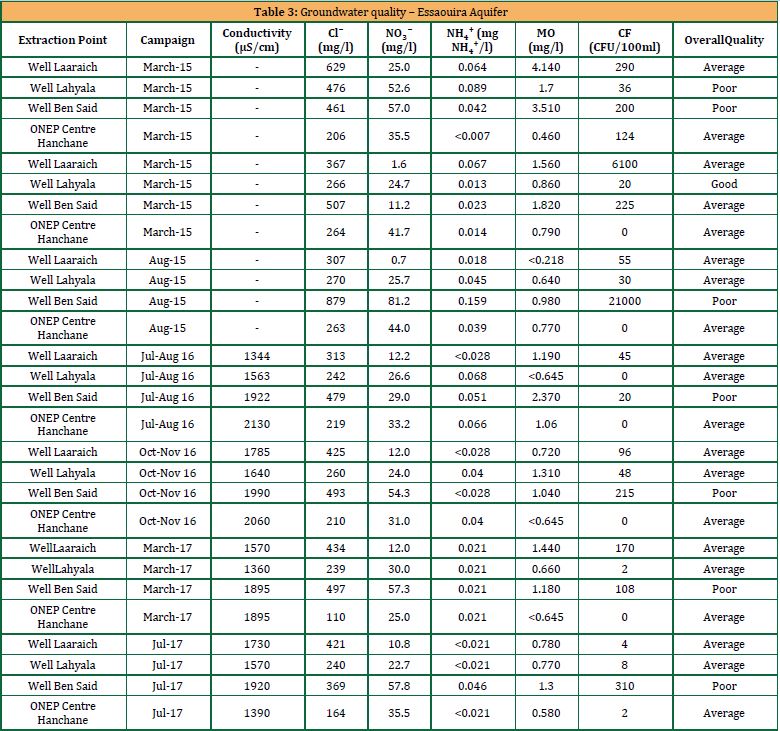
Concerning the Essaouira aquifer, the data in Table 6 present a comprehensive analysis of the groundwater quality from various wells in the Essaouira aquifer, assessed across multiple sampling campaigns from March 2015 to July 2017. The table includes measurements of key water quality parameters such as conductivity, chloride (Cl⁻), nitrate (NO₃⁻), ammonium (NH₄⁺), organic matter (MO), and coliform bacteria (CF). Out of 28 water quality analyses conducted between 2013 and 2017:71% indicated average quality; 25% indicated poor quality; and 4% were of good quality.

The poor quality was observed at two specific points: IRE n° 261/43 (March 2013) and IRE n° 621/43 (across 6 campaigns). The factors contributing to the degraded water quality are generally high conductivity, nitrates, and chloride. Nitrates are the primary cause of the poor quality observed. Specifically, IRE point n° 261/43 is located in the Meskala-Kourimate aquifer, while IRE point n° 621/43 is situated in the coastal aquifer. The overall water quality is average for the Meskala-Kourimate aquifer, whereas it ranges from average to poor for the coastal aquifer. The quality-degrading elements include nitrates, which are responsible for the poor quality, as well as salinity and chloride.‏

The data indicate significant spatial and temporal variability in groundwater quality within the Essaouira aquifer, driven by a mix of natural and human-induced factors. Natural processes, such as the inherent salinity of the aquifer, particularly in coastal areas, may account for the high conductivity and chloride levels observed in some wells. This natural salinity could be exacerbated by seawater intrusion a common issue in coastal aquifers where the over-extraction of groundwater reduces the hydraulic head, allowing saline water to migrate inland and mix with freshwater. Seawater intrusion is a significant concern globally, as it can lead to the salinization of freshwater resources, rendering them unsuitable for drinking and irrigation. Agricultural activities also play a crucial role in influencing groundwater quality. Elevated nitrate levels, such as those found in Well Ben Said, are likely linked to the use of nitrogen-based fertilizers in nearby agricultural areas (Ahmed et al., 2024). Nitrates, being highly soluble in water, can easily leach into groundwater, especially in regions with intensive agriculture. The presence of nitrates above recommended limits poses significant health risks, particularly for infants and pregnant women, as it can lead to conditions like methemoglobinemia (blue baby syndrome). This situation underscores the necessity for improved agricultural management practices, such as precision farming and the use of alternative, less harmful fertilizers, to mitigate groundwater contamination. Human impact is further evidenced by the intermittent detection of coliform bacteria, suggesting possible contamination from sewage or animal waste. The presence of coliform bacteria in groundwater is a clear indicator of potential pathways for pathogenic microorganisms, posing serious public health risks. This contamination points to deficiencies in the region’s sanitation infrastructure and highlights the need for better waste management practices. In many regions, inadequate sewage treatment and disposal systems can lead to the contamination of groundwater sources, particularly in densely populated or rural areas with limited infrastructure. Temporal trends show a concerning increase in conductivity and certain contaminants over time, indicating a gradual deterioration in water quality (Bencheikh et al., 2020). This decline may be driven by factors such as over-extraction of groundwater, which can reduce natural recharge rates and increase pollutant concentrations in the remaining water. Additionally, the impacts of climate change could exacerbate these trends by altering precipitation patterns, increasing the frequency and severity of droughts, and reducing the availability of water for natural aquifer recharge. These changes could further stress the aquifer system, making it more susceptible to contamination and depletion. Accordingly, the Essaouira aquifer is subjected to multiple pressures from both natural processes and human activities, which collectively impact its water quality. The scientific community and policymakers must address these challenges through comprehensive groundwater management strategies. These strategies should include monitoring and regulating water extraction, improving agricultural and waste management practices, and enhancing the region’s infrastructure to ensure the sustainable use and protection of this vital water resource. Such measures are essential for safeguarding the aquifer, which is crucial for the region’s economic development and public health (Nadjib et al., 2023; Fattah et al., 2021; Mabrouki et al., 2022; Fattah et al., 2021; Siti et al., 2023).

3.1.2 Seasonal Evolution Of Quality

The study of the seasonal evolution of groundwater quality is crucial for understanding the dynamic interactions between environmental factors and anthropogenic activities that affect water resources. It provides essential insights into the temporal fluctuations in water quality, which are vital for effective water resource management, public health protection, and sustainable development. By analyzing these seasonal changes, we can better identify and mitigate the impacts of pollution, climate variability, and other stressors on aquifers.

The seasonal evolution of groundwater quality in the Tensift Basin, as presented in Table 7, shows varying conditions across the Haouz, Bahira, and Essaouira aquifers over the period 2013-2017. The Haouz aquifer exhibited a decline in the percentage of wells classified as “Excellent,” dropping from 7% in March 2013 to 0% from July-August 2016 onwards. In contrast, the proportion of wells with “Good” quality generally increased, peaking at 60% in July 2017. “Average” and “Poor” quality classifications fluctuated, while “Very Poor” remained relatively low, reaching a maximum of 13%. The Bahira aquifer consistently lacked “Excellent” quality water, with “Good” quality peaking at 27% in March 2013 and declining to 9% in subsequent years. Most wells fell into the “Average” category, with a slight increase to 64% in 2017. The proportion of “Poor” and “Very Poor” quality wells varied, with a notable increase in “Very Poor” classification in March 2017. The Essaouira aquifer showed no “Excellent” quality water throughout the period. The majority of wells were classified as “Average,” with a stable 75% across most campaigns. A small proportion was rated “Poor,” with the highest at 50% in March 2013 (Rihab et al., 2023; Elouardi, 2023).

The observed seasonal variations in groundwater quality across the Tensift Basin’s aquifers underscore the complex interplay between natural and anthropogenic factors, further exacerbated by the impacts of climate change. The Haouz aquifer, which exhibited a decline in “Excellent” quality water and a corresponding increase in “Good” quality, suggests a potential improvement in management practices or natural recharge processes in recent years. However, the persistence of “Average” and “Poor” quality classifications highlights ongoing issues, possibly linked to agricultural runoff, industrial activities, and urbanization. The presence of “Very Poor” quality water, though limited, is concerning and may indicate localized pollution sources or over-extraction leading to a concentration of contaminants. In the Bahira aquifer, the absence of “Excellent” quality water and the predominance of “Average” and “Poor” quality classifications suggest significant water quality challenges. The slight increase in “Very Poor” quality water in March 2017 raises red flags regarding the aquifer’s vulnerability to contamination. The consistency of “Average” quality water indicates a baseline level of contamination, potentially from natural mineral dissolution, agricultural practices, or insufficient wastewater treatment. The declining “Good” quality and fluctuating “Poor” classifications point towards variable management and environmental pressures (Fattah et al., 2021). The Essaouira aquifer’s lack of “Excellent” quality water and the dominance of “Average” classification across all campaigns reflect a stable but concerning level of water quality. The periodic presence of “Poor” quality water indicates localized issues, possibly related to seawater intrusion, given the aquifer’s coastal proximity, and agricultural activities. The lack of significant improvement over time suggests that existing management strategies may be insufficient to address the underlying causes of water quality degradation (Mabrouki et al., 2022). Climate change may play a critical role in these observed patterns by altering precipitation patterns, increasing the frequency and severity of droughts, and reducing natural recharge rates. These changes can exacerbate the stress on groundwater resources, making them more susceptible to contamination from surface activities and reducing the dilution capacity of the aquifers. Moreover, rising temperatures can accelerate the decomposition of organic matter and increase the mobility of certain pollutants, further compromising water quality (Fattah et al., 2021). Consequently, the data reflect a complex and evolving situation in the Tensift Basin’s groundwater quality, influenced by a combination of natural factors, human activities, and climate change. Addressing these challenges will require a comprehensive approach, including improved monitoring, sustainable management practices, and adaptive strategies to mitigate the impacts of climate change on water resources (Siti, 2023; Rihab et al., 2023).

3.2. Impact of climate change on groundwater recharge the Tensift basin

Climate change is significantly affecting groundwater recharge in the Tensift Basin, with notable impacts on water quality across the Haouz, Bahira, and Essaouira aquifers. According to data collected between 2013 and 2017, there has been a marked decline in groundwater quality, particularly in the Haouz aquifer. The percentage of water classified as “Excellent” dropped from 7% in March 2013 to 0% by July 2017 (table 7). Meanwhile, “Good” quality water saw a gradual increase from 47% to 60%. This shift suggests that while some improvements have been made, the overall quality remains inconsistent, with a persistent presence of “Average” and “Poor” classifications.

In the Bahira aquifer, the water quality data indicate a predominance of “Average” quality, consistently ranging from 45% to 64% (table 7). The “Poor” category showed significant fluctuations, with periods where up to 45% of the water samples were classified as such, highlighting ongoing challenges in maintaining stable water quality. The absence of “Excellent” water quality and minimal “Good” classifications point to a need for improved water management strategies. Meanwhile, the Essaouira aquifer consistently showed a majority of “Average” quality water, with “Poor” water also present, indicating the region’s vulnerability to climate-related changes and seawater intrusion.

These trends underscore the broader challenges posed by climate change in the region, including increased evapotranspiration and altered precipitation patterns. The data reflect a general decline in water quality, likely influenced by factors such as rising temperatures and variable rainfall. This scenario stresses the urgency for implementing sustainable water management practices, enhancing monitoring systems, and strengthening policies to mitigate the impacts of climate change on groundwater resources.

4. CONCLUSION

The groundwater quality in the Tensift Basin, encompassing the Haouz, Bahira, and Essaouira aquifers, reveals significant spatial and temporal variability, influenced by both natural and anthropogenic factors. This variability is further compounded by the impacts of climate change, as evidenced by the observed decline in water quality, particularly in the Haouz aquifer, where excellent quality water has vanished, and good quality has only slightly improved. The persistent issues of high salinity, nitrates, and coliform bacteria, especially near urban areas and agricultural zones, underscore the need for urgent intervention.

The Bahira aquifer faces consistent challenges with average to poor water quality, primarily driven by geological factors and agricultural pollution. The situation in the Essaouira aquifer, characterized by average to poor water quality, highlights the region’s susceptibility to marine intrusion, which is exacerbated by rising sea levels and reduced recharge rates. These findings indicate that a significant portion of the monitored points report water quality ranging from average to good, with minor seasonal variations. However, the presence of coliform bacteria and fluctuating mineral content raises serious concerns about sanitary conditions and contamination risks. Addressing these challenges requires comprehensive groundwater management, including enhanced monitoring, sustainable practices, and adaptive strategies to mitigate the impacts of climate change. Such measures are essential for ensuring safe drinking water, protecting public health, and maintaining the sustainability of groundwater resources in the Tensift Basin. The data call for a concerted effort to improve wastewater treatment, regulate agricultural practices, and develop resilient infrastructure to safeguard the region’s vital water resources.

REFERENCES

ABHT, 2017 : Etude de l’inventaire du degré de pollution des ressources en eau dans la zone d’action de l’agence de Bassin hydraulique de Tensift. Waman Consulting

Ahmed, M. Saqr., Mahmoud, E., Abd-Elmaboud., 2024. Saltwater Intrusion in Coastal Aquifers: A Comprehensive Review and Case Studies from Egypt. doi: 10.32388/xlis2f

Al-Aizari., H., Fatima, A., Ali, R., Al-Aizari., Abdel-Basit, Al-O., Abdul-Jaleel, M., Al-Aizari., 2023. Evaluation of Groundwater Quality and Contamination Using the Groundwater Pollution Index (GPI), Nitrate Pollution Index (NPI), and GIS. Water, doi: 10.3390/w15203701

Alexandr, N., Alexandr, G, I., Pavlovsky, O., Shershnyov, V., 2024. Assessment of of phosphorus fertilizer wastes production impact on subterranean water quality, Gomel chemical plant, Republic of Belarus. doi: 10.18799/24131830/2024/1/4227

Arifullah., Hu, C., Waseem, A., Abdur, R., Zahid, U., Muddaser, S., Abdulwahed, F., Alrefaei., Mohamed, K., Lotfi, A., Mohamed, M., Abdel-Daim., 2022. Quality Assessment of Groundwater Based on Geochemical Modelling and Water Quality Index (WQI). Water, 14(23):3888-3888. doi: 10.3390/w14233888

Asaad, M., Armanuos., Abdelazim, M., Negm., Oliver, C., Saavedra, V., 2016. Groundwater Quality Investigation Using Multivariate Analysis — Case Study: Western Nile Delta Aquifer, Egypt.

Baccouche, H., Lincker, M., Akrout, H., Mellah, T., Anane, M., Ghrabi, A., Karatzas, George, S. G., 2022. Assessment of the influence of surface water on groundwater quality related to the Wadi El-Bey watershed (Tunisia) using field sampling and quantitative groundwater modelling. doi: 10.5194/egusphere-egu22-4516

Bencheikh, I., Mabrouki, J., Azoulay, K., Moufti, A., El Hajjaji, S., 2020. Predictive analytics and optimization of wastewater treatment efficiency using statistic approach. In Big Data and Networks Technologies 3, Pp. 310-319. Springer International Publishing.

Benchrifa, M., Elouardi, M., Fattah, G., Mabrouki, J., and Tadili, R., 2023. Identification, simulation and modeling of the main power losses of a photovoltaic installation and use of the internet of things to minimize system losses. In Advanced technology for smart environment and energy. Pp. 49-60. Cham: Springer International Publishing.

Benchrifa, M., Mabrouki, J., Tadili, R., 2022, November. Estimation of global irradiation on horizontal plane using artificial neural network. In The International Conference on Artificial Intelligence and Smart Environment, Pp. 395-400. Cham: Springer International Publishing.

Diana, C. C., Ágnes, B., Călin, N., Silvia, C. M., Daniela, B., Sorina, D., Antonia, O., 2023. Assessment of Groundwater Quality in Relation to Organic versus Mineral Fertilization. Water, 15(16): Pp. 2895-2895. doi:10.3390/w15162895

Elouardi, M., Mabrouki, J., El Belghiti, M. A., 2023. Evaluation of algal absorbed CO2 sequestration techniques: a review. Euro-Mediterranean Journal for Environmental Integration, 8(3), Pp. 481-491.

Evangelos, M., Penny, J. J., Heather, L., Buss, S. T., Bingham., Dianne, M., John, B., Daren, C. G., 2022. Geochemical cycling in aquifers contributes to the transport, storage and transfer of anthropogenically-derived phosphorus to surface waters. Frontiers in Environmental Science, 10 doi:10.3389/fenvs.2022.932566

Fattah, G., Ghrissi, F., Mabrouki, J., Al-Jadabi, N., 2021. Modeling and assessment of the impact of land use in the Western RIF Region, Morocco, on Water Quality. The International Archives of the Photogrammetry, Remote Sensing and Spatial Information Sciences, 46, Pp. 225-230.

Fattah, G., Ghrissi, F., Mabrouki, J., Kabriti, M., 2021. Control of physicochemical parameters of spring waters near quarries exploiting limestone rock. In E3S web of conferences, Vol. 234, Pp. 00018. EDP Sciences.

Ghizlane, F., Mabrouki, J., Ghrissi, F., Azrour, M., 2022. Proposal for a high-resolution particulate matter (PM10 and PM2. 5) capture system, comparable with hybrid system-based internet of things: case of quarries in the western rif, Morocco. Pollution, 8(1), Pp. 169-180.

Gokulan, R., Sivarethinamohan, R., Sujatha, S., Balamurugan, K. S., Ravindran, G., Senthil, K., M., Gasim, H., 2023. A Review of the Status, Effects, Prevention, and Remediation of Groundwater Contamination for Sustainable Environment. Water, doi: 10.3390/w15203662

Jeerapong, L., Phornsuda, C., Kamdee, K., Bounhome, P. J., 2023. Groundwater Quality Variations in Multiple Aquifers: A Comprehensive Evaluation for Public Health and Agricultural Use. Geosciences, 13(7): Pp. 195-195. doi: 10.3390/geosciences13070195

Mabrouki, J., Azrour, M., Boubekraoui, A., and El Hajjaji, S., 2022. Simulation and optimization of solar domestic hot water systems. International Journal of Social Ecology and Sustainable Development (IJSESD), 13(1), Pp. 1-11.

Mabrouki, J., Benchrifa, M., Ennouhi, M., Azoulay, K., Bencheikh, I., Rachiq, T., El Hajjaji, S., 2022, November. Geographic information system for the study of water resources in Chaâba El Hamra, Mohammedia (Morocco). In The International Conference on Artificial Intelligence and Smart Environment. Pp. 469-474. Cham: Springer International Publishing.

Marwan, G., Fatima, E, El, G., Masaya, T., 2022. Preliminary results of the contribution of Marrakech High Atlas watersheds to the Plioquaternary aquifer of the Haouz plain recharge. A primary hydrological study based on remote sensing technologies.. doi: 10.5194/ ergosph ere-egu22-10233

Mohammed, H., Lhoussaine, B., Abdelfettah, S., Ilham, B., Ghani, C., 2020. Moroccan Groundwater Resources and Evolution with Global Climate Changes. 10(2):81-. doi: 10.3390/GEOSCIENCES10020081

Nadjib, H., Mohamed, A., Samira, K., Adel, B., Rabah, K., 2023. GIS and Index-Based Methods for Assessing the Human Health Risk and Characterizing the Groundwater Quality of a Coastal Aquifer. doi: 10.12912/27197050/171444

Ouharba, E. L., Mabrouki, J., and Triqui, Z. E., 2024. Assessment and Future Climate Dynamics in the Bouregreg Basin, Morocco–Impacts and Adaptation Alternatives. Ecological Engineering & Environmental Technology, 25.

Purnima, Mehta., Mohan, Singh, Jangra., Parminder, Kaur, Baweja., Arun, Lal, Srivastav. (2024). Impact of climate change on rural water resources and its management strategies. Pp. 45-54. doi: 10.1016/b978-0-443-18778-0.00018-0

Rihab, C., Fethi, B. Riheb, H, Lassaad, G. Amor, H., Younes, H., 2023. Assessing Spatial Distribution and Quality of Phreatic Water for Sustainable Supply: A Study of the Tebessa Aquifer System. doi: 10.21203/rs.3.rs-3272648/v1

Sarah, A., Bourke., Sarah, A., Bourke., Kristian, J., Hermann., M., Jim, H., 2017. High-resolution vertical profiles of groundwater electrical conductivity (EC) and chloride from direct-push EC logs. Hydrogeology Journal, 25(7): Pp. 2151-2162. doi: 10.1007/S10040-017-1587-Z

Siti, M., Rabeya, A., Ngakan, K., Acwin, D., Ahmad, A., Mansoor, Al. S., Anton, T., Elena, S., Sergushina., Iskandar, M., Natalia, Z., Yasser, F. M., Evgeny, T., 2023. Assessment of groundwater quality and their vulnerability to pollution using GQI and DRASTIC indices. Journal of Water and Land Development, doi: 10.24425/jwld.2022.140789

Yulu, W., Luyao, W., 2020. Pollution Characteristics and Comprehensive Evaluation of Soil Organic Compounds at a Chemical Contaminated Site. 514(3): Pp. 032045-. doi: 10.1088/1755-1315/514/3/032045‏

Pages 466-474
Year 2024
Issue 4
Volume 8

Download

Water Conservation and Management (WCM)

wcm.04.2024.461.465

ANALYSIS OF THE IMPACT OF CLIMATE CHANGE ON WATER RESOURCES: CASE
OF THE TENSIFT BASIN (MOROCCO)

Journal: Water Conservation and Management (WCM)
Ghizlane Fahdi, Driss Azdem, Aziza Lamchaimech, Mounia Benrhanem, Jamal Mabrouki, Souad El hajjaji
Print ISSN : 2523-5664
Online ISSN : 2523-5672

This is an open access article distributed under the Creative Commons Attribution License CC BY 4.0, which permits unrestricted use, distribution, and reproduction in any medium, provided the original work is properly cited

Doi: 10.26480/wcm.04.2024.461.465

Abstract

To understand and solve some problems in hydrology and water resources, like plan management, operation management, environmental protection, natural balance, and so on, it is useful to look into how climate change affects these areas. Both in theory and in real life. Climate change is likely to become a growing concern for water professionals in Morocco, as in all regions of the world. The Tensift basin, one of the largest in Morocco, is already suffering from the problem of dwindling water resources. Combined with the risk of a reduction in these resources as a result of climate change, this problem calls for new thinking in terms of socio-economic development guidelines and strategies. The aim of this work is to study the relationship between water resources and climate change in the case of the Tensift basin, by exploring water resources, climate change and related mechanisms, based on data from the Tensift Water Basin Agency.

Keywords

Water resources ; Tensift basin; Greenhouse gas; climate change; scenarios.

1. INTRODUCTION

Climate change is defined as a period of 10 years or more in which the average condition of the climate and its deviations experience one or more substantial changes that combined, according to statistics, are statistically significant (Moussa, et al., 2012; Brouyère et al., 2022; Ouhamdouch et al., 2018). The implications of climate change are wide-ranging and multifaceted and include both good and negative outcomes (Bellal et al., 2020). Future climate change will have the greatest impact on the sustainable development of regional, national, and even global areas as it not only impacts the hydrological, biological, and ecological systems but also the economic and human existence (Bekkar et al., 2023). A crucial component of the hydrologic cycle and water resources is the connection to climate change (Elassassi et al., 2022). Climate influences, namely rainfall and temperature variations, have an impact on water resources through changes in water and water quality. And it is made possible by modifications to the different water cycle linkages (Folton et al., 2012; Vecchio and Kuper, 2022). It was noted in the 2007 IPCC Fourth Assessment Report that throughout the previous century, the global temperature has risen by 0.6 to 0.8°C (Change, 1990; Change, 1990; Benchrifa et al., 2022 ; Masson-Delmotte et al., 2022). Similar to many other dry and semi-arid Mediterranean regions, Morocco has had severe droughts in recent years, mostly since the 1960s, which has had a devastating effect on precipitation and, in turn, the number of mobilized water resources (Ghizlane, et al., 2022; Hassani et al., 2021). Water shortages that have affected the supply of water for various industries (agricultural, urbanization, manufacturing, etc.) during the past several years have had a major effect on the economy of the nation (Qadem, 2015; Mabrouki et al., 2022; Taïbi, 2003).

This paper is based on in-depth research into the relationship between water resources and climate change in the case of the Tensift basin, exploring water resources, climate change and related mechanisms. The analysis will be based on the study of elaborate scenarios on the impact of climate change on the basin and GHG emissions.

2. METHODOLOGY

2.1 Characterization of The Study Area

The Oued Tensift rises in the High Atlas Mountains at an altitude of 4,000 meters. Some 250 km long, it flows into the Atlantic Ocean after receiving contributions from numerous tributaries particularly on the left bank figure 1. The most important of these originate in the High Atlas, including the Rdat, Zat, Ourika, Rheraya, and N’Fis wadis (Ouhamdouch, et al., 2018),. The Tensift watershed is characterized by the presence of active, semi-active, and non-active basins: of the 19,400 km2 of the total watershed, the truly active part is only 7,800 to 8,000 km2. The Oued Tensift basin is characterized by the presence of two distinct parts: The southern part of the basin corresponds to the northern flank of the Atlas Mountains, and is occupied by medium-sized basins (200 to 1500 km²), well-watered and very steep, which constitute the left bank tributaries of the Oued Tensift. The rest of the basin corresponds to the downstream course of these tributaries, to the course of the Oued Tensift itself, and to the small basins which constitute the right bank tributaries of the Oued Tensift. This part of the basin is not very steep and receives little water (Tanouti, 2017; Benchrifa et al., 2023).

The whole of the Haouz plain between Marrakech and Mejjate is part of the semi-arid continental climate zone, with low rainfall (annual average of 250 mm) and low humidity (Tanouti and Molle, 2013). The spatial distribution of rainfall reflects the influence of distance from the Atlantic and altitude: 190 mm in Chichaoua, 250 mm in Marrakech, and 490 mm in Amezmiz. Temperatures here are high, with very wide daily and annual temperature ranges: very high summer temperatures (average maximum 38°C) and low winter temperatures (average minimum 5°C). The temperature contrasts are remarkable (Hajhouji, 2024). There are notable daily and yearly temperature differences. The Jbilets (Figure.2) climate stations are situated on the perimeter, on the lower slopes. It is not possible to measure directly how the climatic gradients change with height. There are significant temperature variations and a semi-arid environment. Rainfall occurs between 250 and 270 mm every year (Haida et al.,1996; Zamrane, 2016).

To study the consequences of climate change on water resources, the area corresponds to the action zone of the Tensift Water Basin Agency (ABHT), which covers a surface area of 24,800 km2, i.e. almost 3% of the country’s total surface area. It should be noted that the Department of Water Research and Planning recently carried out a study on “integrating climate change into water resource planning in Morocco” (Benchrifa et al., 2023).

Various scenarios are available in the literature to represent a range of possible future projections. These scenarios include: In the CMIP3 (AR4) project, the scenarios used are the SRES (Special Report on Emissions Scenarios). These are different hypotheses of socio-economic development that generate different levels of greenhouse gas (GHG) emissions. For the CMIP5 (AR5) project, new scenarios have been defined to take account of recent developments, such as the rapid growth of emerging countries, and also to extend the projections beyond 2100. The approach consisted in setting ‘targets’ for the concentration of GHGs in the atmosphere, and then developing socio-economic scenarios that could generate each of these concentrations. The graph below compares the (SRES) and (RCP) scenarios (Benchrifa et al., 2023).

3.RESULTS AND DISCUSSION

To study the consequences of climate change on water resources, the area corresponds to the action zone of the Tensift Water Basin Agency (ABHT), which covers a surface area of 24,800 km2, i.e. almost 3% of the country’s total surface area. It should be noted that the Department of Water Research and Planning recently carried out a study on “integrating climate change into water resource planning in Morocco” (Benchrifa et al., 2023).

3.1 Water Quality Model Test

3.1.1 Surface Water and Groundwater Resources

Surface water resources are highly irregular and unevenly distributed. The High Atlas is the water tower for surface run-off, since the most important wadis originate there, while the plain is a transitional zone for water use (Mahmouhi et al., 2016; Ezaidi and Ait Tirri, 2002). Torrential run-off, which occurs following storms or intense rainfall, is collected by the Tensift hydrographic network, which drains it into the ocean. These resources are threatened by a problem of increasing scarcity, accentuated by years of drought. This problem has already resulted in the over-exploitation of groundwater and water transfers from an adjacent basin: the Oum Rabii basin (Agoumi and Debbarh, 2005; Panagopoulos et al., 2011).

As table 1 shows, in total, the potential of the Tensift basin totals 665.3 Mm3 over the period 1945-2016, which is comparable with the 677.2 Mm3 estimated in the 2010 PDAIRE study (supplies observed at supply sites, without taking into account the volumes drawn by the PMH). In terms of distribution, it should be noted that the Nfis sub-basin (194 Mm3) generates around 29% of the Tensift basin’s total input (Bellal et al., 2020; Elassassi et al., 2022; Marofi, 1999).

3.2 GHG Emission Scenarios

Based on various assumptions, greenhouse gas (GHG) emission scenarios are forecasts that are used to anticipate possible future climates. The A1, A2, B1, and B2 scenarios are included in the IPCC’s Special Report on Emissions Scenarios (SRES), which represents different rates of economic expansion, advances in technology, and changes in governmental initiatives (IPCC. 2024). Different future GHG emission paths and their effects on radiative forcing are described by Representative Concentration paths (RCPs), such as RCP2.6, RCP4.5, RCP6.0, and RCP8.5. Shared Socioeconomic Pathways (SSPs) provide comprehensive frameworks for studying climate change consequences, mitigation, and adaptation based on socioeconomic trends (Benchrifa et al., 2023). Examples of SSPs include SSP1 (sustainability), SSP2 (middle of the road), SSP3 (regional competition), SSP4 (inequality), and SSP5 (fossil-fueled development) (Change, 1990; van, 2023). The results of studies utilizing these scenarios varied widely, from large emission reductions and sustainable growth in SSP1 and RCP2.6 to high emissions and sluggish economic growth in SSP3 and RCP8.5, underscoring the significance of technical and policy decisions in determining future emissions (Masson-Delmotte et al., 2022; Butphu and Kaewpradit, 2022; Bencheikh et al., 2020).

In order to account for the long-term uncertainty for many of the driving variables, the range of GHG emissions in the scenarios gets wider with time. After 2050, this widening is mostly due to various socioeconomic events (Benchrifa et al., 2023).

According to the various drought scenarios (Figure.3), the economic impacts range from 4.2 billion dollars (historical drought with a 500-year recurrence) to 7 billion dollars (drought with a 500-year recurrence in a severe climate change scenario – RCP 8.5 – in 2050), causing a loss of 1.8 to 3.5 percentage points to GDP while reducing the capital adequacy ratio of banks by 1.3 to 2.2%. The analysis highlights the significant amplification effects of climate change in all the scenarios (Change, 1990 ; Hassani et al., 2021; Benchrifa et al., 2023; Bencheikh, 2020; Voldoire, A., 2013).

4.IMPACT OF CLIMATE CHANGE ON WATER SUPPLIES

The feeder sites selected for the DRPE study are as follows (Benchrifa et al., 2023).‏

The feeder sites selected for the DRPE study are as follows (Benchrifa et al., 2023).

The annual and seasonal series of mean annual rainfall (MAR), mean annual temperature (MAT) and runoff were plotted on the same graph in order to assess the quality of the data used in the multiple regression analysis. These graphs clearly point out the relationships between the three variables and allow the identification of obvious shifts in the data. MAR is highly variable and it is therefore more difficult to discern a clear relationship with runoff. The figures below show the annual series of MAR, MAT and runoff parameters, by sub-basin (Benchrifa et al., 2023).

The analysis revealed that the results of the variability analysis of the change in precipitation and temperature are highly variable. For the models considered in the DRPE study, the variation in temperature is between +1 and +2.5°C. On the other hand, the variation in rainfall is between -30% and +3%.

These results (Figure 5 and Figure 6) show that the models that produce the greatest and least change in precipitation are not the same for each season. For the seasonal change in variable temperature, the majority of models indicate an increase in temperature for all seasons. Although the csiro model indicates an increase in precipitation, there is a decrease in the volume of runoff. For this reason, this model induces an increase in temperature, which produces a decrease in runoff volume.

The scenarios, which are typical in the literature, encompass a broad range of the primary demographic, economic, and technical driving drivers of GHG. Of the four stories, each scenario is a certain quantitative interpretation (Fattah et al., 2021). Additionally, a variety of government policies, including those pertaining to resource usage, pollution control, social and economic growth, demographic shifts, and technology advancements, can have an impact on the factors that drive greenhouse gas emissions (Mabrouki et al., 2022). The resulting events and narratives substantially reflect this impact. It is advised that any investigation employ a range of SRES scenarios with different driving force assumptions (Fattah et al., 2021). For most studies, therefore, more than one family should be considered. The key unknowns, which range from emissions to driving factors, could alter depending on the application (Ouharba et al., 2024). A few examples include policy analysis, climate modeling, impact assessments, vulnerability assessments, mitigation strategies, and possibilities for adaptation (Nan et al., 2011).

5.CONCLUSION

The Tensift basin has a water deficit. In the absence of an appropriate regional water policy, and with climate change, this deficit is set to increase and would ultimately threaten the quality of life of the population, thus prompting integrated reflection by the various stakeholders in different sectors (water resources, agriculture, and urbanization, tourism….) in order to achieve balanced, rational and sustainable management of water resources. The study of how climate change affects water resources will likely focus on improving the accuracy of hydrological models under conditions of land surface parameter changes, developing accurate regional development space and time climate scenarios, perfect distributed hydrologic models, and developing land surface development models that use two-way coupling techniques.

REFERENCES

Moussa, A. B., Chahlaoui, A., Rour, E. H., Chahboune, M., Aboulkacem, Et A., 2012. Étude Du Changement De L’etat Des Eaux De L’oued Khoumane A La Confluence Avec Les Eaux Thermales De La Source Ain Hamma Moulay Idriss Maroc , Larhyss Journal P-Issn 1112-3680 / E-Issn 2521-9782, No 11, Art. No 11, Nov. 2012, Consulté Le: 28 Janvier 2024. [En Ligne]. Disponible Sur: Http://Larhyss.Net/Ojs/Index.Php/Larhyss /Article/View/136

Brouyère, S., Glaude, R., Hutzemakers, J., Orban, P., Goderniaux, P., 2022. Impact du changement climatique sur les ressources en eaux souterraines de Wallonie: des prédictions du passé aux observations du présent , in Journée d’étude 2022. Eau potable: de la protection des ressources à la consommation.

Ouhamdouch, S., Bahir, M., Carreira, P., 2018. Impact du changement climatique sur la ressource en eau en milieu semi-aride : exemple du bassin d’Essaouira (Maroc) , rseau, vol. 31, no 1, p. 13‑27, 2018, doi: 10.7202/1047050ar.

Bellal, S.-A., Baiche, A., Dari, Et. O., 2020. Secheresse Et Fluctuations Des Ressources En Eau Souterraines: Le Cas Du Plateau De Mostaganem (Ouest Algerien) », Eau Et Environnement Territoires Et Societes, Vol. 14, P. 107, 2020.

Bekkar, A., Hssina, B., Douzi, S., Khadija, D., 2023. Transformer-Based Model for Multi-Horizon Forecasting Ozone in Marrakech city, Morocco. Pp. 8. doi: 10.1109/SITA60746. 2023.10373756.

Elassassi, Z., Ougrad, I., Bedoui, I., Kara, M., El Bouch, M., Assouguem, A., Chaouch, A., 2022. Spatial and Temporal Variations of the Water Quality of the Tiflet River, Province of Khemisset, Morocco, Water, vol. 14, no 12, Art. no 12, janv. 2022, doi: 10.3390/w14121829.

Folton, N., Tolsa, M., and Arnaud, P., 2012, November.Le Bassin de recherche du Réal Collobrier-Étude des processus hydrologiques en milieu méditerranéen a échelle fine. in 50 ans de l’Orgeval, IRSTEA, 2012, Pp. 7 p.

Vecchio, K. D., Kuper, M., 2022. La mise en visibilité des eaux souterraines au Maroc: un processus historiquement lié aux politiques de développement de l’irrigation , Développement durable et territoires. Économie, géographie, politique, droit, sociologie, vol. 12, no 3.

Change, C., 1990. The IPCC Scientific Assessment, First Assessment Report, Contributing Author, WGII Chapter 5. Cambridge university press, Cambridge, UK, 1990.

Benchrifa, M., Mabrouki, J., Tadili, R., 2022. November. Estimation of global irradiation on horizontal plane using artificial neural network. In The International Conference on Artificial Intelligence and Smart Environment, Pp. 395-400. Cham: Springer International Publishing.

Masson-Delmotte, V., Zhai, P., Pörtner, H.-O., Roberts, D., Skea, J., Shukla, P. R., 2022. Global Warming of 1.5 C: IPCC special report on impacts of global warming of 1.5 C above pre-industrial levels in context of strengthening response to climate change, sustainable development, and efforts to eradicate poverty. Cambridge University Press.

Ghizlane, F., Mabrouki, J., Ghrissi, F., and Azrour, M., 2022. Proposal for a high-resolution particulate matter (PM10 and PM2. 5) capture system, comparable with hybrid system-based internet of things: case of quarries in the western rif, Morocco. Pollution, 8(1), Pp. 169-180.

Hassani, F. E., Hattafi, Y., Lahrach, A., 2021. Water Dynamics of the Sefrou Watershed, Northern Tabular Middle Atlas, Morocco, Journal of Geoscience and Environment Protection, vol. 9, no 9, Art. no 9, sept. 2021, doi: 10.4236/gep.2021.99007.

Qadem, A., 2015. Quantification, modélisation et gestion de la ressource en eau dans le bassin versant du Haut Sebou (Maroc) », These de doctorat, Université de Lorraine. Consulté le: 30 janvier 2024. En ligne. Disponible sur: https://www. theses.fr /2015LORR0263

Mabrouki, J., Benchrifa, M., Ennouhi, M., Azoulay, K., Bencheikh, I., Rachiq, T., and El Hajjaji, S., 2022, November. Geographic information system for the study of water resources in Chaâba El Hamra, Mohammedia (Morocco). In The International Conference on Artificial Intelligence and Smart Environment, Pp. 469-474. Cham: Springer International Publishing.

Taïbi, A. N., La ressource en eaux non conventionnelles facteur de développement en zone saharienne, présenté à Conférence internationale, Hydrologie des régions méditerranéennes et semi-arides, ENSA, 2003. Consulté le: 30 janvier 2024. En ligne. Disponible sur: https://shs.hal.science/halshs-00477734

Ouhamdouch, S., Bahir, M., Carreira, P., 2018. Impact du changement climatique sur la ressource en eau en milieu semi-aride : exemple du bassin d’Essaouira (Maroc) , rseau, vol. 31, no 1, Pp. 13‑27, 2018, doi: 10.7202/1047050ar.

Tanouti, O., 2017. La gestion intégrée des ressources en eau à l’épreuve du bassin versant : cas du bassin du Tensift au Maroc , These de doctorat, Paris 10, 2017. Consulté le: 2 août 2024. En ligne. Disponible sur: https://theses.fr/2017PA100172

Benchrifa, M., Elouardi, M., Fattah, G., Mabrouki, J., Tadili, R., 2023. Identification, simulation and modeling of the main power losses of a photovoltaic installation and use of the internet of things to minimize system losses. In Advanced technology for smart environment and energy, Pp. 49-60. Cham: Springer International Publishing.

Tanouti, O., Molle, F., 2013. Réappropriations de l’eau dans les bassins versants surexploités. Le cas du bassin du Tensift (Maroc), Études rurales, vol. 192, no 2, Pp. 79‑96, 2013, doi: 10.4000/etudesrurales.9902.

Hajhouji, Y., 2024. Modélisation hydrologique du bassin versant de l’oued Rheraya et sa contribution à la recharge de la nappe du Haouz (bassin du Tensift, Maroc), phdthesis, Université Paul Sabatier – Toulouse III, 2018. Consulté le: 2 août 2024. En ligne. Disponible sur: https://theses.hal.science/tel-02328912

Haida, S., Snoussi, M., Latouche, C., Probst, J.-L., 1996. Géodynamique actuelle du bassin versant de l’Oued Tensift (Maroc) : érosion mécanique et bilan des transports solides fluviaux. / Present geodynamic of the Tensift drainage basin (Morocco) : mechanical erosion and fluvial transports of sediments, 1996, doi: 10.3406/ sgeol.1996.1933.

Zamrane, Z., 2016. Recherche d’indices de variabilité climatique dans des séries hydroclmatiques au Maroc : identification, positionnement temporel, tendances et liens avec les fluctuations climatiques : cas des grands bassins de la Moulouya, du Sebou et du Tensift », phdthesis, Université Montpellier ; Université Cadi Ayyad (Marrakech, Maroc). Faculté des sciences Semlalia, Consulté le: 2 août 2024. En ligne. Disponible sur: https:// theses. hal. science/tel-01690063

Mahmouhi, N. E., Wartiti, M. E., Wissem, S. A., Kemmou, S., Bahi, S. E., 2016. Utilisation des systèmes d’information géographiques et des modèles hydrologiques pour l’extraction des caractéristiques physiques du bassin versant d’Assaka (Guelmim, sud du Maroc), vol. 16, no 2, 2016.

Ezaidi, A., Ait Tirri, A., 2002. Une approche sur la collecte d’eau au niveau du Bassin versant: le cas du Bassin Talkjounte au Maroc », Water harvesting in Mediterranean zones: an impact assessment and economic evaluation, Pp. 25, 2002.

Agoumi, A., Debbarh, A., 2005. Ressources en eau et bassins versants du Maroc: 50 ans de développement, Report Prepared Within the Framework of the , Water: Management of Scarcity, Organized by the Association of Moroccan Engineers of Bridges and Roads, Pp. 13‑62.

Panagopoulos, Y., Makropoulos, C., Mimikou, M., 2011. Reducing surface water pollution through the assessment of the cost-effectiveness of BMPs at different spatial scales », Journal of Environmental Management, vol. 92, no 10, Pp. 2823‑2835, doi: 10.1016/j.jenvman.2011.06.035.

Marofi, S., 1999. Role des echanges nappes-fosses dans le fonctionnement hydrologique d’un bassin versant en milieu mediterraneen cultive, These de doctorat, École nationale supérieure agronomique (Montpellier ; 1960-2006), 1999. Consulté le: 29 janvier 2024. En ligne. Disponible sur: https://www.theses.fr/1999ENSA0005

IPCC. 2024. Sectoral greenhouse gas emissions by sector, European Environment Agency. Consulté le: 2 août 2024. En ligne. Disponible sur: https://www.eea.europa.eu/data-and-maps/daviz/change-of-co2-eq-emissions-2

van, J.-P., persele de Strihou, Y., Le Treut, H., Hallegatte, S., Hourcade, J.-C., Science du changement climatique : acquis et controverses. 2004. Consulté le: 23 novembre 2023. En ligne. Disponible sur: https://dial. uclouvain. be/pr/boreal /object/ boreal: 161628

Butphu, S., Kaewpradit, W., 2022. Impacts of eucalyptus biochar application on greenhouse gas emission from an upland rice–sugarcane cropping system on sandy soil, Experimental Agriculture, vol. 58, Pp. e25, janv. 2022, doi: 10.1017/ S0014 479722 000254.

Bencheikh, I., Mabrouki, J., Azoulay, K., Moufti, A., and El Hajjaji, S., 2020. Predictive analytics and optimization of wastewater treatment efficiency using statistic approach. In Big Data and Networks Technologies 3. Pp. 310-319. Springer International Publishing.

Voldoire, A., 2013. The CNRM-CM5.1 global climate model: description and basic evaluation, Clim Dyn, vol. 40, no 9, Pp. 2091‑2121, mai 2013, doi: 10.1007 /s00382-011-1259-y.

Fattah, G., Ghrissi, F., Mabrouki, J., and Kabriti, M., 2021. Control of physicochemical parameters of spring waters near quarries exploiting limestone rock. In E3S web of conferences, Vol. 234, Pp. 00018. EDP Sciences.

Mabrouki, J., Azrour, M., Boubekraoui, A., and El Hajjaji, S., 2022. Simulation and optimization of solar domestic hot water systems. International Journal of Social Ecology and Sustainable Development. IJSESD, 13(1), Pp. 1-11.

Fattah, G., Ghrissi, F., Mabrouki, J., and Al-Jadabi, N., 2021. Modeling and assessment of the impact of land use in the Western RIF Region, Morocco, on Water Quality. The International Archives of the Photogrammetry, Remote Sensing and Spatial Information Sciences, 46, Pp. 225-230.

Ouharba, E. L., Mabrouki, J., and Triqui, Z. E., 2024. Assessment and Future Climate Dynamics in the Bouregreg Basin, Morocco–Impacts and Adaptation Alternatives. Ecological Engineering and Environmental Technology, 25.

Nan, Y., Bao-hui, M., Chun-kun, L., 2011.Impact Analysis of Climate Change on Water Resources, Procedia Engineering, vol. 24, Pp. 643‑648, 2011, doi: 10.1016 / j.proeng. 2011.11.2710.

Pages 461-465
Year 2024
Issue 4
Volume 8

Download

Water Conservation and Management (WCM)

wcm.04.2024.454.460

SYNERGISTIC EFFECT OF REPLACING FRESH WATER WITH TREATED WASTEWATER ON THE CHEMICAL AND MECHANICAL PROPERTIES OF CONCRETE

Journal: Water Conservation and Management (WCM)
Husam Al-Hamaiedh, Esraa Tarawneh, Yaqeen Al-Tarawneh, Abdallah Khatib
Print ISSN : 2523-5664
Online ISSN : 2523-5672

This is an open access article distributed under the Creative Commons Attribution License CC BY 4.0, which permits unrestricted use, distribution, and reproduction in any medium, provided the original work is properly cited

Doi: 10.26480/wcm.04.2024.454.460

Abstract

Jordan, ranked as the world’s second most water-scarce country, faces severe water shortages. Treated wastewater (TWW) has become an essential part of Jordan’s water budget to bridge the gap between water supply and demand, primarily used for agricultural and industrial purposes. The construction sector, especially concrete production, consumes larg amounts of water. This study explores the feasibility of using TWW to partially or completely replace fresh water in concrete production. Concrete mixtures were prepared with varying TWW ratios (0%, 25%, 50%, 75%, and 100%) and tested for workability, compressive strength, microscopic properties (SEM-EDS), and interaction mechanisms (FTIR-ATR) to assess the impact of TWW on synergistic properties. The results showed that workability decreased proportionally with increasing TWW content. However, different TWW proportions did not affect the compressive strength of concrete or the 7-day to 28-day strength ratio. FTIR-ATR analysis revealed unique silicon-oxygen tetrahedral structures in calcium silicate hydrate, but no new bonds or components were produced by TWW. SEM-EDS microstructure testing indicated no chemical changes that could affect concrete properties. The study concludes that replacing fresh water with TWW in concrete production is feasible, conserving fresh water and supporting circular economy goals. Additionally, the study contributes to the development of low-cost concrete production and fresh water conservation.

Keywords

Concrete, workability, strength, wastewater, morphology.

1. INTRODUCTION

Jordan ranks as the second most water-scarce country in the world, with an annual per capita renewable water supply of less than 100 cubic meters, far below UNICEF’s severe water scarcity threshold of 500 cubic meters (MWI 2016). Given these water sector challenges, treated wastewater (TWW) became an integral part of the country’s water budget. In 2021, the amount of TWW reached 185.6 million cubic meters (Mm³), of which 88% was used for irrigation directly or after mixing with rainwater (MWI 2021).

In 2021, approximately 531.1 million cubic meters (Mm³), representing 48.6% of Jordan’s water budget, was allocated for agricultural use, with 164 Mm³ coming from TWW. Jordan plans to expand sewer system coverage services from 65% to 80% by 2040, which is expected to increase the amount of TWW to 279 Mm³ by that year (MWI 2023). Besides agricultural use, TWW is feasible for use in the construction sector, such as in concrete production and stone cutting, to replace the huge amount of fresh water consumed in this sector. Around one billion tonnes of fresh water is used for washing aggregates, fresh concrete production, and concrete curing (Varshney et al., 2021; British Standards Institution 2013). Due to significant population growth caused by the influx of refugees over the past few decades, the construction sector in Jordan is experiencing rapid growth. Therefore, replacing fresh water with TWW in the construction sector, which can integrate various types of liquid and solid wastes into its processes, is of high importance, especially for a country like Jordan.

Many studies have explored the incorporation of different types of solid wastes in the construction industry. Marble and granite sludge have been successfully reused as substitutes for raw materials in the ceramic industry and as fine aggregate in mortar and concrete (Al-Hamaiedeh 2010; Al-Hamaiedeh and Khushefati 2013; Al-Jarajreh, et al., 2023). He study investigated the partial replacement of fine aggregate with glass waste (Al-Awabdeh et al., 2022). Furthermore, the study achieved the successful incorporation of face masks into concrete mixtures (Al Swalqah et al., 2023). The feasibility of using TWW in concrete production has also been studied by many researchers, yielding varied and sometimes contradictory results. This analysis using secondary TWW in concrete production enhances compressive and flexural strength (Ahmad and Ayyad 2021). In analysis, found that using TWW as mix water decreases compressive strength and extends initial and final setting times demonstrated that using a mixture of 25% fresh water and 75% TWW as mixing water in concrete production yielded the highest compressive strength found that TWW does not adversely affect concrete quality (Al-Ghusain and Terro 2003; Bouaich et al., 2022; Yao et al., 2022). Their study showed a slight decrease in workability, an increase in compressive strength, and similar values of density, setting time, and porosity compared to control concrete. The result highlighted that using TWW in plain cement concrete production did not affect concrete quality in terms of desired strength (compressive, tensile, and flexural) (Muhammad et al., 2021). The study reported that using wastewater in brick production increased the strength of the bricks by 15–25%, while maintaining the physical and durability characteristics within the standard requirements (Ghafoor et al., 2022).

It is expected that improving TWW quality will enhance concrete properties. Dilution with fresh water offers a cost-effective and environmentally friendly method for TWW quality improvement. This research aims to explore the effect of TWW quality when used as mixing water on the strength, workability, chemical properties, structure, and microscopic form (morphology) of the produced concrete.

2. RESEARCH METHODOLOGY

The study was conducted in Al-Karak governorate – Jordan. Samples of fresh water were collected from two sources, Ain-Sara spring and Al-Harbeya ground water well. Samples of TWW were collected from two wastewater treatment plants, Karak wastewater treatment plant (KWWTP), which located not far from Ain Sara spring and Mutah-Mazar treatment plants (MMWWTP) located near Al-Harbeya well. The collected fresh water FW and TWW samples were tested for BOD according to 5210 D standard method; COD according to 5220 D standard method; Dissolved Oxygen (DO) according to 4500 O standard method; pH according to 4500-H+B standard method; TSS according to 2540 D standard method; TDS according to 2540 C standard method; Turbidity according to 2130 A standard method; Escherichia coli (E. coli) according to 9223 B standard method and heavy metals according to 3111 B standard method to explore the quality of water.
Different mixtures comprising fresh water (FW) and treated wastewater (TWW) were prepared and used as mixing water in concrete mixtures. TWW from KWWTP was mixed with FW from Ain Sara, and TWW from MMWWTP was mixed with FW from Al Harbeya well in the following ratios:

D0: 100% TWW and 0% FW.
D25: 75% TWW and 25% FW.
D50: 50% TWW and 50% FW.
D75: 25% TWW and 75% FW.
D100: 0% TWW and 100% FW.

Ten concrete mixes were designed in accordance with the guidelines of BS 1881-125 [4] (Table 1). Five of these mixtures utilized a combination of treated wastewater (TWW) from the KWWTP and fresh water (FW) from the Ain Sara spring as the mixing water. The other five mixes employed a blend of TWW from the MMWWTP and FW from the Al-Harbeya well as the mixing water. The concrete mixtures comprised ordinary Portland cement with a grade of 42.5 N, limestone crushed aggregate with a maximum size of 25 mm, and silica sand with a maximum size of 4.75 mm, and were designed to achieve a compressive strength of 30 MPa.

The mixing process was performed using an electrically powered mixer in accordance with BS 1881-125:2013. Ten concrete mixes were prepared following the composition mentioned in each mixture was prepared using one dilution.

The workability of each concrete mixture was assessed using a slump test, conducted in accordance with BS 1881-102:1983 as shown in Table 2. A total of 60 cubes were prepared and tested for this study. From each concrete mixture, 6 cubes were made, with three cubes tested at 7 days and three at 28 days. The average compressive strength of each set of three cubes was recorded, along with the standard deviation, as shown in Table 3. The composition of each concrete mixture was evaluated using attenuated total reflectance-fourier transform infrared spectroscopy (ATR-FTIR) analysis. Small samples from each mixture were ground into powder and placed inside a PerkinElmer Spectrum Two FT-IR device equipped with ATR. The analysis was conducted over a wavenumber range of 600 cm−1 to 4000 cm−1. Additionally, changes in the morphology of the concrete mixtures, as well as the bond between the aggregate and the cementitious matrix, were investigated using scanning electron microscopy (SEM) analysis. This technique was used to analyze the chemical elements present in the sample and their respective percentages, thereby determining the microscopic structure of the sample.

The film samples were coated with platinum to a thickness of ~300 Å under an argon atmosphere using AGAR sputter coater machine (model AGB7340, UK) in a high-vacuum evaporator. SEM-EDS analysis performed on concrete samples at 28 days of curing from mixtures prepared with mix water containing (0%, 50%, and 100% TWW). The samples undergo a microstructure using electron beam to scan the surface for a three-dimensional image. EDS analysis was used to analyze the X-rays that are emitted when the sample interacts with the electron beam.

One of the benefits of conducting this test is obtaining accurate structural details of the concrete sample, including the distribution and arrangement of particles, as well as identifying the chemical elements in the sample and ensuring that there are no unwanted chemical elements and compounds resulting from the interaction between the elements that make up the concrete mixture and the chemicals and organic materials present in the TWW.

3. RESULTS AND DISCUSSION

3.1 Concrete Tests

3.1.1 Slump Test Result

The slump test was performed on all prepared concrete mixtures. Table 2 shows the slump test results for concrete mixtures prepared with mixing water from KWWTP and Ain Sara, as well as those prepared with mixing water from MMWTP and Al-Harbeya well, using various dilution ratios. The results indicate that as the proportion of treated wastewater (TWW) increases, there is a corresponding decrease in slump values. Concrete mixtures prepared and cured with fresh water from Ain Sara spring and Al-Harbeya well exhibit higher slump values, suggesting greater workability. The reduction in workability is likely due to the higher solid concentrations in TWW. These findings are consistent with the observations made by (Aldossary et al., 2020).

3.1.2 Compressive Strength

The concrete compressive strength was assessed at 7 days and 28 days of curing. For each mixture, three cubes were tested at 7 days and three cubes were tested at 28 days. Table 5 displays the mean compressive strength results and standard deviations for samples prepared using water from KWWTP and Ain Sara spring.

The results shown in Table 5 and Figure 1 demonstrate that the concrete strength at 7 days and 28 days remains unaffected by the proportions of (FW) from Ain Sara spring and treated wastewater (TWW) from KWWTP used in the mixing water. Similarly, the data presented in Table 6 and Figure 2 indicate that the compressive strength at both 7 days and 28 days is not influenced by the proportions of FW from Al-Harbeya well and TWW from MMWWTP.

Figure 3 shows a scatter plot of the ratio of compressive strength at 7 days to the compressive strength at 28 days with different proportions of (TWW) and FW in mixing water.

3.1.2.1 Statistical Analysis Of The Compressive Strength Results

The data were analyzed using a univariate general linear model in SPSS, with dilution percentage treated as a covariate, and curing time and source of mixing water as factors. The analysis, as shown in Table 7, revealed that the effect of dilution percentage on strength was not significant. Increasing the percentage of treated wastewater did not adversely affect the compressive strength of concrete at either 28 days or 7 days. There was no significant difference in compressive strength between concrete prepared with undiluted treated wastewater (TWW) and that prepared with fresh water (FW). On average, the compressive strength at 7 days was approximately 7 MPa lower than at 28 days. A significant difference was observed between the compressive strength of concrete prepared using water from KWWTP and Ain Sara compared to that prepared using water from MMWWTP and Al-Harbeya. However, in both cases, the percentage of treated wastewater did not affect the compressive strength of the concrete.

The ratio of compressive strength at 7 days to that at 28 days was statistically analyzed to ascertain whether the utilization of treated wastewater influences the concrete’s curing rate. A deceleration in strength development is considered undesirable for concrete performance. As indicated in Table 8, the dilution rate does not significantly impact the rate of strength development. Additionally, the data reveal that the concrete on average reached approximately 79% of its 28-day compressive strength after 7 days of curing.

3.2.1 FTIR Result

The infrared spectra of fabricated harden cement specimens using different mixing water matrix are illustrated in Figure . The characteristic absorption bands of hardened cement specimen using fresh water are attributed to the hydroxyl groups (O-H) expanding at 3420 cm-1. The peak at 800-1050 cm−1 could be attributed to the antisymmetric stretching vibration of Si–O–Si and the stretching vibration of O–Si–O. In addition, the bands at 1640 cm−1 in the spectra of all samples belonged to the H–O–H vibration of the coordinated water. The absorption band at 1450 cm−1 was assigned to the C–OH bending vibrations. These bands embody the unique silicon–oxygen tetrahedral structure of CSH (Richardson, 2004). However, the intensity of these bands became weaker when CSH was prepared using TWW.

The results demonstrated that the addition of TWW did not cause any new bonds to form within the concrete mixture, or new components to develop in the concrete.

S1: Concrete mixture made with 100% fresh water (FW) from Ain Sara spring.
S2: Concrete mixture made with a mix of 50% FW from Ain Sara spring and 50% treated wastewater (TWW) from KWWTP.
S3: Concrete mixture made with 100% TWW from KWWTP.
S4: Concrete mixture made with 100% FW from the Al-Harbeya well.
S5: Concrete mixture made with a mix of 50% FW from Al-Harbeya well and 50% TWW from MMWWTP.
S6: Concrete mixture made with 100% TWW from MMWWTP.

3.2.2 Scanning electron microscopy SEM coupled with EDS analysis

The surface morphology of fabricated hardened concrete specimens using different weight percentages of mixing water matrix were scanned under SEM-EDS. SEM images confirm the formation of main hardened CSH phases.

The results of the SEM-EDs microstructure test show that adding TWW did not lead appreciable changes in the elemental composition of concrete samples, and did not lead to the appearance of new compounds resulting from the interaction of the constituents of TWW with the chemicals that make up the concrete mixture. This means that no chemical change occurred that might lead to a change in the properties of the concrete.

4.CONCLUSIONS

The study demonstrated the feasibility of using treated wastewater (TWW) as mixing water in concrete production. It examined the effects of TWW on the workability, compressive strength, chemical composition, and morphology of the resulting concrete. The findings were as follows:

•Concrete workability decreased proportionally with increasing TWW content in the mixing water.

•Different proportions of TWW did not affect the compressive strength of concrete or the ratio of 7-day to 28-day strength.

•The chemical characteristics of the concrete samples were not influenced by TWW, and no new chemical compounds were detected in the concrete structure.

•A significant amount of TWW can be utilized in concrete production, conserving fresh water and supporting circular economy goals. This study contributes to the development of low-cost concrete and fresh water conservation.

The primary goal of the study was achieved, confirming the potential of replacing fresh water with TWW in concrete production. However, further research is needed to explore the impact of TWW on other concrete properties.

This work was supported by the deanship of scientific research – Mutah University (grant numbers 704/2022).

REFERENCES

Ahmad, O.A. and Ayyad, S.M., 2021. Secondary treated wastewater as a concrete component and its impact on the basic strength properties of the material’, Archives of Civil Engineering, 67(1).

Aldossary, M.H.A., Ahmad, S. and Bahraq, A.A., 2020. Effect of total dissolved solids-contaminated water on the properties of concrete’, Journal of Building Engineering, 32, Pp. 101496.

Al-Ghusain, I. and Terro, M., 2003. Use of treated wastewater for concrete mixing in Kuwait’, Kuwait Journal of Science and Engineering, 30(1), Pp. 213–228.

Al-Hamaiedeh, H.D., and Khushefati, W.H., 2013. Granite Sludge Reuse in Mortar and Concrete, Journal of Applied Sciences, 13(3), Pp. 444-450.
Al-Hamaiedh, H., 2010. Reuse of Marble Slime Sludge in Ceramic Industry, Jordan Journal of Civil Engineering, 4(3).

Al-Jarajreh, S.S., Al-Hamaiedeh, H., Al-Khetan, M., Jwehan, Y., and Aljaafreh, T., 2023. Improvement of ornamental stones as sand replacement in concrete using silane coupling agent, Results in Engineering, DOI: 10.1016/j.rineng.101580.

Al Swalqah, R.A., Al-Kheetan, M.J., Jweihan, Y.S., and Al-Hamaiedeh, H., 2023. Synergistic Effect of Treated Polypropylene-Based Disposable Face Masks on Durability and Mechanical Properties of Concrete’, Arabian Journal for Science and Engineering, Pp. 1-9.

Al-Awabdeh, F.W., Al-Kheetan, M.J., Jweihan, Y.S., Al-Hamaiedeh, H., and Ghaffar, S.H., 2022. Comprehensive investigation of recycled waste glass in concrete using silane treatment for performance improvement’, Results in Engineering, 16, Pp. 100790.

Bouaich, F.Z., Maherzi, W., El-Hajjaji, F., Abriak, N.E., Benzerzour, M., Taleb, M.and Rais, Z., 2022. Reuse of treated wastewater and non-potable groundwater in the manufacture of concrete: major challenge of environmental preservation’, Environmental Science and Pollution Research, 29, Pp. 146-157.

British Standard Institution, 1983a. Testing concrete. Method for determination of slump’, BS Pp. 1881-102: 1983a.

British Standards Institution. 2013. ‘BS 1881-125:2013: Testing Concrete Methods for Mixing and Sampling Fresh Concrete in the Laboratory’, London.

Ghafoor, S., Hameed, A., Shah, S.A., Azab, M., Faheem, H., Nawaz, M.F. and Iqbal, F., 2022. Development of construction material using wastewater: an application of circular economy for mass production of bricks’, Materials, 15(6), Pp. 2256.

MWI. 2016. National Water Strategy 2016–2025.

MWI. 2021. The Annual Water Book – Water Year 2020-2021.

MWI. 2023. National Water Strategy 2023-2040.

Varshney, H., Khan, R.A. and Khan, I.K., 2021. Sustainable use of different wastewater in concrete construction: A review, Journal of Building Engineering, 41, Pp. 102411.

Yao, X., Xu, Z., Guan, J., Liu, L., Shangguan, L. and Xi, J., 2022. Influence of wastewater content on mechanical properties, microstructure, and durability of concrete’, Buildings, 12(9), Pp. 1343

Pages 454-460
Year 2024
Issue 4
Volume 8

Download

Water Conservation and Management (WCM)

wcm.04.2024.444.453

WATER QUALITY AND BIOLOGICAL CHARACTERISTICS OF EZEAGU WATERFALL

Journal: Water Conservation and Management (WCM)
Celestine Chukwuebuka Eneh, Ifeanyi Oscar Aguzie, Elijah Chibueze Odii, Nelson Jehosephat Nwankwo, Joseph Onyekwere Okoro, Ifeanyi Maxwell Ezenwa
Print ISSN : 2523-5664
Online ISSN : 2523-5672

This is an open access article distributed under the Creative Commons Attribution License CC BY 4.0, which permits unrestricted use, distribution, and reproduction in any medium, provided the original work is properly cited

Doi: 10.26480/wcm.04.2024.444.453

Abstract

The water quality and biological characteristics of Ezeagu Waterfall was assessed during the second quarter of 2016. The study encompassed the analysis of physicochemical parameters as well as the composition and abundance of benthic macro-invertebrates. The physicochemical parameters: total hardness, pH, salinity, alkalinity, dissolved oxygen (DO), biological oxygen demand (BOD), chemical oxygen demand (COD), temperature, depth, chloride, sulphate and nitrate, were evaluated by standard procedures. Scoop net, serrated core sampler and Ekman grab served for sampling of macro-invertebrates. Indices of diversity, evenness and richness were used to compare biotic spatial composition of the waterfall. The pH for the duration of the study was acidic (3.83 ± 0.67 to 5.17 ± 0.12) and salinity ranged from 0.01 ± 0.00 ppt to 0.05 ± 0.04 ppt. Temperature variation was approximately 2ºC for the duration of the study. The highest total hardness was 18.00 ± 1.15 mg/L. The DO decreased significantly from April to June (p < 0.05). BOD and COD showed minimal month dependent changes. Concentration of chloride, nitrate and sulphate increased from April to June. A total of 73 macroinvertebrates in 11 orders, 17 families (including 4 unidentified) and 17 species were recovered. Neoperla sp., a stonefly was the most abundant species (23.3%), followed by Dystisecus marginalis (16.4%) and Caridina africana (13.7%). Simpson’s (D = 0.12629) and Gini-Simpson’s (1-D = 0.875371) indices indicated a high species diversity. Margalef (3.729204) and Menhinick (1.989700) indicated high species richness. Ezeagu waterfall was not polluted. This facilitated the thriving and proliferation of pollution-sensitive species, including Neoperla spp., Hydropsychid spp. and Phyllomacromia spp.

Keywords

Ezeagu Waterfall, physicochemical, macroinvertebrates, abundance, diversity indices, water quality

1. INTRODUCTION

Water is the most abundant resource on planet Earth (Bwire et al., 2020). Clean, safe, and adequate water is vital for the survival of all living organisms and for the smooth functioning of ecosystems, communities, and economies (Matta et al., 2017). However, due to rising human population, industrialization, fertilizer use, and other anthropogenic activities, water is heavily contaminated with a variety of dangerous pollutants (Sharma et al., 2016). Water abstraction for domestic use, agricultural production, mining, industrial processes, power generation, and forestry practices can lead to deterioration in both water quality and quantity, impacting not only aquatic ecosystems but also the availability of safe water for human consumption (Programme, U. N. E. P. G. E. M. S., Gems/Water. 2008).

Water quality is defined in terms of its chemical, physical and biological contents (Makinde et al., 2015). The availability of good-quality water is an indispensable factor in preventing diseases and improving the quality of life (Sharma et al., 2016). To comprehend the extent and nature of contamination, continuous monitoring of water quality is essential. This necessitates a robust monitoring system that encompasses the physical, chemical, and biological components of freshwater ecosystems (Magbanua et al., 2023). Understanding physicochemical factors can provide insights into the productivity of a water resource, guide the choice of appropriate water treatment procedures, and assess the potential for thriving populations of species. Recognizing the significance of physicochemical parameters in water, the World Health Organization (WHO) recommends regular monitoring to ensure they remain within acceptable limits (WHO. 2008). Depending on the level of contamination, appropriate curative or preventive measures must be implemented to restore water quality (Renu Nayar, 2020).

Biological monitoring, often referred to as biomonitoring, involves systematically utilizing living organisms or their responses to assess the quality of the aquatic environment (Barbour et al., 1999). The use of sentinel species (bio-indicators) has been traditionally used in studies of bio-monitoring, including environmental risk assessment (Friberg et al., 2011). The underlying principle of using bio-indicator species for water quality assessment is based on the notion that the presence of these organisms reflects the overall environmental health (Johnson and Wiederholm, 1993).

Surface waters, including perennially flowing streams, are heavily stressed due to their diverse uses for water supply, agriculture, industry, and recreation. This extensive use renders these waters susceptible to contamination (Walkeret al., 2019). Ensuring safe and reliable water for global populations while promoting the sustainable utilization of water resources stands as a fundamental objective of the Millennium Sustainable Goals. As a consequence, water sources worldwide undergo periodic analysis. Waterfalls, most of which originate from streams or rivers cascading from high elevations over cliffs or rocks, have received minimal attention from researchers worldwide (Offem et al., 2012). The remote location of Ezeagu Waterfall in Enugu State, Nigeria, has hindered comprehensive analytical investigations in that area. The present study seeks to determine the physicochemical and biological characteristics of this water body.

2. MATERIALS AND METHODS

2.1 Study Area and Sampling Stations

Ezeagu Waterfall, also known as Ezeagu River, is locally referred to as Agada or Okpaku by the Umuagu community. It is situated in Omughu Obeleagu Umana, within the Ezeagu Local Government Area of Enugu State, Nigeria. Geographically, the waterfall lies between latitude 6°25’N and longitude 7°15’E (Figure 1).

Enugu State is located in the southeastern part of Nigeria, sharing its borders with Abia and Imo States to the south, Ebonyi State to the east, Benue State to the northeast, Kogi State to the northwest, and Anambra State to the west. The state benefits from a favorable year-round climate and soil conditions, positioned at an elevation of approximately 223 meters (73 ft.) above sea level. The soil is well-drained during the rainy seasons. The hottest month, February, records an average temperature of 30.64°C (87.16°F), while the coolest temperatures occur in November, dipping to 15.86°C (60.54°F). The lowest rainfall, around 0.16 cubic centimeters (0.0098 cu in.), is typical in February, contrasting with the highest, 35.7 cubic centimeters (2.18 cu in.), observed in July (Okeibunor et al., 2013).

Ezeagu Waterfall is a spring that spans approximately 126 meters in width, featuring varying depths ranging from 0.8 to 3.2 meters. It descends from a 23-meter-high cliff. This stream significantly contributes to the water supply of the Umuagu community, also serving as a tourist attraction and supporting agricultural and domestic uses.

Three sampling sites, termed as Stations 1, 2, and 3, were chosen along the length of the waterfall, approximately 30 meters apart. These stations were selected based on their distinct features. Station 1 was located upstream, Station 3 downstream, and Station 2 in the middle of the waterfall, benefiting from direct sunlight penetration.

2.2 Collection, Processing, and Characterization of Water and Macroinvertebrate Samples

Sampling was designed to include the early to peak periods of the rainy season. For three months (April to June), water samples and sediments were collected monthly at each sampling site. A 150 ml plastic container was used for collection. Prior to use, the containers underwent thorough cleaning with 5% nitric acid, followed by rinsing with distilled water, and drying to eliminate any potential impurities. This procedure adheres to the methods outlined by (Wangboje and Oronsaye, 2001). For sediment collection, an Eckman grab sampler was employed, and the collected sediments were then carefully placed into appropriately labeled plastic bags. Once collected, both water and sediment samples were transported to the laboratory within a 24-hour window and stored at a temperature of 5°C before analysis.

Water temperature was determined in situ using clinical mercury in glass thermometer. The depth of water at each sampling station was measured according to (Warner and Hughes, 1998). The monthly hydrogen ion concentration (pH) was determined in the field with the use of a digital pH meter (model EIL 3055). Dissolved oxygen (DO) was determined using the Winkler’s method (Boyd et al., 1979). The biochemical oxygen demand (BOD) was determined using the permanganate method (Chapman, 2021). Alkalinity and salinity were determined using the titration method. Water hardness was determined in the laboratory using Erichrome Black T indicator method. The nitrate (NO3-), sulphate (SO4) and chloride (Cl) were determined using the ultraviolet spectrophotometric and Mohr’s method, respectively (APHA. 2012). Chemical oxygen demand (COD) was determined by titrimetric method

Macroinvertebrates were collected utilizing a 0.05 μm mesh size scoop net, a serrated core sampler, and an Ekman grab. The kick-sweep method was also employed during the sampling process. This technique involves kicking the riverbed for three minutes, which causes organisms to be dislodged and trapped. Larger stones within the sampled area were gently rubbed to dislodge clinging organisms, enabling them to be swept into the net. Quantitative sampling was carried out using a serrated core sampler. The mesh net containing the collected samples was then inverted and gently shaken within a plastic container filled with water, helping to separate leaves, rocks, and other debris from the collected organisms. The serrated core sampler was emptied out into containers for sorting. Sorting was done in the laboratory. The macroinvertebrates were preserved in a 70% ethyl alcohol. Identification was by means of a dichotomous key by (Umar et al., 2015).

3. DATA ANALYSIS

Data was analyzed using Statistical Package for Social Sciences (SPSS) version 20 (IBM Corp., Amonk, New York) and Microsoft Office Excel (Microsoft Inc., Redmond, USA). Two-way analysis of variance (ANOVA) was used to compare physicochemical parameters between the stations and the months. Percentage abundance, diversity, evenness, and richness indices were calculated. Simpson’s index, Gini-Simpson, Reciprocal Simpson, Shannon-Wiener diversity index, Modified Shannon-Wienner index, Berger-Parker index, McIntosh index, Margalef index, Menhinick index, Hill’s family of numbers (N0, N1 and N2), Sheldon’s index, Heip index, Pielo’s index and Simpson’s index of evenness were all calculated according to the formulae listed by (Ludwig and Reynolds,1988; Krebs, 2014). P ≤ 0.05 was considered as significant

4. RESULTS

4.1 Physicochemical Characteristics of Ezeagu Waterfall

The overall physicochemical characteristic of Ezeagu Waterfall at the three sampled locations during the study is presented in Table 1.

Variation observed in the physicochemical characteristics of Ezeagu Waterfall during the study was dependent on the sampled station, and the month samples were collected. Significant variations were observed between the stations for some of the parameters, while some were virtually unchanged. Significant variations from month to month were also observed for some of the parameters. There was approximately 2 ºC variation in the temperature of the water for the duration of the study. The peak temperature observed for the duration of the study was 29ºC in May and the least was 26.67 ºC (± 0.33) in June. Temperature decreased in stations 1 and 3 between April and June. The depth of the water at the sampling points ranged from 0.70 ± 0.18 m to 1.35 ± 0.26 m. Water depth varied significantly in April (p < 0.05). Salinity of Ezeagu Waterfall ranged from 0.01 ppt in May to 0.05 ± 0.04 ppt in June. Salinity of Ezeagu Waterfall only changed slightly between April and June (Table 2).

At all the stations pH for the duration of the study was acidic (3.73 ± 0.67 to 5.17 ± 0.12). pH between the three sampled stations only differed significantly in April (p < 0.05). The pH at stations 2 and 3 decreased significantly in June compared to April and May. At station 2, the pH decreased from 4.90 ± 0.58 in April and 4.87 ± 0.03 in May to 3.73 ± 0.67 in June. Similarly, at station 3, the pH decreased from 4.70 ± 0.57 in April and 5.17 ± 0.12 in May to 3.83 ± 0.67 in June. The alkalinity of Ezeagu Waterfall ranged from a maximum of 46.18 ± 1.18 mgL-1 at station 3 to a minimum of 33.13 ± 1.12 mgL-1 at station 2. The alkalinity of the water body decreased from April to June. The decrease was significant between April and June at all the stations (p < 0.05). Alkalinity of Ezeagu Waterfall was never significantly different between the stations for the months of the study. Ezeagu Waterfall generally had low total hardness values. The highest total hardness value was 18.00 ± 1.15 mgL-1. At station 1, total hardness of the water increased from 10.00 ± 2.31 in April to 18.00 ± 1.15 mgL-1 in May, and decreased to 6.00 ± 1.15 mgL-1 in June (p < 0.05). The Biological Oxygen Demand (BOD) of the water was between 3.28 ± 0.06 mgL-1 and 4.03 ± 0.19 mgL-1 for the duration of the study. No significant variation occurred in the BOD between the stations. The COD of Ezeagu Waterfall ranged from 23.70 ± 0.58 mgL-1 to 26.12 ± 0.15 mgL-1 for the duration of the study. In the month of April, the COD of station 3 was significantly higher than station 1 and station 2 values. With the exception of station 3, there were no significant variations in the values of COD between any two months. In station 3, the COD decreased significantly from 26.12 ± 0.15 mgL-1 in April to 23.59 ± 0.42 mgL-1 in May. The Dissolved oxygen (DO) in Ezeagu Waterfall for the duration of the study ranged from 4.83 ± 0.19 to 7.37 ± 0.30. The values of DO decreased significantly from April to June in stations 1 (6.61 ± 0.06 to 4.97 ± 0.48), station 2 (6.70 ± 0.46 to 4.83 ± 0.19) and station 3 (7.37 ± 0.30 to 4.90 ± 0.15). No significant difference was observed in the DO values between any two stations (Table 3).

4.2 Variations in the Nutrient Composition of Ezeagu Waterfall

The maximum and minimum concentration of chloride in Ezeagu Waterfall was 23.31 ± 1.38 mgL-1 and 21.80 ± 0.60 mgL-1 respectively. Chloride concentration only increased progressively from April (22.19 ± 0.44 mgL-1) through May (22.77 ± 0.62 mgL-1) to June (23.93 ± 0.18 mgL-1) in station 3. The difference between chloride concentration in April and June for station 3 was significant (p < 0.05). Difference in the concentration of chloride between the stations was noticed only in June where the chloride concentration of station 3 was significantly higher than that of station 2 (p < 0.05). The concentration of sulphate at the stations ranged between 0.12 ± 0.00 mgL-1 to 0.74 ± 0.02 mgL-1. Sulphate concentration increased significantly from April through May to June in all the stations. Significant difference in sulphate concentrations between the stations was observed only in June: the concentration of sulphate in station 3 was significantly higher than other stations. The nitrate concentrations at the three stations were never significantly different from each other for the three months of the study. Though at station 2 significant difference was observed between April and June nitrate concentrations where the level increased from April to June (Table 4).

The multi-dimensional physicochemical relationships necessitated a principal component analysis (PCA). PCA reduced the dimensions into four principal components (PCs) which cumulatively explained76.9% of total variations in physicochemical characteristics of the waterfall in the period studied. In the first PC, which explained 38.7% of variance, alkalinity, sulphate, and DO loaded strongly (r ≥ 0.75), while temperature and pH loaded moderately (0.75 ≥ r ≥ 0.50). Two variables loaded strongly in the second PC, total hardness and salinity, while pH and nitrate loaded moderately. In the third and fourth PCs, COD and chloride loaded strongly respectively (Table 5).

4.3 Macroinvertebrates Species and Abundance in Ezeagu Waterfall

A total of 73 macro-invertebrates in 11 orders (Coleopterans, Decapoda, Hemiptera, Odanata, Plecoptera, Trichoptera, Ephemeroptera, Araneae, Isoptera, Blatodea and Magadrilacea), 17 families including 4 unidentified (Dysticidae, Hydraenidae, Aeshinidae, Nepidae, Corixidae, Atyidae, Astacidae, Libellulidae, Macromiidae, Perlidae, Baetidae, Blaberidae and Hydropsychidae); and 17 species were collected from the waterfall. The species include Astacopsis sp., Dystiscus marginalis, Caridina africana, Ranatra linearis, Corixa punctuata and Acisoma sp.
(Table 6, Figure 3).

The most represented Order was Coleoptera with 3 families; while Dysticidae was the family with the highest numbers of species representation at Ezeagu Waterfall. The species with the highest abundance was Neoperla sp. (23.3%) followed by D. marginalis (16.4%) and Caridina africana (13.7%). The least abundant species were R. linearis, Phyllomacromia sp., and the unidentified species under Hydraenidae, Magadrilacea, Isoptera and Blatodae (1.4%). In station 1, the most abundant species were D. marginalis (18.2%), Astacopsis sp. (18.2%) and Neoperla sp. (18.2%). In station 2 there was almost a uniform abundance of species; out of the 8 species found in that location, 7 had 11.1% abundance, and only D. marginalis had 22.2% abundance. Neoperla sp. was the most abundant species (28.6%) in station 3.

4.4 Diversity, Evenness and Richness Indices of Ezeagu Waterfall

The Simpson’s and Gini-Simpson’s indices for station 1 (0.140496 and 0.859504), station 2 (0.13502 and 0.864198), station 3 (0.150794 and 0.849206) and overall (0.12629 and 0.875371) indicates a high species abundance (Table 7). From the reciprocal Simpson’s index (equivalent to Hill’s N2), there were approximately 7 very highly abundant species in station 1 (N2 = 7.117647), 7 very highly abundant species in station 2 (N2 = 7.363636), 7 very highly abundant species in stations 3 (N2 = 6.631579) and 8 very highly abundant species overall in Ezeagu Waterfall (N2 = 7.918276). There were eight highly abundant species according to Hill’s N1 in station 1 (N1 = 7.838465), eight in station 2 (N1 = 7.715185), nine in station 3 (N1 = 8.556323), and eleven overall in Ezeagu Waterfall (N1 = 10.64785). Station 2 from Simpson’s (E = 0.920455), Sheldon’s (E = 0.857243), Hill’s (E = 0.954434) and Heip’s (E = 0.839398) indices had the highest species evenness. Margalef and Menhinick’s indices ascribed respectively 2.588124 and 1.918806 to station 1; 3.185837 and 2.66667 to station 2, and 2.94301 and 1.85164 to station 3. Thus, the species richness of the stations according to these indices was in the order: Station 2 > Station 3 > Station 1.

5. DISCUSSION

The physicochemical parameters of Ezeagu Waterfall displayed fluctuations in the levels of both physical and chemical attributes of the water between April and June. These fluctuations were characterized by both increases and decreases. The water quality parameters, temperature have considerable impacts on the aquatic ecosystem species (Meshesha et al., 2020). Minimum and maximum temperatures of 25.00°C and 35.50°C, respectively are typical of tropical waters and are essential for the proper growth of aquatic organisms (Oboh and Agbala, 2017). In the case of Ezeagu Waterfall, the temperature exhibited a consistent decrease from April to June (28.67°C ± 0.33 to 26.67°C ± 0.33). This temperature variation is likely attributed to fluctuations in solar radiation intensity, coupled with increased water volume and current due to the transition from the late dry/early rainy season in April to the fully rainy season in June. The mean water temperature observed during the study period remained within the standard permissible limits set by (Beszczynska-Möller et al., 2012). Comparable temperature observations have been documented for rivers in Nigeria as well as in other regions (Atobatele and Ugwumba, 2008; Adesakin et al., 2020; Vijayakumar et al., 2014).

The pH levels observed at the sampled stations exhibited a shift towards acidity from April to June (ranging from 3.73 ± 0.67 to 5.17 ± 0.12). This trend coincided with the transition from the dry to the rainy season. The pH of water depend on the geology and soils of the area (Numbere, 2017). The increased acidity can be attributed to the influx of organic matter carried by rainfall during the peak wet season, resulting in runoff. A decrease in dissolved oxygen levels and a dip in pH are the end results of this runoff’s contribution to the utilization of organic material through dehydration. However, the pH values determined in this study fell outside the range of surface water quality standards outlined by previous literature (Saalidong et al., 2022). This observation is consistent with the pH values reported in similar research conducted in Opi Lake (Onah et al., 2022). Moreover, it supports the assertion from the (UNEP GEMS/Water Programme, 2008) that rainfall naturally introduces acidity due to the dissolution of CO2. The substantial presence of dense vegetation in the vicinity may have contributed to the accumulation of organic materials that subsequently decomposed, further contributing to the observed acidic pH. Additionally, the underlying composition of the water body’s base, whether stony or sandy, could account for variations in buffering capacity. As a result, station 1, with a stony base, exhibited higher pH levels, while the sandy nature of station 3 might have contributed to the observed lower pH levels.

The levels of both BOD and COD remained relatively consistent across all sampled stations throughout the study duration. The biochemical oxygen demand was very low during this study. Specifically, BOD values below 6 mgL-1 indicate a lower presence of organic pollutants and suggest a water environment conducive to supporting aquatic life (Oluyemi et al., 2011). The BOD values observed at the waterfall fell within the recommended range for surface water quality. Hence, Ezeagu waterfall is therefore suitable for drinking. The water’s hardness gives an indicator of its capacity to withstand high soap concentration. The concentration of the total hardness is far lower than the permissible level of 150mg/l. Similarly, low values of water hardness were recorded in a study conducted in Sagbama Creek Niger Delta Nigeria (Seiyaboh et al., 2017).

The levels of dissolved oxygen (DO) were consistently low. Notably, these levels were even lower at the peak of the rainy season in June, which contradicts findings from other researcher (Ryan et al., 2020), who reported higher dissolved oxygen during the rainy season. Similar results were documented in previous works (Adedeji et al., 2019; Adedayo, 2016), demonstrating comparable dissolved oxygen values. This decrease in dissolved oxygen could be attributed to excessive algae and phytoplankton growth driven by high levels of phosphorus and nitrogen (Woldeab et al., 2023). This decomposition can lead to an increase in the composition of algae and other microorganisms in the water, which subsequently contributes to oxygen depletion (Programme, U. N. E. P. G. E. M. S., Gems/Water. 2008). Moreover, the level of pH in the water body influences dissolved oxygen levels, impacting both respiration and photosynthesis processes. Despite these fluctuations, the recorded ranges of dissolved oxygen remained within the minimum recommended values.

Nutrient levels varied noticeably over the course of the study. Nitrate is an essential nutrient for the growth of phytoplankton. Remarkably, the levels of nitrate were consistently low. This pattern of low nitrate values aligns with findings from other researchers (Woldeab et al., 2023), who recorded similarly low values. They reported the lowest nitrate concentration of 0.26 ± 0.015 mgL-1 in the rainy month of July and the highest value of 4.15 ± 0.127 mgL-1 in the dry month of February. The minimal variation in nitrate concentration observed in our study could potentially be attributed to different hydrogeological regimes. In June, downstream at station 3 exhibited higher chloride and sulfate concentrations. Chloride levels progressively increased from April to June at station 3, while sulfate showed consistent increases across all stations. High concentration of chloride from this study could be due to uses of chlorine as a disinfectant in water purification (Adesakin et al., 2020). Importantly, the recorded chloride ranges from surface water samples fell within the stipulated limits set by the WHO for potable water quality. Nutrient content in rivers is influenced by factors like flow intensity, changing sources, and water conditions. This study revealed a low mean sulphate values from surface water sources and were within the WHO and SON stipulated limits of 250 mgL-1. The low concentration of sulphate could be due to the absence of anthropogenic activities that influence the concentration in water bodies (Adesakin et al., 2020). The variability in sulfate levels may stem from multiple sources, including decomposition of organic matter, rain-induced organic material inflow, and shifts in water characteristics. The reasons for chloride fluctuations, however, appear less distinct compared to sulfate.

Macroinvertebrates serve as crucial indicators in ecological assessments of aquatic ecosystems since the composition and richness of their communities provide insights into environmental and anthropogenic changes (Brantschen et al., 2022). Most of the macroinvertebrates identified in this study are found throughout Nigeria (Onah et al., 2022; Arimoro and Keke, 2017; Arimoro et al., 2015). The moderate species diversity in the river can be attributed to specific physicochemical conditions, such as low pH and low dissolved oxygen (DO). Additionally, the moderate abundance (number of individuals) and diversity of benthic invertebrates documented in this study could be linked to the heterogeneous nature of the vegetation within the littoral zone of the study stations. This diverse vegetation likely provided a suitable habitat for a wide range of benthic fauna (Arimoro and Keke, 2017). Aquatic insects were the predominant benthic macroinvertebrates in the Ezeagu Waterfall. Regarding the taxonomic distribution of macro-invertebrates, Plecopterans were the most dominant, followed by Decapods and Coleopterans. This differs from findings in previous research works who reported Odonata, Trichoptera, and Diptera as the most abundant in southeastern and southern Nigerian water bodies (Adedeji et al., 2019; Ezenwa et al., 2023; Olomukoro, and Ezemonye, 2007). Plecopterans have a reputation for living in clean, well-oxygenated, little-polluted environments at fairly cool temperatures (Saal et al., 2021). Also, the abundance of Coleoptera in most of the stations is an indication that these sites are relatively free from gross pollution (Arimoro and Keke, 2017). Neoperla species stood out as the dominant species occurring in all three stations. Stoneflies like Neoperla are reliable indicators of water pollution levels due to their sensitivity to oxygen content (Myers et al., 2011). This is because their gills are located along the body, effectuating this family’s dependence on high dissolved oxygen in the water to respire (Ab Hamid and Md Rawi, 2017). Their absence in highly polluted, oxygen-depleted waters suggests that Ezeagu Waterfall was unpolluted during the study. A few species from the Odonata and Ephemeroptera orders, indicative of clean water quality, were also present. The presence of Coleoptera in an aquatic system, along with other less tolerant species such as Ephemeroptera, Plecoptera, Tricoptera, and Odonata has been observed to reflect clean water conditions (Miserendino and Pizzolon, 2003).

6. CONCLUSION

The macro-invertebrate diversity of Ezeagu Waterfall and its physicochemical characteristics are indicative of clean water or, reservedly, minutely contaminated water. Therefore, the water is favorable to macroinvertebrates. Its high acidity, however, may reduce its usefulness to human.

ACKNOWLEDGMENTS

The authors wish to thank the Department of Biochemistry and Zoology & Environmental Biology, University of Nigeria, Nsukka, Enugu State, for their assistance with laboratory resources throughout the course of this research.

FUNDING

The authors declare no specific funding for this work

CONFLICT OF INTEREST

The authors declare no conflict of interest.

REFERENCES

Ab Hamid, S., and Md Rawi, C. S., 2017. Application of Aquatic Insects (Ephemeroptera, Plecoptera and Trichoptera) in Water Quality Assessment of Malaysian Headwater. Tropical Life Sciences Research, 28(2), Pp. 143–162. https://doi.org/ 10.21315/ tlsr2017.28.2.11

Adedayo, E., 2016. Physicochemical Analysis of the Coastal Waters of Ondo State ,. International Journal of Research in Agriculture and Forestry, 3(11), Pp. 13–20.

Adedeji, H., Idowu, T. A., Usman, M. A., and Sogbesan, O., 2019. Seasonal variations in the physico-chemical parameters of Lake Ribadu, Adamawa state Nigeria. International Journal of Fisheries and Aquatic Studies, 7(1), Pp. 79–82. https://doi.org/10.13140/RG.2.2.19472.87044

Adesakin, T. A., Oyewale, A. T., Bayero, U., Mohammed, A. N., Aduwo, I. A., Ahmed, P. Z., Abubakar, N. D., and Barje, I. B., 2020. Assessment of bacteriological quality and physico-chemical parameters of domestic water sources in Samaru community, Zaria, Northwest Nigeria. Heliyon, 6(8), e04773. https://doi.org/10.1016/j.heliyon.2020.e04773

APHA, 2012. American Public Health Association. Standard Methods for examination of water and wastewater. ISBN 978-087553-013-0

Arimoro, F. O., and Keke, U. N., 2017. The intensity of human-induced impacts on the distribution and diversity of macroinvertebrates and water quality of Gbako River, North Central, Nigeria. Energy, Ecology and Environment, 2(2), Pp. 143–154. https://doi.org/10.1007/s40974-016-0025-8

Arimoro, F. O., Odume, O. N., Uhunoma, S. I., and Edegbene, A. O., 2015. Anthropogenic impact on water chemistry and benthic macroinvertebrate associated changes in a southern Nigeria stream. Environmental Monitoring and Assessment, 187(2), Pp. 14. https://doi.org/10.1007/s10661-014-4251-2

Atobatele, O. E., and Ugwumba, O. A., 2008. Seasonal variation in the physicochemistry of a small tropical reservoir (Aiba Reservoir, Iwo, Osun, Nigeria). African Journal of Biotechnology, 7(12), Pp. 1962–1971. https://doi.org/10.5897/AJB2008.000-5043

Barbour, M.T., Gerritsen, J., Snyder, B.D. and Stribling, J. B., 1999. Rapid Bioassessment Protocols for Use in Stream and Wadeable Rivers: Periphyton, Benthic Macroinvertebrates and Fish (2nd Editio). U.S. Environmental Protection Agency, Office of Wate.

Beszczynska-Möller, A., Fahrbach, E., Schauer, U., and Hansen, E., 2012. Variability in Atlantic water temperature and transport at the entrance to the Arctic Ocean, 1997–2010. ICES Journal of Marine Science, 69(5), Pp. 852–863.https://doi.org/10. 1093/icesjms/fss056

Boyd, C. E., Romaire, R. P., and Johnston, E., 1979. Water Quality in Channel Catfish Production Ponds. Journal of Environmental Quality, 8(3), Pp. 423–429. https://doi.org/10.2134/jeq1979.00472425000800030031x

Brantschen, J., Pellissier, L., Walser, J., and Altermatt, F., 2022. Evaluation of primer pairs for eDNA‐based assessment of Ephemeroptera, Plecoptera, and Trichoptera across a biogeographically diverse region. Environmental DNA, 4(6), Pp. 1356–1368. https://doi.org/10.1002/edn3.342

Bwire, G., Sack, D. A., Kagirita, A., Obala, T., Debes, A. K., Ram, M., Komakech, H., George, C. M., and Orach, C. G., 2020. The quality of drinking and domestic water from the surface water sources (lakes, rivers, irrigation canals and ponds) and springs in cholera prone communities of Uganda: an analysis of vital physicochemical parameters. BMC Public Health, 20(1), 1128. https://doi.org/10.1186/s12889-020-09186-3

Chapman, D., 2021. Water Quality Assessments. CRC Press. https://doi.org/10.1201/978 1003062103

Ezenwa, I. M., Ekechukwu, N., Ukwueze, C., Okafor, G., Orakwelu, C. H., Ezeorah, C. C., Hinmikaiye, F. F., Ngene, C. I., Omoigberale, M., and Nwani, C., 2023. Anthropogenic induced physicochemical gradients and associated macroinvertebrate community changes in derived savannah stream in Nigeria: Implication for biotic assessment. Acta Ecologica Sinica, 43(3), Pp. 535–544. https://doi.org/10.1016/ j.chnaes.2022.06.003

Friberg, N., Bonada, N., Bradley, D. C., Dunbar, M. J., Edwards, F. K., Grey, J., Hayes, R. B., Hildrew, A. G., Lamouroux, N., Trimmer, M., and Woodward, G., 2011. Biomonitoring of Human Impacts in Freshwater Ecosystems. Pp. 1–68. https://doi.org/10.1016/B978-0-12-374794-5.00001-8.

Johnson R. K., Wiederholm T., R. D. M., 1993. Freshwater Biomonitoring Using Individual Organisms, Populations and Species Assemblages of Benthic Macroinvertebrates. Chapman and Hall.

Krebs, C. J., 2014. Ecological methodology (Third). Pearson PLC.
Ludwig, J. A., and Reynolds, J. F., 1988. Statistical ecology: a primer in methods and computing. John Wiley and Sons, Ltd.
Magbanua, F. S., Hilario, J. E., Salluta, J. C. R. B., Alpecho, B. C., Mendoza, S. S., and Lit, I. L., 2023. Freshwater biomonitoring with macroinvertebrates in the Philippines: Towards the development of the Philippine biotic index. Limnologica, 102, 126098. https://doi.org /10.1016/j.limno.2023.126098

Makinde, O. O., Edun, O. M., and Akinrotimi, O. A., 2015. Comparative Assessment of Physical and Chemical characteristics of Water in Ekerekana and Buguma Creeks , Niger Delta Nigeria. Journal of Environment Protection and Sustainable Development, 1(3), Pp. 126–133.

Matta, G., Srivastava, S., Pandey, R. R., and Saini, K. K., 2017. Assessment of physicochemical characteristics of Ganga Canal water quality in Uttarakhand. Environment, Development and Sustainability, 19(2), Pp. 419–431. https:// doi.org/ 10.1007/s10668-015-9735-x

Meshesha, T. W., Wang, J., and Melaku, N. D., 2020. Modelling spatiotemporal patterns of water quality and its impacts on aquatic ecosystem in the cold climate region of Alberta, Canada. Journal of Hydrology, 587, 124952.https://doi.org/10.1016/j. jhydrol. 2020.124952

Miserendino, M. L., and Pizzolon, L. A., 2003. Distribution of macroinvertebrate assemblages in the Azul‐Quemquemtreu river basin, Patagonia, Argentina. New Zealand Journal of Marine and Freshwater Research, 37(3), Pp. 525–539. https://doi.org/10.1080 00288330.2003.9517187

Myers, L. W., Kondratieff, B. C., Mihuc, T. B., and Ruiter, D. E., 2011. The Mayflies (Ephemeroptera), Stoneflies (Plecoptera), and Caddisflies (Trichoptera) of the Adirondack Park (New York State). Transactions of the American Entomological Society, 137(1 & amp; 2), Pp. 63–140. https://doi.org/10.3157/061.137.0118

Vijayakumar, N., Shanmugavel, G., Sakthivel, D., and Anandan, V., 2014. Seasonal variations in physico-chemical characteristics of Thengaithittu estuary, Puducherry, South East-Coast of India. Advances in Applied Science Research, 5(5), Pp. 39–49. www.pelagiaresearchlibrary.com

Numbere, A. O., 2017. Concentrations of Iron and Other Physico-Chemical Parameters in Ground and Surface Water in Some Mangrove Forest Areas in the Niger Delta, Nigeria. African Journal of Applied Zoology and Environmental Biology. 2017, 19(April), Pp. 1–12. www.uniportjournals.com/ajazebajazeb_ng@yahoo.com

Oboh, I., and Agbala, C., 2017. Water quality assessment of the Siluko River, southern Nigeria. African Journal of Aquatic Science, 42(3), Pp. 279–286. https://doi.org/10.2989/160859 14.2017.1371579

Offem, B. O., and Ikpi, G. U., 2012. Distribution and dynamics of a tropical waterfalls ecosystem. Knowledge and Management of Aquatic Ecosystems, 404, 10. https://doi. org/10.1051/kmae/2012004

Okeibunor, J. C., Onyeneho, N. G., Nwaorgu, O. C., I’Aronu, N., Okoye, I., Iremeka, F. U., and Sommerfeld, J., 2013. Prospects of using community directed intervention strategy in delivering health services among Fulani Nomads in Enugu State, Nigeria. International Journal for Equity in Health, 12(1), Pp. 1–17. https://doi.org/10.1186/ 1475-9276-12-24

Olomukoro, J. O., and Ezemonye, L. I. N., 2007. Assessment of the macro-invertebrate fauna of rivers in southern Nigeria. African Zoology, 42(1), Pp. 1–11. https://doi.org/ 10.1080/15627 020.2007.11407371

Oluyemi, E. A., Adekunle, A. S., Adenuga, A. A., and Makinde, W. O., 2011. Physico-chemical properties and heavy metal content of water sources in Ife North Local Government Area of Osun State, Nigeria. African Journal of Environmental Science and Technology, 4(10), Pp. 156–158. http://www.academicjournals.org/AJEST

Onah, I., Ajanwachukwu, O., and Ubachukwu, P., 2022. Comparison of physico-chemical parameters with macroinvertebrate and vertebrate fauna of Lake Ogelube and Lake Ojii, Opi-Agu, south-eastern Nigeria. African Journal of Aquatic Science, 47(4), Pp. 489–498. https://doi.org/10.2989/16085914.2022.2080174

Programme, U. N. E. P. G. E. M. S., Gems/Water. 2008. Water quality for ecosystem and human health (2nd editio). Ontario, Canada: UNEP Gems/Water Programme.

Renu Nayar. 2020. Assessment of Water Quality Index and Monitoring of Pollutants by Physico-Chemical Analysis in Water Bodies: A Review. International Journal of Engineering Research And, V9(01), Pp. 178–185. https://doi.org/10.17577/ ijertv9is010046.

Ryan, M. U., Bookout, B., and Kaushal, S. S., 2020. Influence of temperature, precipitation, and cloud cover on diel dissolved oxygen ranges among headwater streams with variable watershed size and land use attributes. Aquatic Sciences, 82, Pp. 82. https://doi.org/10.1007/s00027-020-00756-6

Saal, I., Bouchelouche, D., Hamache, C., and Arab, A., 2021. Evaluation of the surface water quality in the Kebir-Rhumel catchment area (northeast Algeria) using biotic indices and physico-chemical analyses. Environmental Science and Pollution Research, 28(34), Pp. 46565–46579. https://doi.org/10.1007/s11356-020-10598-2

Saalidong, B. M., Aram, S. A., Otu, S., and Lartey, P. O., 2022. Examining the dynamics of the relationship between water pH and other water quality parameters in ground and surface water systems. Published: January 25, 2022. https://doi.org/10.1371/ journal.pone.0262117

Seiyaboh, E. I., Izah, S. C., and Oweibi, S., 2017. Assessment of Water quality from Sagbama Creek, Niger Delta, Nigeria. Biotechnological Research, 3(1), Pp. 20–24.

Sharma, V., Kumar, Y., and Kumar, A., 2016. Assessment of Physico Chemical Parameters for Analysing Water : A Review Assessment of Physico Chemical Parameters for Analysing Water : A Review. J. Biol. Chem. Chron., 2(1), Pp. 25–33.

Umar, D. M., Harding, J. S., and Winterbourn, M. J., 2015. Freshwater Invertebrates of the Mambilla Plateau, Nigeria.

Walker, D. A., Epstein, H. E., Sibik, J., Bhatt, U., Romanovsky, V. E., Breen, A. L., Chasnikova, S., Daanen, R., Druckenmiller, L. A., Ermokhina, K., Forbes, B. C., Frost, G. V., Geml, J., Kaarlejärvi, E., Khitun, O., et al., 2019. Vegetation on mesic loamy and sandy soils along a 1700-km maritime Eurasia Arctic Transect. Applied Vegetation Science, 22(1), Pp. 150–167. DOI:10.1111/avsc.12401

Wangboje, O. M., and Oronsaye, J. A. O., 2001. Bioaccumulation of iron, lead, mercury, copper, zinc and chromium by fish species from Ogba River, Benin City, Nigeria. African Journal of Zoology and Environmetal Management, 3, Pp. 45 – 49.

Warner R. R., H. T. P., 1998. The population dynamics of Cichlid fishes. Proceeding of 6th International Coral Reef Symposium, 1: Pp. 149-155.

WHO. 2008. Guidelines for Drinking-water Quality: Second addendum. World Health Organization Press, 1, Pp.17–19. http://www.who.int/water_sanitation_health/dwq/ seconddad dendum20081119.pdf

Woldeab, B., Ambelu, A., Efrem, Z., Deribe, S., Megersa, M., Alemu, T., and Mereta, S. T., 2023. Depth profile of reservoir water quality in the Southwest of Ethiopia. Heliyon, 9(7), e17474. https://doi.org/10.1016/j.heliyon.2023.e17474

Pages 444-453
Year 2024
Issue 4
Volume 8

Download

Water Conservation and Management (WCM)

wcm.04.2024.430.443

COAGULATION ENHANCEMENT OF AL-GHABAWI LANDFILL LEACHATE USING SEEDS OF MORINGA OLEIFERA

Journal: Water Conservation and Management (WCM)
Husam Al-Hamaiedh, Ahmad Jamrah, A., Shireen Al-Tarawneh, Tharaa M. Al-Zghoul
Print ISSN : 2523-5664
Online ISSN : 2523-5672

This is an open access article distributed under the Creative Commons Attribution License CC BY 4.0, which permits unrestricted use, distribution, and reproduction in any medium, provided the original work is properly cited

Doi: 10.26480/wcm.04.2024.430.443

Abstract

Municipal solid waste (MSW) management is a significant challenge in Jordan, particularly regarding landfill leachate (LL). Al-Ghabawi landfill, the country’s largest, lacks proper leachate treatment, with the current practice being limited to evaporation in open ponds, an environmentally unacceptable method. This study dealt with the coagulation process for treating LL produced from Al-Ghabawi landfills by using alum and moringa seeds as coagulants. The results showed that the optimum pH for the coagulation process was 5.5. The optimal dosages were 800 mg/L for moringa oleifera and 400 mg/L for alum (high dose), and 80 mg/L for moringa oleifera and 40 mg/L for alum (low dose). The use of moringa oleifera and alum together yielded the best removal rates for turbidity (48.9%), total suspended solids (TSS) (41.21%), total dissolved solids (TDS) (17.9%), and Mn (73.7%). Pb and Cr, however, exhibited lower removal rates, with the best achieved by using moringa seeds and alum together (42.8% and 46.58%, respectively). Notably, moringa oleifera seeds alone as a coagulant outperformed alum in removing COD (91.57%) and BOD (85.71%), indicating that moringa oleifera is a more effective option for increasing the biodegradability of the leachate, as evidenced by the increased BOD5/COD ratios, from 0.5159 to 0.875 and 1.206 for high and low doses, respectively. These findings suggest that the coagulation process can be significantly improved by utilizing moringa oleifera seeds, a natural and sustainable coagulant, in combination with alum for the treatment of Al-Ghabawi LL.

Keywords

Al-Ghabawi landfill, moringa oleifera, alum, landfill leachate.

1. INTRODUCTION

The rapid technological advancement, economic expansion, and urban agglomeration have resulted in a notable increase in the solid waste (SW) generation, which has in turn raised increasing serious concerns for public health and safety across the world (Vergara, and Tchobanoglous, 2012; García-Guaita et al., 2018; Das et al., 2019). According to data from the World Health Organization (WHO), the global urban population was approximately 220 million in 1900, generating less than 300 thousand tons of SW per day (Raghu, and Rodrigues, 2020). By the year 2000, the urban population had risen dramatically to 2.9 billion, leading to the generation of 3 million tons of SW per day. World Bank projections suggest that the annual global generation of SW is expected to increase significantly from 1.3 billion tons to 2.2 billion tons by the year 2025 (Pappu et al., 2007; Elnaklah, and Alotaibi, 2023). All these facts have motivated researchers worldwide to explore effective strategies for solid waste management (SWM) approaches to develop a sustainable environmental system (Raghu, and Rodrigues, 2020; Khan et al., 2024; Alazaiza et al., 2024). The generated SW is divided into agricultural, industrial, domestic waste, and miscellaneous (Abdel-Shafy, and Mansour, 2018). The total volume of municipal solid waste (MSW) generated in the Mediterranean regions, especially in Jordan, has increased from 31.3 million tons in 1980 to 203.6 million tons in 2016, which is equivalent to 2.7 million tons of annual MSW production (Al-Alimi et al., 2022). This makes SWM a global necessity.

The primary operations of SWM include reuse, recycling, composting, and waste prevention, as well as landfilling. Recently many researches have focused on the material recovery of SW as secondary raw materials for industry. A successful reuse of marble and granite sludge as replacements for raw materials in the ceramic industry and as fine aggregate in mortar and concrete was demonstrated by (Al-Hamaiedh, 2010; Al-Hamaiedeh, and Khushefati, 2013; Al-Jrajreh et al., 2023). The study explored the partial replacement of fine aggregate by glass waste (Al-Awabdeh et al., 2022). Additionally, successful incorporation of face masks in concrete mixtures was achieved by Al Swalqah et al, 2023). The organic fraction of municipal SW has been reused for compost production by (Al-Nawaiseh, et al, 2021). Biogas production through the co digestion of sewage sludge and MSW as well as from the organic fraction of MSW has achieved, according to studies by Aljbour et al, 2021; Aljbour, 2021; Al-Hajaya et al., 2021). However, sanitary landfilling is widely recognized as the most extensively utilized in MSW management due to its economic benefits (Babalola and Busu, 2011; Arabeyyat et al., 2024). The waste is usually laid out in thin layers and compacted to minimize its volume as much as possible. It is also regularly covered with suitable material. Throughout this process, numerous biological, physical, and chemical reactions occur, decomposing organic substances. As rainwater percolates through the waste, it combines with these decomposed organic substances, resulting in the creation of a highly polluted liquid referred to as “leachate” (Bilgili et al., 2007; Li et al., 2010; Jamrah et al., 2024). As it drains to bodies of surface water, this leachate may eventually seep into the groundwater and soil (Fan et al., 2006; Wijekoon et al., 2022). High levels of chlorinated inorganic and organic salts, heavy metals (Swar et al., 2023), ammonium nitrogen (Genethliou et al., 2023), and organic matter (OM) (Jotin et al., 2012) can all be found in leachates. Global indices, such as 5-day biochemical oxygen demand (BOD5) (Swar et al., 2023), chemical oxygen demand (COD) (Bouchareb et al., 2022), and total organic carbon (TOC) (Elleuch et al., 2020), are used to define organic pollutants in leachate. The nature of leachate varies significantly among landfills depending on waste composition, climatic conditions (such as rainfall rate), landfill age, and landfilling technology (Abdelaal et al., 2014).

In Jordan, there are 23 landfills; among them, only Al-Ghabawi can be described as a sanitary landfill. As this leachate is not treated, the process is limited to collecting it in open ponds in which it is evaporated, and this method is not environmentally acceptable. However, even in these landfills, the accumulation of untreated leachate is a serious environmental problem (Al-Alimi et al., 2022). Al-Ghabawi landfill is the only sanitary landfill in Jordan and the largest landfill that receives waste from many regions, so it was chosen for this study. The leachate generated from Al-Ghabawi landfill poses a significant threat to the limited water resources in Jordan. This is because the leachate from Al-Ghabawi landfill contains high concentrations of heavy metals (As, Ni, Cd, Mn, and Cr) as well as organic concentrations. The levels of these contaminants exceed water limit standards. On the other hand, the leachate also contains certain heavy metals, which do not have a dangerous effect (Swar et al., 2023; Al, Pb, Zn, and Co). The leachate in Al-Ghabawi landfill is being collected and stored in open lagoons for evaporation (Department of Environmental Studies and Awareness, 2019). Landfill leachate improper disposal poses a serious risk to water and soil ecosystems and is one of the main sources of pollution. It also upsets ecological equilibrium and presents a serious risk to the health of locals (Alazaiza et al., 2024; Maiti et al., 2016; Deng et al., 2020; Keyikoglu et al., 2021). According to reports, there is a chance that very contaminated leachate will seep into the ground and contaminate soils, surface water, and groundwater by (SQ et al., 2015; Bashir et al., 2015). Consequently, before the leachate is released into the environment, it must be properly treated.

Several treatment methods have been employed to treat landfill leachate (LL) with varying degrees of effectiveness (Jamrah et al., 2023). Conventional methods for treating LL have been employed, such as physical, biological, and chemical methods (Mojiri et al., 2021). Chemical treatment processes, including coagulation-flocculation (C/F) and electrochemical treatments such as electro-coagulation (EC), have also been effective (Assou, 2016). Physical treatment processes such as filtration (Da Silva et al., 2014) and adsorption are commonly used to treat LL. Furthermore, a range of biological treatment processes have been effectively studied in both anaerobic and aerobic conditions. Most treatment approaches have limits when it comes to the costly part of funding (Vieira et al., 2010). The chemical treatment process that is commonly used is the coagulation process (Muhammad, M. M., Hamisu, A. J., and Lawan, M. A., 2020). Coagulation, a process for removing suspended and colloidal dissolved particles from water, has proven to be effective and cost-efficient (Muhammad et al., 2020; Chua, 2019). In the coagulation process, chemical and inorganic coagulants are added (Swelam, 2019). These different coagulants can reduce colloidal organic matter, toxic substances, and turbidity (Qureshi, 2016; Rahmadyanti et al., 2021). However, it has a number of drawbacks, including high toxicity, being expensive, producing a lot of sludge, and being environmentally harmful (Qureshi et al., 2016; Al-Qodah et al., 2024). Moreover, sludge produced by chemical coagulants is a source of pollution because it is not biodegradable, which may have a dangerous impact on the environment ( Aal-Hamad, 2023). It has been classified as schedule waste by some countries that require special treatment (Asopa, and Korake, 2019; Hamaideh et al., 2024). Furthermore, synthetic or chemical coagulants are regarded as toxic environmental pollutants as they raise the pH of the water (Rahmadyanti et al., 2021). In addition, Alzheimer’s disease may be brought on by synthetic coagulant residues in water (Nouhi et al., 2019). These reasons have led to an increase in research on the use of natural coagulants, particularly in developing countries.

Several natural materials derived from plants have been studied as potential coagulants for LL treatment. These include Guar gum (Cheng et al., 2020), lateritic soil (Lim, 2012), tannin (Banch, 2019), tamarindus indica seeds (Aziz et al., 2018), and Moringa oleifera (Cao et al., 2021). Moringa oleifera, in particular, has gained global recognition for its medicinal and nutritional value. It belongs to the Moringaceae family, a group of 14 types that comprises shrubs and trees (Banch et al., 2019). The seeds of the Moringa tree have been extensively studied for their coagulation properties (Matouq et al., 2015). The use of Moringa seeds as a coagulant was first documented in 1981, when Sudanese women observed its effectiveness in purifying turbid water from the Nile (Matouq et al., 2015). Previous studies have shown that Moringa oleifera may be used as a coagulant to remove colors, COD, and turbidity (Sivakumar, 2013). Glycerid acid, micro-mineral compounds, polmiric acid, and emulsions found in Moringa oleifera seeds work as chelates to draw metal ions and other particles (Vijayaraghavan et al., 2011). Overall, natural plant-based coagulants offer a promising alternative for LL treatment, and ongoing research aims to explore their effectiveness and potential applications further.

The present paper focuses on conducting a coagulation process to treat leachate production from the Al-Ghabawi landfill by using Moringa oleifera seeds (MOS) as a natural coagulant and alum as a commercial coagulant. These experiments were conducted in several stages. The first stage involved adding the same amount of alum to find the optimum pH that achieved the best removal of turbidity. The next stage was adding different doses of alum at the optimum pH, then the best dose of alum was determined. After that, the coagulation process was performed by adding different doses of Moringa seeds with the optimum dose of alum at the optimum pH, and then the best dose of Moringa seeds was determined. Finally, the experiment was carried out using Moringa seeds alone as a natural coagulant at the optimum pH and determining the best doses of Moringa seeds. The study aims to explore the optimum parameters of the coagulation process of leachate treatment by using the seeds of Moringa oleifera as a natural coagulant and alum as a commercial coagulant, assess the performance of the coagulation process in the removal of the main pollutants from the leachate, and evaluate the quality of the treated leachate and the potential of its reuse.

2. DESCRIPTION OF THE STUDY AREA

The Al-Ghabawi landfill is situated in the eastern desert at Uhud, 40 kilometers from Amman. Situated at (31° 55’44.0″ N and 36° 10’56.0 E), the property covers an approximate area of 2 km2, including semi-flat terrain with an average gradient of 1.4% from southeast to northwest. The closest residential area is located almost 7 km to the southwest and west of the landfill; the surrounding area is characterized as a semi-arid desert with poor soil quality and low organic content, particularly in the eastern and southern regions. The Amman Municipality is not the only location served by the landfill; in addition to the capital, Amman, other regions served by the landfill include the municipalities of the army, Rusaifa, Zarqa, Na’ur, Sahab, Muwaqqar, the private sector, and others (Yamin, 2017).

The Al-Ghabawi landfill is Jordan’s first of its sort. Gas collection systems were included in the landfill’s construction and design. Since 2003, waste has been disposed of in cells that make up the landfill (Yamin, 2017). Four years after the landfill’s establishment, in 2007, a system for gathering leachate was installed inside the landfill . Each landfill cell has a submersible pump inside it that pumps the leachate toward the succulent basins as part of the leachate system. To protect the surrounding ecosystem, these basins have been designed and coated with insulating materials to stop leachate from leaking into the soil and groundwater .

As seen in Figure 1, the leachate is collected in ponds and allowed to evaporate naturally. It was intended to treat leachate through final infiltration, sedimentation, and an aeration system (surface aerators). But as of right now, the treatment system is not operative. With a maximum evaporation surface of 19,000 m2, the current maximum capacity for leachate storage is about 44,000 m3. Leachate generation peaks at around 445,606 m3/y, or about 5090 m3/h on a daily average.

3. MATERIALS AND METHODS
3.1 Materials
3.1.1 Preparation of A Leachate Sample

Leachate samples were collected from the Al-Ghabawi landfill located in the eastern desert near Uhud from March 2019 to October 2020. Raw samples were collected from the outflow box in Cell #5, as shown in Figures 2a and b. Samples of leachate were taken from the midpoint of the leachate depth. Throughout the sample process, leachate was completely filled into each sampling container without any air bubbles. A 10-liter sample was collected, and it was stored in a polyethylene container before being transported to the laboratory and kept at 4 ˚C as described to be used for two consecutive days as suggested by the Standard Methods of Chemical Analysis and the standard conservation methods for the examination of water and wastewater (APHA Awwa, 2005; Kulikowska and Klimiuk 2008; Tatsi et al., 2003). This is usually carried out to reduce the possibility of biodegradation or volatilization. Because the leachate is a concentrated liquid—which has a dark black color—it was diluted with distilled water to be used in jar tests. The leachate samples were diluted by adding 800 ml of distilled water to every 200 ml of leachate and stirring for about 60 seconds.

3.1.2 Preparation of Moringa Oleifera Seeds

The Moringa oleifera used in this study was obtained from the governorate of Irbid, and it is of Sudanese origin. It was formed as a plant from which one kilogram of seeds was extracted, as shown in Figures 3a and b. According to seeds were then dried in an oven (Memmert, Gemini Sustainable Lab Equipment, The Netherlands) at 50 ˚C for a whole day in order to produce extract for use in treatability studies. After that, the wings of the seeds were manually removed using a knife since, according to unshelled Moringa seeds produce the greatest outcomes when compared to shelled seeds. After that, as suggested the seeds were placed in a food blender to obtain powdered moringa seeds, as shown in Figure 3c by Katayon et al.2006). The powder was then sieved using a 0.75-mm sieve, as recommended by (Sivakumar, 2013). Then, in a beaker, 10 g of powdered seeds were dissolved in 1000 ml of distilled water. The combination was homogeneously mixed for two minutes at high speed using a food blender. After that, the combination was kept at 5 ˚C for a whole day. The solution was then used for the coagulation process.

3.1.3 Chemicals

All chemicals used in this study were of analytical grade as recommended by the AEEP Environmental Engineering Unit operation and unit process laboratory manual. The chemicals, including sodium hydroxide NaOH (0.1 M), sulfuric acid H2SO4 (0.05 M and 0.02 M), and aluminum sulfate Al2(SO4)3.18H2O (10,000 mg/L), were bought from Alnoorien Company.

3.2 Methods

3.2.1 Jar Test

In order to conduct this test, a number of water samples must be prepared and put in a multi-stirring device (Stuart Scientific, UK). The samples are then calibrated with a variable range of coagulant salts: 10, 15, 20, 25, 30, 35, 40, 45, 50, 55, 60, and 65 mg/L. The samples are then vigorously stirred with a glass rod and allowed to settle for 30 minutes. After that, the water is allowed to calm down and settle for an entire hour. The water, which is described as ultra-floaty, is then examined to determine its color and degree of turbidity. In this case, the lowest amount of coagulated salts can be estimated and evaluated to provide adequate removal for the intended purpose.

The second set of samples is prepared with a pH degree above the usual range of 4, 4.5, 5, 5.5, 6, 6.5, 7, 7.5, 8, 8.5, and 9. The amount of previously coagulated salt is determined and added to each beaker, where it is stirred, aggregation, and merging. Sedimentation and fine particles. It is feasible to verify the proper pH and examine the floating materials. If required, the amount of coagulated salt can be adjusted.

3.3 Pre-Treatment

3.3.1 Determination of Optimum pH

Six beakers were filled with one liter of leachate prepared at varied pH values of 4, 4.5, 5, 5.5, 6, 6.5, 7, 7.5, 8, 8.5, and 9 in order to examine the optimum leachate pH for the coagulation process. Through the addition of H2SO4 and NaOH solutions, the samples’ pH was adjusted. The samples were measured using a pH meter (Senso Direct 150) to get exact pH readings. The samples were placed at the intensity of rapid mixing at 100 rpm for two minutes, and aluminum sulfate was added in two ranges: 20 mg/l and 200 mg/l, to each beaker. After two minutes of rapid mixing, followed by 15 minutes of slow mixing at 30 rpm. The beakers are then gently taken out, and their stability and sedimentation are examined. After, samples were taken at the 30 minute, 60 minute, and 90 minute sedimentation times. 10 ml were then taken in the middle of each beaker by pipettes, the turbidity was measured by a (portable turbidity meter 430-260) and the optimal pH was determined.

3.3.2 Determination of The Optimum Dosage Of Alum

In this experiment, 1000 ml of leachate was used to determine the optimum dosage of alum. Optimum pH was sustained throughout the experiment with the addition of either 0.1 M NaOH or (0.05 M and 0.02 M) H2SO4 solution. Then, adding different amounts of alum solution in two ranges (10, 20, 30, 35, 40, 45, 50, 55, 60, 70, 80, 90 mg/l) and (100, 200, 300, 400, 500, 600, 700, and 800 mg/l) to the beakers coincided with the operation of the device. With a rapid mix velocity of 100 rpm for two minutes and then slow mixing at 30 rpm for 15 minutes, the sample was left for stability at sedimentation times of 30 min, 60 min, and 90 min. Then taking 10 ml of the leachate sample at the intermediate depth of the beaker by pipettes. Hence, the turbidity was measured for each sample, and the optimal dose of alum was determined from two ranges. After that, the optimal sample was taken, and several parameters were analyzed; total suspended solid (TSS), total dissolved solid (TDS), electrical conductivity (EC), COD, BOD, and atomics (Cr, Fe, Mn, Pb, and Co).

3.3.3 Determination of the Optimum dosage of Moringa Oleifera

After finding the optimum pH and the optimum dosage of alum, we used them for this experiment to find the optimum dosage of Moringa oleifera. The beakers were filled with leachate, the optimum pH was determined, and the optimum dose of coagulant was added to all samples. After that, various amounts of Moringa oleifera were added that were previously prepared by two ranges (10, 20, 30, 35, 40, 45, 50, 60, and 70 mg/l) and (100, 150, 200, 250, 300, 400, 500, 600, and 700 mg/l), with a rapid mix velocity of 100 rpm for two minutes, then slow mixing at 30 rpm for 15 minutes. The sample was left for stability at sedimentation times of 30 min, 60 min, and then taking 10 ml of the sample from the middle of each beaker. The turbidity was measured for each sample, and the optimal dosage of Moringa oleifera was determined for two ranges. After that, the optimal sample was taken, and several analyses were made: TSS, TDS, EC, COD, BOD, and atomics (Cr, Fe, Mn, Pb, and Co).

3.3.4 Determination of the Optimum Dosage of Moringa Oleifera Alone as a Coagulant

After determining the optimal pH and the optimum dose of Moringa oleifera seeds, Moringa oleifera seeds were used alone as a coagulant. beakers were prepared and filled with the pre-prepared leachate, and the optimum pH was adjusted for all of them. The jar test device was turned on, and the pre-prepared Moringa solution was added with doses of (10, 20, 30, 35, 40, 45, 50, 60, 70, and 80 mg/l) and (100, 200, 300, 400, 500, 600, 700, and 800 mg/l), with a rapid mix velocity of 100 rpm for two minutes, then slow mixing at 30 rpm for 15 minutes. The sample was left for stability at sedimentation times of 30 min, 60 min, then taking 10 ml of the sample from the middle of each beaker. The turbidity was measured for each sample, and the optimal dosage of Moringa oleifera alone was determined for two ranges. After that, the optimal sample was taken, and several parameters were analyzed: TSS, TDS, EC, COD, BOD, and atomics (Cr, Fe, Mn, Pb, and C).

3.4 Analytical

Samples were analyzed before and after each treatment stage, where the samples to be measured for heavy metals, including Pb, Mn, Co, Fe, and Cr, were filtered using a 0.45μm syringe filter (Standard Method 3111 B). EC was measured using the CON 6-LaMotte instrument (LaMotte Co., Washington, USA), with the values reported in mS/cm. Several physico-chemical parameters, including turbidity used (Standard Method 2130A) by VEP SCIENTIFICA TB1, Italy, pH used (Standard Method 4500-H+B), TSS used (Standard Method 2540 D), TDS used (Standard Method 2540 C), total coliform used (Standard Method 9223 B), E. coli used (Standard Method 9223 B), COD used (Standard Method 5210 D), and BOD used (Standard Method 5220 D) for leachate were carried out at Prince Faisal Center for Research on the Dead Sea, Environment, and Energy (APHA Awwa, 2005).

The percentage removal efficiency (R%) was calculated according to the following equation (Castañeda-Díaz et al., 2017): (10)
Where C0 and Ce are the initial and final COD concentrations (mg/L) of each of the parameters (turbidity, COD, and BOD).

4. RESULTS AND DISCUSSIONS

4.1 The Effect of Turbidity

The leachate was coagulated using alum and Moringa oleifera seeds as coagulants. The turbidity changed as a function of time, and the experiment’s findings were used to calculate the optimum pH, alum dosage, and Moringa oleifera seed dosage.

4.1.1 Effects of pH on Turbidity and Determining the Optimum pH

The coagulation process is highly dependent on pH, whereas the water’s pH effects the coagulants’ surface charge, which in turn effects the suspension’s level of stability (Oladoja, 2015). Moreover, it effects the effectiveness of the coagulation process ( Lester-Card et al., 2023). In this study, the impact of the leachate’s initial pH (which ranged from 7.15 to 8) was examined to determine the optimum pH for maximum efficiency. Figure 4 shows the results of the removal efficiency of turbidity due to the coagulation process with 20 mg/L of alum, as affected by the pH values ranging from 4 to 9. Additionally, the removal efficiencies of turbidity shown are for sedimentation times of 30 min, 60 min, and 90 min.

Based on the results illustrated in Figure 4, the turbidity removal efficiency increases with increasing pH values and decreases with increasing sedimentation times. At a pH range of 6 to 9, the removal percentages of turbidity decreased, ranging from 10% to 7.5%, 7.5%, and 6.67% for 30, 60, and 90 minutes, respectively. In contrast, from pH 4 to 5, the removal percentages of turbidity were negative, which indicates that the alum is usually in a dissolved state at these pH levels. Hence, not only coagulation does not take place, but also dissolved alum contributes to the turbidity. Furthermore, the percentage removal of turbidity at pH 5.5 is the highest across the pH range, with reductions of 15.833%, 15%, and 15% after 30, 60, and 90 minutes, respectively (Lester-Card et al.,2023). Found that the alum coagulant operated best at pH values between 5 and 9. The optimum pH of 5.5 was considered in the consecutive determination of the optimum coagulant dosage for turbidity removal in leachate.
After that, we increased the dose of alum from 20 mg/L to 200 mg/L. Figure 5 shows the results of the removal efficiency of turbidity due to coagulation with 200 mg/L of alum, as affected by the pH values ranging from 4 to 9. The turbidity values shown are for sedimentation periods of 30, 60, and 90 minutes.

As shown in Figures 4 and 5, the percentages of removing turbidity from leachate differed significantly when the alum dose was increased from 20 mg/L to 200 mg/L, as the removal efficiency increased from 15.83% to 51.88% for the alum dose of 20 mg/L and 200 mg/L, respectively, at pH 5.5 and sedimentation time of 30 minutes. In addition to the differences, the pH ranges differed at the results of the negative removal efficiency of turbidity, as the values of the negative removal percentages ranged at the pH from 4 to 5 and 4 to 4.5, at the alum dose of 20 mg/L, and 200 mg/L, respectively.

Based on the results illustrated in Figure 5, the percentage of turbidity removal decreases with increasing pH values. At a pH range of 5.5 to 9, the removal percentages of turbidity decreased, ranging from 51.88%, 50.94%, and 50.94% to 30.19%, 28.3%, and 28.3% for 30, 60, and 90 minutes, respectively. This is explained by the sluggish, extremely weak reactions that happen at high pH levels. In contrast, from pH 5 to 5.5, the turbidity removal efficiencies were very high, within the range of 49.33% to 51.88%. Within the pH range of 4 to 5.5, there was a significant improvement in the effectiveness of removing turbidity. With a 51.88% removal rate at 30 minutes, pH 5.5 has the best turbidity removal effectiveness across the pH range. This is far more than the mere -17% elimination at pH 4.

4.1.2 Effect of Alum Doses on Turbidity at Optimum Ph 5.5 And Determined the Optimum Alum Dose

The effect of alum dosage on the turbidity removal in leachate was examined by varying the alum dosages between 10 and 80 mg/L. In each of the jar test experiments, the pH of the leachate samples was set at an optimum 5.5. Following the test, the samples were allowed to settle for 30, 60, and 90 minutes before the turbidity measurement was conducted. Figure 6 shows the results of the removal efficiency of turbidity due to coagulation when the optimum pH value was 5.5 as effected by alum doses.

As shown in Figure 6, the best removal efficiency was achieved when the alum dose was 40 mg/L. Where the removal when alum doses was 45, 50, 60, 70, and 80 mg/L was very close to 40 mg/L, but the 40 mg/L were chosen in terms of cost and quantity. Beyond this dose, no additional alum dosage has made a discernible difference in the removal efficiency. The plotted graph in Figure 6 shows that the best percentage of turbidity removal (18.26%) was obtained at 40 mg/L of alum dosage, which is more than the lowest dosage (10 mg/L) with only 1.74% of turbidity removal.

After that, we increased the dose of alum from 80 mg/L to 800 mg/L. Figure 7 shows the results of the removal efficiency of turbidity due to coagulation when the optimum pH value was 5.5 as effected by alum doses. Alum doses ranged from 100 to 800 mg/L; the turbidity values shown are for sedimentation periods of 30, 60, and 90 minutes.

As shown in Figure 7, the best removal efficiency was achieved when the alum dose was 400 mg/L. Where the removal when alum doses was 500, 600, and 700 mg/L, very close to 400 mg/l, but the 400 mg/L were chosen in terms of cost and quantity. Additionally, the figure indicates a decrease turbidity removal efficiency at 800 mg/L of alum; this can be taken as evidence that the predominant coagulation mechanism is charge neutralization. Furthermore, the best percentage removal of turbidity occurred at 400 mg/L of alum dosage, with turbidity removal efficiencies of 48.9%, 47.9%, and 47.7% after 30, 60, and 90 minutes, respectively.

4.1.3 Effects of Optimum Alum Dose and Moringa Oleifera Seed Doses on Turbidity at Optimum pH 5.5 and Determined the Optimum Moringa Dose

After determining the optimum pH value was 5.5 and also the optimum removal of turbidity at 40 and 400 mg/l of alum, with a removal efficiency of 18% and 48%, respectively, Figure 8 shows the results of the removal efficiency of turbidity due to coagulation when the optimum pH value was 5.5 and the optimum alum dose was 40 mg/L, as affected by Moringa seed doses. Moringa seeds ranged from 10 to 70 mg/L, the turbidity values shown are for sedimentation times of 30 min, 60 min, and 90 min.

According to Figure 8, the best removal efficiency was achieved when the alum dose was 40 mg/l. The removal of Moringa seed doses was 45, 50, 60, and 70 mg/l, very close to 40 mg/l, but the 40 mg/l were chosen in terms of cost and quantity.
Figure 9 shows the results of the removal efficiency of turbidity due to coagulation when the optimum pH value was 5.5 and the optimum alum dose was 400 mg/l, as affected by Moringa seed doses. Moringa seeds ranged from 100 to 700 mg/l, the turbidity values shown are for sedimentation times of 30 min, 60 min, and 90 min.

According to Figure 9, the best removal efficiency was achieved when the alum dose was 300 mg/l. The removal of Moringa seed doses was 400, 500, 600, and 700 mg/l, very close to 300 mg/l, but the 300 mg/l were chosen in terms of cost and quantity

4.1.4 Effect of Moringa Seeds Alone as A Coagulant on Turbidity and Determined The Optimum Dose Of Moringa Seeds

The coagulation experiment was carried out using Moringa seeds alone as a natural coagulant. Figure 10 shows the results of the removal efficiency of turbidity due to coagulation when the optimum pH value was 5.5 as affected by Moringa seeds. Moringa seed doses ranged from 10 to 80 mg/l; the turbidity values shown are for sedimentation times of 30 min, 60 min, and 90 min.

According to Figure 10, The best removal efficiency was achieved when the alum dose was 45 mg/l. Where the removal when alum doses was 50, 60, 70, and 80 mg/l was very close to 45 mg/l, but the 45 mg/l were chosen in terms of cost and quantity.

Figure 11 shows the results of the removal efficiency of turbidity due to coagulation when the optimum pH value was 5.5 as affected by Moringa seeds. Moringa seed doses ranged from 100 to 800 mg/l; the turbidity values shown are for sedimentation times of 30 min, 60 min, and 90 min.

According to Figure 11, the best removal efficiency was achieved when the alum dose was 400 mg/l. Where the removal when alum doses were 500, 600, 700, and 800 mg/l was very close to 400 mg/l, but the 400 mg/l were chosen in terms of cost and quantity.
Whereas, there was no significant effect on the rate of turbidity removal when using Moringa seeds alone as a coagulant compared to when using Moringa dose and alum dose together as coagulants, as their results were better.

4.2 Effect On TSS Removal

Suspended solid particles in water and wastewater cause scattering of light, leading to turbidity in the water (Rügner et al., 2013). Solid particles that are soluble in water, both organic and inorganic, make up TSS. Excessive levels of TSS in water bodies can disturb aquatic life and cause sedimentation (Azis et al., 2015). Therefore, it is expected that the behavior of suspended solid particles will be similar to that of turbidity in the landfill leachate. Figure 12 shows the results of the removal efficiency of TSS due to coagulation when the optimum pH value was 5.5, the optimum alum dose, and the optimum Moringa seed dose.

The results of this study, as shown in Figure 12, show that the addition of alum alone led to the lowest removal efficiency of TSS, amounting to 9.89% and 16.48% for low and high doses, respectively. On the other hand, the addition of Moringa oleifera alone slightly improved the removal efficiency of alum alone, reaching 16.48% and 17.03% for low and high doses, respectively. Figure 4 shows that the TSS removal efficiency is improved when optimum Moringa dose is added, better than when the alum dose is added. The instability of negatively charged colloids in cationic polyelectrolytes was the reason for Moringa oleifera removal of TSS (Chaouki et al., 2017) .

In contrast, the maximum TSS removal efficiency was achieved by adding the optimum amount of alum and Moringa oleifera to the coagulation process, at 41.21% and 33.52% for high and low dosages, respectively. This result is due to the addition of alum and Moringa oleifera, which effect hydrolysis products, and cations interact with negatively charged colloids to cause charge neutralization. There is a decrease in suspended particles as neutral solids sediment to the bottom due to gravity (Ramprasad et al., 2019; Gautam and Saini, 2020).

4.3 Effect on TDS Removal

Figure 13 shows the results of the removal efficiency of TDS due to coagulation when the optimum pH value was 5.5, the optimum alum dose, and the optimum Moringa seed dose. To see which of these stages yields the best removal, the alum dose and Moringa seed dose were added together as coagulants for each dose.

According to Figure 13, the best removal efficiency was achieved when the alum dose and Moringa dose were added together, reaching 17.9% and 10.81% for high and low doses, respectively. The result shows that the TDS removal efficiency is improved when the optimum Moringa dose is added, better than when the alum dose is added. There was no significant effect on TDS, as elimination rates were very low for all stages.

4.4 Effect on EC Removal

Table 2 shows the EC value at each stage of the coagulation treatment process by alum and Moringa oleifera seeds at optimum doses.
Table 2 illustrates the effect of coagulant type on leachate conductivity. The effluent’s conductivity was 50094 mS/cm prior to treatment. Following the treatment procedure, it was discovered that the conductivity values for employing alum alone, alum and Moringa oleifera combined, and Moringa oleifera alone were decreased to 10695, 10352, and 10674 mS/cm, respectively. This may be the result of the coagulants ability to conduct electricity due to a decrease in dissolved ions.
Figure 14 shows the results of the removal efficiency of EC due to coagulation when the optimum pH value was 5.5, the optimum alum dose, and the optimum Moringa seed dose.

According to Figure 14, the best removal efficiency was achieved when the alum dose and the Moringa dose were added together. The figure shows that the removal efficiency was large and close for all stages.

4.5 Effect on Heavy Metals Removal

Generally, low concentrations of heavy metals are observed. Human health may be impacted by high concentrations of heavy metals (Shan et al., 2017). Thus, before being released into the environment, heavy metals need to be treated. The concentrations of heavy metals in the different treatment steps are presented below.

4.5.1 Effect on Iron (Fe) Removal

Figure 15 shows the results of the removal efficiency of Fe due to coagulation when the optimum pH value was 5.5, the optimum alum dose, and the optimum Moringa seed dose. To see which of these stages yields the best removal, the alum and Moringa seed doses were added together as coagulants for each dose.

According to Figure 15, the best removal efficiency was achieved when the alum dose and the Moringa dose were added together. In Figure 15, the coagulation process with Moringa oleifera is able to remove Fe up to 87.9% and 74.52% for high and low doses, respectively, while the addition of alum slightly improved the removal of Fe, reaching 92.21% and 83.3% for high and low doses, respectively. This result shows that the Fe removal efficiency is improved when an optimum alum dose is added, rather than when optimum Moringa seeds are added alone. These results indicate the effectiveness of the coagulation process when using alum and Moringa oleifera together as coagulants.

4.5.2 Effect on Lead (Pb) Removal

Figure 16 shows the results of the removal efficiency of Pb due to coagulation when the optimum pH value was 5.5, the optimum alum dose, and the optimum Moringa seed dose. To see which of these stages yields the best removal, the alum and Moringa seed doses were added together as coagulants for each dose.

According to Figure 16, the best removal efficiency was achieved when the alum dose and the Moringa dose were added together, reaching 38% and 42.8% for the low and high doses, respectively. The figure shows that the Pb removal efficiency is improved when the optimum Moringa dose is added, rather than when the optimum alum is added. In contrast to the Fe removal results, only the coagulation process achieved a lower removal efficiency for pb compared to Fe. In addition, and in contrast to the results for Fe, using Moringa oleifera as a coagulant achieved better lead removal efficiency than using alum as a coagulant.

4.5.3 Effect on Manganese (Mn) Removal

Figure 17 shows the results of the removal efficiency of Mn due to coagulation when the optimum pH value was 5.5, the optimum alum dose, and the optimum Moringa seed dose. To see which of these stages yields the best removal, the alum and Moringa seed doses were added together as coagulants for each dose.

According to Figure 17, the best removal efficiency was achieved when the alum dose and the Moringa dose were added together. The figure shows that the Mn removal efficiency is improved when the optimum Moringa dose is added, rather than when the optimum alum is added.

4.5.4 Effect on Chromium (Cr) Removal

The Cr causes various threats to humans and animals, such as cancer and mutations. It is also easily transported into the environment due to its ability to react and dissolve in water (Öman et al., 2000). Figure 18 shows the results of the removal efficiency of Cr due to coagulation when the optimum pH value was 5.5, the optimum alum dose, and the optimum Moringa seed dose. To see which of these stages yields the best removal, the alum and Moringa seed doses were added together as coagulants for each dose.
According to Figure 18, the best removal efficiency was achieved when the alum dose and the Moringa dose were added together.

4.5.5 Effect on Cobalt (Co) Removal

Figure 19 shows the results of the removal efficiency of Co due to coagulation when the optimum pH value was 5.5, the optimum alum dose, and the optimum Moringa seed dose. To see which of these stages yields the best removal, the alum and Moringa seed doses were added together as coagulants for each dose.

According to Figure 19, the best removal efficiency was achieved when the alum dose and the Moringa dose were added together. There was no significant difference between the coagulation stages, as the results were somewhat similar.

4.6 Effect on COD Removal

The COD represents the amount of oxygen required to completely oxidize the organic waste constituents chemically to inorganic end products (Akcin et al., 2005). The COD value for the leachate sample from the landfill site was 81400 mg/L. Figure 20 shows the results of COD removal efficiency due to coagulation when the optimum pH value was 5.5, the optimum alum dose, and the optimum Moringa seed dose. To see which of these stages yields the best removal, the Moringa seed dose was added as a coagulant for each dose.

The results showed that the use of Moringa oleifera and alum together as coagulants was able to produce COD removal efficiency of 88% and 87.92% for high and low doses, respectively, while alum reached an efficiency of 80.2% and 76.17% for high and low doses, respectively, as shown in Figure 20. According to Figure 20, the best removal efficiency was achieved when Moringa seed alone was added. The figure shows that the COD removal efficiency is improved when the optimum Moringa dose and the optimum alum dose are added, rather than when the optimum alum dose is added.

After the addition of Moringa oleifera seeds to the prepared leachate, the initial COD decreased. The COD was reduced by 91.57% and 88.14% for high and low doses, respectively. The reduction was wide-ranging, from 81400 mg/L before treatment to 6860 and 9650 mg/L after treatment with high and low Moringa oleifera doses, respectively. This suggests that Moringa oleifera, because it decreases solids, nutrients, and organics, is a suitable coagulant for COD reduction. (Patel and Vashi, 2013; Suhartini et al., 2013) reported that Moringa oleifera reduced wastewater COD.

4.7 Effect on BOD Removal

The BOD is the measure of the biodegradable organic mass of leachate, and that indicates the maturity of the landfill, which typically decreases with time (Bhalla et al., 2013; Al-Zghoul et al., 2023). In this study, the BOD value for the raw leachate was 42000 mg/L. Figure 21 shows the results of BOD removal efficiency due to coagulation when the optimum pH value was 5.5, the optimum alum dose, and the optimum Moringa seed dose. To see which of these stages is the best removal, the best result was achieved when Moringa seed was added as a coagulant for each dose.

The results showed that the use of Moringa oleifera and alum together as coagulants was able to improve BOD removal efficiency by 80.95% and 71.43% for high and low doses, respectively, while alum reached an efficiency of 61.9% and 57.14% for high and low doses, respectively, as shown in Figure 21. According to Figure 21, the best removal efficiency was achieved when Moringa seeds alone were added. The figure shows that the BOD removal efficiency is improved when the optimum Moringa dose and the optimum alum dose are added, rather than when the optimum alum dose is added.

After the addition of Moringa oleifera seeds to the prepared leachate, the initial BOD decreased. The BOD was reduced by 85.71% and 80.95% for high and low doses, respectively. The reduction was wide-ranging, from 42000 mg/L before treatment to 6000 and 8000 mg/L after treatment with high and low Moringa oleifera doses, respectively.

5. CONCLUSIONSBased on the findings of this study, the following conclusions can be drawn:

• The best removal of turbidity was achieved at an optimum pH of 5.5.
• It was found that the use of Moringa seeds with alum doses together as coagulants gave the best removal of turbidity, followed by the use of alum alone as a coagulant, which gave better removal of turbidity than the seeds of Moringa alone.
• The TSS was removed at a moderate rate; the best removal of TSS was when Moringa seeds and alum doses were used together as coagulants, followed by Moringa seeds alone, then alum alone.
• The TDS was removed at a low rate; the best removal of TDS was when Moringa seed dose and alum dose were used together as coagulants.
• The results showed that the heavy metals (Fe, Pb, Mn, Cr, and Co) that were analyzed achieved the best removal when using Moringa seed dose and alum dose together as coagulants. The best removal was by a high percentage of iron, followed by cobalt, manganese, chromium, and lead, respectively.
• It achieved the best removal efficiency of COD and BOD by using Moringa seeds alone as a coagulant with high percentages, followed by Moringa seeds and alum doses together as coagulants, and then alum alone.
• Moringa oleifera was able to enhance the coagulation process with alum. This was evidenced by a significant decrease in the parameters.
• Moringa oleifera seeds can be used as a natural coagulant to reduce the COD and BOD of LL.
• The results indicated that the use of Moringa oleifera as a coagulant for removing BOD in a MSW leachate seems to be an economical and worthwhile alternative over conventional methods.

RECOMMENDATIONS

Future researchers are recommended to consider the following recommendations based on the findings of this study:
• Developing the leachate treatment plant in Al-Ghabawi landfill to make it feasible and operating it in the landfill, as the process in the landfill is limited to collecting it in ponds and evaporating it.
• Starting to improve the treated LL to be used for irrigation purposes and to make use of it in one way or another.
• Conducting more research related to the use of Moringa oleifera on other types of leachate with different concentrations and properties.
• Doing experiments on LL using other natural materials.
• Carrying out more research and studies related to the effectiveness of treatment with Moringa and other coagulants and in the presence of other biological, physical, or chemical treatment techniques.
• Doing a biological treatment of the leachate to increase the efficiency of organic matter, ammonia, and other materials.

REFERENCES

Aal-Hamad, K. K., 2023. Optimization Of The Performance Of Date Seed As a Natural Coagulant For Industrial Wastewater Treatment (Doctoral dissertation).

Abdelaal, F.B., Rowe, R.K., Islam, M.Z., 2014. Effect of leachate composition on the long-term performance of a HDPE geomembrane. Geotext. Geomembr. 42, Pp. 348–362.

Abdel-Shafy, H. I., and Mansour, M. S., 2018. Solid waste issue: Sources, composition, disposal, recycling, and valorization. Egyptian journal of petroleum, 27(4), Pp. 1275-1290.

Akcin, G., Alp, Ö., Gulyas, H. and Büst, B., 2005. Characteristic, analytic and sampling of wastewater. EMWater E-Learning Course, Lesson A, 1, Pp.1-49.

Al Swalqah, R. A. A., Al-Kheetan, M. J., Jweihan, Y. S., and Al-Hamaiedeh, H., 2023. Synergistic Effect of Treated Polypropylene-Based Disposable Face Masks on Durability and Mechanical Properties of Concrete. Arabian Journal for Science and Engineering, Pp. 1-9.

Al-Alimi, A.K.A., Al-Sarheed, H.T., Elarabiyat, O., and Rimawi, O.A., 2022. Heavy Metals and PAHs in the Municipal Solid Waste in Ghabawi Landfill/Jordan.

Al-Awabdeh, F. W., Al-Kheetan, M. J., Jweihan, Y. S., Al-Hamaiedeh, H., and Ghaffar, S. H., 2022. Comprehensive investigation of recycled waste glass in concrete using silane treatment for performance improvement. Results in Engineering, 16, 100790.

Alazaiza, M. Y., Alzghoul, T. M., Al Maskari, T., Amr, S. A., and Nassani, D. E., 2024. Analyzing the Evolution of Research on Student Awareness of Solid Waste Management in Higher Education Institutions: A Bibliometric Perspective. Sustainability, 16(13), 5422.

Al-Hajaya, M., Aljbour, S. H., Husam, A. H., Abuzaid, M., Tayel, E. H., Hemidat, S., and Nassour, A., 2021. Investigation of energy recovery from municipal solid waste: a case study of Al-karak city/Jordan. Civil and Environmental Engineering, 17(2), Pp. 610-620.

Al-Hamaiedeh, H. D., and Khushefati, W., 2013. Granite sludge reuse in mortar and concrete. Journal of Applied Sciences, 13(3), Pp. 444-450.

Al-Hamaiedh, H., 2010. Reuse of marble sludge slime in ceramic industry. Jordan Journal of Civil Engineering, 4(3), Pp. 264-271.

Aljbour, S. H., Al-Hamaiedeh, H., El-Hasan, T., Hayek, B. O., Abu-Samhadaneh, K., Al-Momany, S., and Aburawaa, A., 2021. Anaerobic co-digestion of domestic sewage sludge with food waste: Incorporating food waste as a co-substrate under semi-continuous operation. Journal of Ecological Engineering, 22(7), Pp. 1-10.

Aljbour, S. H., El-Hasan, T., Al-Hamiedeh, H., Hayek, B., and Abu-Samhadaneh, K., 2021. Anaerobic co-digestion of domestic sewage sludge and food waste for biogas production: A decentralized integrated management of sludge in Jordan. Journal of Chemical Technology and Metallurgy, 56(5), Pp. 1030-1038.

Al-Jrajreh, S. S., Al-Hamaiedeh, H., Al-Kheetan, M. J., Jweihan, Y. S., and Aljaafreh, T., 2023. Improvement of ornamental stone wastes as sand replacement in concrete using silane coupling agent. Results in Engineering, 20, 101580.

Al-Nawaiseh, A. R., Aljbour, S. H., Al-Hamaiedeh, H., El-Hasan, T., Hemidat, S., and Nassour, A., 2021. Composting of Organic Waste: A Sustainable Alternative Solution for Solid Waste Management in Jordan. Jordan Journal of Civil Engineering, 15(3).

Al-Qodah, Z., Al-Zghoul, T. M., and Jamrah, A., 2024. The performance of pharmaceutical wastewater treatment system of electrocoagulation assisted adsorption using perforated electrodes to reduce passivation. Environmental Science and Pollution Research, Pp. 1-15.

Al-Zghoul, T. M., Al-Qodah, Z., and Al-Jamrah, A., 2023. Performance, Modeling, and Cost Analysis of Chemical Coagulation-Assisted Solar Powered Electrocoagulation Treatment System for Pharmaceutical Wastewater. Water, 15(5), Pp. 980.

APHA Awwa, W.P.C.F., 2005. Standard methods for the examination of water and wastewater. APHA WEF AWWA.‏
Arabeyyat, O. S., Shatnawi, N., Shbool, M. A., and Al Shraah, A., 2024. Landfill site selection for sustainable solid waste management using multiple-criteria decision-making. Case study: Al-Balqa governorate in Jordan. MethodsX, Pp. 102591.

Asopa, K. R., and Korake, S. R., 2019. Use of sapodilla seed and dolichos lablab in treatment of grey water. IJRESM, 2, Pp. 755-759.

Assou, M., El Fels, L., El Asli, A., Fakidi, H., Souabi, S., Hafidi, M., 2016. Landfill leachate treatment by a coagulation–flocculation process: Effect of the introduction order of the reagents. Desalin. Water Treat, 57, Pp. 21817–21826.

Azis, A., Yusuf, H., Faisal, Z. and Suradi, M., 2015. Water turbidity impact on discharge decrease of groundwater recharge in recharge reservoir. Procedia Engineering. 125: Pp. 199-206.

Aziz, H. A., Yii, Y. C., Syed Zainal, S. F. F., Ramli, S. F., and Akinbile, C. O., 2018. Effects of using Tamarindus indica seeds as a natural coagulant aid in landfill leachate treatment. Global NEST Journal, 20(2), Pp. 373-380.

Babalola, A., and Busu, I., 2011. Selection of landfill sites for solid waste treatment in Damaturu Town-using GIS techniques. Journal of Environmental Protection, 2(01), Pp. 1.

Banch, T. J., Hanafiah, M. M., Alkarkhi, A. F., and Abu Amr, S. S., 2019. Factorial design and optimization of landfill leachate treatment using tannin-based natural coagulant. Polymers, 11(8), Pp. 1349.

Bashir, M.J., Aziz, H.A., Amr, S.S.A., Sethupathi, S.A.P., Ng, C.A., Lim, J.W., 2015. The competency of various applied strategies in treating tropical municipal landfill leachate. Desalin. Water Treat. 54, Pp. 2382–2395.

Bhalla, B., Saini, M.S., and Jha, M.K., 2013. Effect of age and seasonal variations on leachate characteristics of municipal solid waste landfill. International Journal of Research in Engineering and Technology, 2(8), Pp.223-232.

Bilgili, M.; Demir, A.; Özkaya, B. Influence of leachate recirculation on aerobic and anaerobic decomposition of solid wastes. J. Hazard. Mater. 2007, 143, Pp. 177–183.

Bouchareb, R., Isik, Z., Ozay, Y., Karagunduz, A., Keskinler, B., Dizge, N., 2022. A hybrid process for leachate wastewater treatment: Evaporation and reverse osmosis/sequencing batch reactor. Water Environ. Res. 94, e10717.

Cao, H. T., Nguyen, N. T. T., Anh, P. N., Vu, H. H., and Nguyen, H. T., 2021. Insight into removal TOC and NH4+ from mature landfill leachate using coupled bio-coagulation from Moringa oleifera seeds and ZVI/H2O2 process. Journal of Water Process Engineering, 42, 102112.

Castañeda-Díaz, J., Pavón-Silva, T., Gutiérrez-Segura, E., Colín-Cruz, A., 2017 Electrocoagulation-adsorption to remove anionic and cationic dyes from aqueous solution by PV-energy. Journal of Chemistry 2017.

Chaouki, Z., Mrabet, I. el, Khalil, F., Ijjaali, M., Rafqah, S., and Anouar, S., 2017. Journal of Materials and Environmental Sciences. 8 (8) : Pp. 2781–2791.

Cheng, S. Y., Show, P. L., Juan, J. C., Ling, T. C., Lau, B. F., Lai, S. H., and Ng, E. P., 2020. Sustainable landfill leachate treatment: Optimize use of guar gum as natural coagulant and floc characterization. Environmental research, 188, Pp. 109737.

Chua, S. C., Malek, M. A., Chong, F. K., Sujarwo, W., and Ho, Y. C., 2019. Red lentil (Lens culinaris) extract as a novel natural coagulant for turbidity reduction: An evaluation, characterization and performance optimization study. Water, 11(8), Pp. 1686.

Da Silva, A.A., Galvão, R.B., Júnior, V.A., 2014. Post-treatment of landfill leachate from Cianorte-PR by upward filtration in gravel followed by adsorption on granular activated carbon. Environ. Forum High. Paul. 10, Pp. 220–233.

Das, S., Lee, S. H., Kumar, P., Kim, K. H., Lee, S. S., and Bhattacharya, S. S., 2019. Solid waste management: Scope and the challenge of sustainability. Journal of cleaner production, 228, Pp. 658-678.

Deng, Y., Zhu, X., Chen, N., Feng, C., Wang, H., Kuang, P., Hu, W., 2020. Review on electrochemical system for landfill leachate treatment: Performance, mechanism, application, shortcoming, and improvement scheme. Sci. Total Environ. 2020, 745, 140768.

Elleuch, L., Messaoud, M., Djebali, K., Attafi, M., Cherni, Y., Kasmi, M., Elaoud, A., Trabelsi, I., Chatti, A., 2020. A new insight into highly contaminated landfill leachate treatment using Kefir grains pre-treatment combined with Ag-doped TiO2 photocatalytic process. J. Hazard. Mater. 382, Pp. 121119.

Elnaklah, R., Alotaibi, B.S., 2023. Do people believe in, green, environment: Evidence from students in educational buildings-Case of study with use in urban planning. In AIP Conference Proceedings, Vol. 2928, No. 1. AIP Publishing.

Fan, H.J., Shu, H.Y., Yang, H.S., Chen, W.C., 2006. Characteristics of landfill leachates in central Taiwan. Sci. Total Environ. 2006, 361, Pp. 25–37.

Fernandes, A., Pacheco, M.J., Ciríaco, L., Lopes, A.J.A.C.B.E., 2015. Review on the electrochemical processes for the treatment of sanitary landfill leachates: Present and future. Appl. Catal. B Environ. 176, Pp. 183–200.

García-Guaita, F., González-García, S., Villanueva-Rey, P., Moreira, M. T., and Feijoo, G., 2018. Integrating urban metabolism, material flow analysis and life cycle assessment in the environmental evaluation of Santiago de Compostela. Sustainable cities and society, 40, Pp. 569-580.

Gautam, S., and Saini, G., 2020. Use of natural coagulants for industrial wastewater treatment. Global Journal of Environmental Science and Management. 6(4) : Pp. 553–578.

Genethliou, C., Tatoulis, T., Charalampous, N., Dailianis, S., Tekerlekopoulou, A.G., Vayenas, D.V., 2023. Treatment of raw sanitary landfill leachate using a hybrid pilot-scale system comprising adsorption, electrocoagulation and biological process. J. Environ. Manag. 330, 117129.

Hamaideh, A., Al-Zghoul, T., Dababseh, N., and Jamrah, A., 2024. Enhancing Water Management in Jordan: A Fresh Tomato Water Footprint Analysis. Jordan Journal of Agricultural Sciences.

Jamrah, A., Al-Zghoul, T.M., and Al-Qodah, Z., 2024. An Extensive Analysis of Combined Processes for Landfill Leachate Treatment. Water, 16(12), Pp. 1640.

Jamrah, A., Al-Zghoul, T.M., and Darwish, M.M., 2023. A comprehensive review of combined processes for olive mill wastewater treatments. Case Studies in Chemical and Environmental Engineering, Pp. 100493.

Jotin, R., Ibrahim, S., Halimoon, N., 2012. Electro coagulation for removal of chemical oxygen demand in sanitary landfill leachate. Int. J. Environ. Sci. 3, Pp. 921.

Katayon, S., Noor, M. M. M., Asma, M., Ghani, L. A., Thamer, A. M., Azni, I., … and Suleyman, A. M., 2006. Effects of storage conditions of Moringa oleifera seeds on its performance in coagulation. Bioresource technology, 97(13), Pp. 1455-1460.

Keyikoglu, R., Karatas, O., Rezania, H., Kobya, M., Vatanpour, V., Khataee, A., 2021. A review on treatment of membrane concentrates generated from landfill leachate treatment processes. Sep. Purif. Technol, 259, Pp. 118182.

Khan, M.A., Khan, R., Al-Zghoul, T.M., Khan, A., Hussain, A., Baarimah, A.O., Arshad, M.A., 2024. Optimizing municipal solid waste management in urban Peshawar: A linear mathematical modeling and GIS approach for efficiency and sustainability. Case Studies in Chemical and Environmental Engineering, 100704.

Kulikowska, D., and Klimiuk, E., 2008. The effect of landfill age on municipal leachate composition. Bioresource technology, 99(13), Pp.5981-5985.

Lester-Card, E., Smith, G., Lloyd, G., and Tizaoui, C., 2023. A green approach for the treatment of oily steelworks wastewater using natural coagulant of Moringa oleifera seed. Bioresource Technology Reports, 22, 101393.

Li, W., Zhou, Q., Hua, T.,2010. Removal of organic matter from landfill leachate by advanced oxidation processes: A review. Int. J. Chem. Eng. 2010, 270532.

Lim, H. K., Ismail, N., Abustan, I., Murshed, M. F., and Ahmad, A., 2012. Treatment of landfill leachate by using lateritic soil as a natural coagulant. Journal of environmental management, 112, Pp. 353-359.

Maiti, S.K., De, S., Hazra, T., Debsarkar, A., Dutta, A., 2016. Characterization of leachate and its impact on surface and groundwater quality of a closed dumpsite–a case study at Dhapa, Kolkata, India. Procedia Environ. Sci. 35, Pp. 391–399.

Matouq, M., Jildeh, N., Qtaishat, M., Hindiyeh, M., and Al Syouf, M. Q., 2015. The adsorption kinetics and modeling for heavy metals removal from wastewater by Moringa pods. Journal of Environmental Chemical Engineering, 3(2), Pp. 775–784.

Mojiri, A., Zhou, J.L., Ratnaweera, H., Ohashi, A., Ozaki, N., Kindaichi, T., Asakura, H., 2021. Treatment of landfill leachate with different techniques: An overview. Water Reuse, 11, Pp. 66–96.

Muhammad, M. M., Hamisu, A. J., and Lawan, M. A., 2020. Comparative study of turbidity removal efficiency of green pea (Cicer arietinum) seed and pod extract for turbid water treatment. Adan Journal Of Agriculture, 1(01), Pp. 104-113.

Nouhi, S., Kwaambwa, H. M., Gutfreund, P., and Rennie, A. R., 2019. Comparative study of flocculation and adsorption behaviour of water treatment proteins from Moringa peregrina and Moringa oleifera seeds. Scientific Reports, 9(1), Pp. 17945.

Oladoja, N. A., 2015. Headway on natural polymeric coagulants in water and wastewater treatment operations. Journal of Water Process Engineering, 6, Pp. 174-192.

Öman, C., Malmberg, M., and Wolf-Watz, C., 2000. Handbok för lakvattenbedömning. RVF Rapport 00, 7.

Pappu, A., Saxena, M., Asolekar, S.R., 2007. Solid wastes generation in India and their recycling potential in building materials. Building and environment. 42(6), Pp. 2311-2320.

Patel, H., and Vashi, R.T., 2013. Comparison of naturally prepared coagulants for removal of COD and colour from textile wastewater global. NEST J., 15(4): Pp. 522-528.

Qureshi, K., Mangi, F., and Bhatti, I., 2016. Development of indigenous Bio-coagulant for Turbidity Removal. Sindh University Research Journal-SURJ. Science Series, 48(3).

Raghu, S. J., and Rodrigues, L. L., 2020. Behavioral aspects of solid waste management: A systematic review. Journal of the Air and Waste Management Association, 70(12), Pp. 1268-1302.

Rahmadyanti, E., Hidajati, N.W., And Saputro, M.S.H., 2021. Effectiveness of Moringa Oleifera as a Natural Coagulant and Adsorbent in Leachate Treatment. EM International, Pp. 747-756.

Ramprasad, C., Sona, K., Afridhi, M., Kumar, R., and Gopalakrishnan, N., 2019. Comparative study on the treatment of landfill leachate by coagulation and electrocoagulation processes. Nature Environment and Pollution Technology. 18(3) : Pp. 845-856.

Rügner, H., Schwientek, M., Beckingham, B., Kuch, B. and Grathwohl, P., 2013. Turbidity as a proxy for total suspended solids (TSS) and particle facilitated pollutant transport in catchments. Environmental earth sciences, 69(2), Pp.373-380.

Shan, T.C., Matar, M., al, Makky, E.A., and Ali, E.N., 2017. The use of Moringa oleifera seed as a natural coagulant for wastewater treatment and heavy metals removal. Applied Water Science. 7 (3) : Pp. 1369–1376.

Sivakumar, D., 2013. Adsorption study on municipal solid waste leachate using Moringa oleifera seed. International Journal of Environmental Science and Technology, 10, Pp. 113-124.

SQ, A., HA, A., MJK, B., 2015. Assessment of various tropical municipal landfill leachate characteristics and treatment opportunities. Glob. Nest J. 17, Pp 1–13.

Suhartini, S., Hidayat, N., and Rosaliana, E., 2013. Influence of powdered Moringa oleifera seeds and natural filter media on the characteristics of tapioca starch wastewater. Int. J. Recycl. Org. Waste Agric., 2: Pp. 1-11.

Sulaiman, M., Umar, D. M., Aliyu, B., and Manan, F. A., 2017. Moringa oleifera seed as alternative natural coagulant for potential application in water treatment : A review Akademia Baru Journal of Advanced Review on Scientific potential application in water treatment : A review. Journal of Advanced Review on Scientific Research, 1(1), Pp. 1–11.

Swar, S.S., Boonnorat, J., Ghimire, A., 2023. Algae-based treatment of a landfill leachate pretreated by coagulation-flocculation. J. Environ. Manag. 342, Pp. 118223.

Swelam, A.A., 2019. Removal comparative study for Cd (II) ions from polluted solutions by adsorption and coagulation techniques using Moringa oleifera seeds. Egyptian journal of chemistry, 62(8), Pp. 1499-1517.

Tatsi, A.A., Zouboulis, A.I., Matis, K.A. and Samaras, P., 2003. Coagulation–flocculation pretreatment of sanitary landfill leachates. Chemosphere, 53(7), Pp.737-744.

Vergara, S. E., and Tchobanoglous, G., 2012. Municipal solid waste and the environment: a global perspective. Annual review of environment and resources, 37, Pp. 277-309.

Vieira, A.M.S., Vieira, M.F., Silva, G.F., Araújo, Á.A., Fagundes-Klen, M.R., Veit, M.T., and Bergamasco, R., 2010. Use of Moringa oleifera seed as a natural adsorbent for wastewater treatment. Water, air, and soil pollution, 206, Pp. 273-281.

Vijayaraghavan, G., Sivakumar, T., and Kumar, A. V., 2011. Application of plant based coagulants for waste water treatment. International Journal of Advanced Engineering Research and Studies, 1(1), Pp. 88-92.

Wijekoon, P., Koliyabandara, P.A., Cooray, A.T., Lam, S.S., Athapattu, B.C., Vithanage, M., 2022. Progress and prospects in mitigation of landfill leachate pollution: Risk, pollution potential, treatment and challenges. J. Hazard. Mater. 421, Pp. 126627.
Yamin, M. Z., 2017. Solid Waste Management in Jordan. Eco MENA, January 3.‏

Pages 430-443
Year 2024
Issue 4
Volume 8

Download

Water Conservation and Management (WCM)

wcm.04.2024.420.429

STUDY OF THE PROCESS OF NEUTRALIZING AND OXIDIZING HARMFUL PHENOL COMPOUNDS IN WASTEWATER USING OZONE TECHNOLOGY

Journal: Water Conservation and Management (WCM)
Askar Abdykadyrov, Palvan Kalandarov, Kyrmyzy Taissariyeva, Sunggat Marxuly, Rimma Abdykadyrkyzy, Аbdurazak Kassimov, Muratbek Yermekbayev and Assem Yerzhan
Print ISSN : 2523-5664
Online ISSN : 2523-5672

This is an open access article distributed under the Creative Commons Attribution License CC BY 4.0, which permits unrestricted use, distribution, and reproduction in any medium, provided the original work is properly cited

Doi: 10.26480/wcm.04.2024.420.429

Abstract

In the scientific research work, the process of neutralization and cleaning of microorganisms harmful to human health found in surface water with an ozonator device based on a pilot electric discharge is considered. A pilot ozonator based on a special high-frequency electric discharge has been developed for disinfection and cleaning of harmful microorganisms found in surface water. In order to conduct practical tests on scientific research work, special water was taken from the Ili floodplain and an examination of the water composition was carried out. According to the results of the examination, various painful microorganisms were found in the composition of the source water that do not meet the maximum permissible concentration (MPC). Effective economic indicators of ozone content (mg/l), contact time (t, minutes) and the like were determined for disinfection and removal of microorganisms from the water composition. In addition, an algorithm for theoretical calculations for the destruction of harmful microorganisms in 1m3 surface water was compiled and a mathematical model was given.

Keywords

Ozonator; ozone; surface water; water field; primary water; ozonated water; ozone content; decontamination process

1. INTRODUCTION

The most effective and appropriate is the use of ozone for water purification and disinfection when using water sources that are heavily contaminated with microbiological indicators (Orlov, V.А., 1996). Ozone is used not only to destroy natural and anthropogenic organic pollutants, but also to neutralize the necessary harmful bactericidal microorganisms that chlorine-based reagents cannot remove (Alekseev et al., 2001; Draginsky et al., 2007).

Ozonation has the following advantages over decontamination of water by chlorine, namely:

  • high oxidizing potential of ozone, as a result of which the bactericidal effect of ozone in water is stronger than that of other chemical reagents;
  • ozone affects not only the redox system of bacteria, but also directly on the protoplasm;
  • ozone acts 15 – 20 times faster than chlorine. For example, while ozone at a dose of 0.45 mg/l kills the polio virus in 2 minutes, chlorine at a dose of 2 mg/l kills after 3 hours.
  • the required amount of ozone is about 2.5 times less than chlorine.

The bactericidal effect of ozone is less dependent on the value of the pH = 6 – 10 range at a water temperature of 0 – 37OC. The effectiveness of the bactericidal effect of ozone is influenced by the presence in the composition of floating and dissolved organic substances, non-ferrous and chemical pollutants ( Draginsky et al., 2007).

Improvement of surface water disinfection methods is currently being developed in the following main areas (Figure 1):

Figure 1: Water disinfection processes

Currently, methods of water disinfection using ozone and UV radiation are quite common in Europe and America (Percival, 1991; Smith and Clark, 1995). For this purpose, a pilot ozonator device was developed in the laboratory, based on a high-frequency electric discharge.

2.MATERIALS AND METHODS.

Disinfection methods are used to remove microorganisms and viruses from the water composition during the process. If the content of viruses and microorganisms is higher than the maximum permissible concentration (MPC), the water will be unsuitable for drinking, domestic use or industrial purposes. Therefore, it is imperative to disinfect the waters that carry out such infectious diseases (WHO, 1994; Alekseeva, 1986).

Currently, tactics there are the most common methods of disinfection and disinfection using strong oxidants such as chlorine, sodium and calcium hypochlorite, ozone. Also in practice, a physical method is widely used – disinfection with ultraviolet rays. Table 1 below presents the results of the analysis of the use of various methods of water disinfection processes in foreign countries (Sehested et al., 1991; Leszczynski, 2013).

Ozone has a high redox potential – 2.07 V (for comparison: Cl2 -1.36 V, O2 – 1.23 V), which is the main reason for its activity in relation to various types of water pollution, including microorganisms (Orlov and Stroyizdat, 1984). In the absence of bromides, by-products are not formed in distilled water (Battino, 1981). In addition, ozone is a toxic and corrosive substance, so the exposure time for disinfection is very fast.

Among the methods of water disinfection, according to foreign experience, the use of ozonator installations as one of the stages of water purification is increasing from year to year. For example, there are more than 1,200 ozonator plants in Europe and the United States, which use ozonation technology as one of the steps in water purification and decontamination processes (Sedlak David, 2011; Von Sonntag and Von Gunten, 2012).

When using chlorine-containing substances and ozone in water treatment processes, you need to pay attention to the following important points:

  • water solubility of ozone;
  • corrosive activity of disinfectant solutions on materials of water treatment stations;
  • efficiency of inactivation of microorganisms when using various disinfectant solutions in working conditions;
  • processing parameters of networks and water supply facilities;
  • environmental impact;
  • feasibility study of the application of the proposed substances and technology.

The advantages of different disinfectants and chemical oxidizers to compare the efficiency of killing bacteria and different viruses contained in water are as follows:

  • Chlorine and chlorine dioxide;
  • Ozone;

The properties and effectiveness of disinfection using UV light can be observed in Figure 2 below (Abdykadyrov et al., 2023).

Figure 2: Efficiency of surface water disinfection methods (Abdykadyrov et al., 2023).

During the process of decontamination and purification of water, ozone dissolves relatively more slowly than chlorine. To increase the solubility of ozone in water, the contact time and contact surface area must be increased. Or it is necessary to use special devices that ensure the intensive mixing of ozone with water. As a rule, the ozone-air mixture is dispersed and given in the form of small bubbles (0.1-1 mm). In scientific research works, some literature (Punmia, 1995) provides data on the solubility of ozone in water depending on temperature, as well as in the W. B. Kogan’s (Kogan, 1961) solubility handbook using the Bunsen coefficient. The conditions given in the definitions make it possible to theoretically predict the equilibrium concentration of ozone. However, the dissolution of ozone in natural water is influenced by many factors, such as the presence of oxidizing agents, the concentration of ozone in the gas mixture, pressure, the size of the gas bubbles created by the aerator, and a number of other factors are not taken into account in the basic formulas. Thus, (Romanovskii, 2015) experimental research work related to processing parameters such as processing time, gas mixture flow rate, ozone concentration in gas mixture, and liquid layer are considered in the following sections.

3. RESULTS AND DISCUSSIONS.

To assess the necessary parameters of the ozonator, an approach based on the assessment of the effect of a disinfectant in a water treatment reactor is often used – the Ct factor. Where C is the concentration of the disinfectant, t is the contact time (reduced microorganisms in order of their number). During the process of ozone disinfection of drinking water, it is usually taken 1.6 mg/l (taking into account the maintenance of a residual concentration of 0.4 mg/l for 4 minutes). Table 2 shows ozone disinfection values of various microorganisms up to 99% percent at pH = 6 – 7 (Draginsky, 2007).

As can be seen from the table, during the process of ozonation of water, it reacts to various mechanisms in the composition of water, including microorganisms, as well as processes of oxidation of heavy and light metals in the chemical composition of water, decomposition of organic compounds, i.e. fats. Water destroys microbacteria, oxidizing the chemical elements it contains. Ozonation of water has the following advantages over chlorination:

  • as a result of the high oxidizing potential of ozone, the bactericidal effect in water is stronger than that of other chemical reagents;
  • ozone affects not only the redox system of bacteria, but also directly on the protoplasm;
  • ozone acts 15 – 20 times faster than chlorine. For example, if ozone kills the Rotavirus in 2 minutes (ozone content 0.45 mg/l), chlorine kills after 3 hours at a dose of 2 mg/l;
  • the required amount of ozone is about 2.5 times less than chlorine (Abdykadyrov et al., 2023).

3.1 Dissolution of Ozone in Water During the Technological Process.

During the dissolution of ozone in water, there is not only a tendency to react with chemicals present in the water, but also its own distribution. These two processes occur simultaneously and depend on the temperature of the water, in the pH environment, and the types of ions dissolved by the Ionic force.

In general, the rate of ozone propagation in water can be written as(Draginsky et al., 2007).

where, Кр is the constant of the rate at which ozone is dissipated in water.

A quantitative description and an important feature of the process of dissolving ozone in water is shown as follows ( Orlov, 1996; Draginsky et al., 2007).

This can be traced to the formation of the ОН∗ radical and hydrogen oxide from the above expressions.

The decomposition of ozone occurs faster in an alkaline medium than in an acidic one, in such conditions the rate of its dissolution is expressed as follows:

where, Кр and Ка are stability at a wide interval of рН in water. The ionic strength of the stabilized phosphate buffer is 0.15 (Mole/m3).

The presence and tendency to decay of ОН −- ions at a pH equal to or lower does not matter. ОН − – ions have a faster tendency to dissolve in self – water in the region of a value up to рН = 7 ÷ 10. Most often, at such pH values, the time of ozone propagation in water is taken into account as about 10 – 25 minutes (Orlov, 1996; Draginsky e2007 (Orlov, 1996; Draginsky et al., 2007).

The solubility and decay rate of ozone in water depends on temperature, the active reaction of the medium and the salt content. With a decrease in temperature and an increase in PH, the solubility of ozone increases, while base salts reduce its solubility, while neutral salts increase the solubility of ozone (EPA, 1999). The rate of decay of ozone increases with increasing temperature, pH and oxidizing substances. It should be noted that the dissolution of ozone in water at different pH values has been cited in many studies (Gurol, and Singer, 1982; Olah, 1976 ), although the results of the kinetics of ozone decay are different their value under experimental conditions is completely different.

Thus, it was found that the buffer additives used (phosphates, boric acid, etc.) are not indifferent to ozone and its decay products (Yoneda and Olah, 1977). They can also react with hydroxyl radicals, which are formed during the decomposition of ozone in water. In some scientific research papers, the mechanism of the chain reaction of ozone interaction with impurities in water is given (Yoneda et al., 1984). As for the dissolution of ozone in an acidic environment, research on this topic adequately demonstrates the increase in the reactivity of ozone in these scientific works (Jacquesy et al., 1997). The mechanism by which ozone interacts with organic compounds leads to the formation of protonated ozone, an intermediate product with very strong electrophilic properties in the presence of peroxide acids (Hoigne, 1983; Razumovsky, 1974). It is known that the O3 molecule in aqueous solutions interacts much more slowly with protonated types of compounds (Hoffman et al., 1995). Therefore, the specific acid catalysis of reactions with ozone is higher than with conventional ozone (Hoigne, 1983).

As shown by studies to determine the kinetics of ozone decay by the height of the liquid column (Romanovskii et al., 2015). (in the experiment, water was used directly from the Ili Water Valley), about 96% percent of it decomposes in 20 minutes (Figure 3).

Figure 3: Decomposition of dissolved ozone in water at the top of the column

One of the most important practical problems with the use of ozone in water disinfection and purification processes is the comparison of its corrosive activity with solutions of chlorine-containing substances.

3.2 Practical Testing of The Device.

For practical study and analysis of the process of disinfection and purification of surface water from harmful micro-organisms, a pilot ozonator based on an electric discharge was specially developed at the Department of Electronics, Telecommunications and space technologies of the Kazakh National Research Technical University named after K. I. Satpayev. The technological scheme of the unit is presented in Figure 4 below.

Where: 1-pump, capacity 10m3; 2-valve, d = 36×40 mm; 3-zeolite sand filter; 4 – activated carbon filter; 5-quartz sand filter; 6-air compressor; 7-electric Crown discharge-based ozonator; 8-Tank (H2O+O3); 9 – membrane filter; 10 – waste ozone decompressor

Figure 2: Technological scheme of the process of neutralization of surface water using ozone technology

The characteristics of the operation of the technological scheme are as follows: the initial water from which the surface water does not come through the pump (1) comes to the load of sand from the first zeolite (3). Water in the load made of this zeolite is cleaned mechanically in advance. The purified water passes through the activated carbon, adsorbed from toxic substances (4), and through a quartz filter, the color of the water is reduced, and it comes into contact with Ozone (8). Ozone is supplied to the tank (8) through the ozonator (7) using a compressor (6). After 30 minutes, ozonated water is filtered through a membrane filter (9) and sent to consumers. The residual ozone deposited on the surface of the tank is decomposed using a destructor (10) and released into the atmosphere. The general image of the upper-frequency corona discharge-based ozonator (7) can be seen in the figure below (Figure 5).Based on the results of Experimental Studies, a regression equation describing the concentration of ozone in water (Gv mg/dm3) was obtained from the studied parameters:

Gv = 3,9436 – 27,2356·D + 0,0339·Gг + 0,0286·Т – 0,0456·Н + 0,0247·Q – 155.3858·D2–

Where Gv is the ozone concentration in water, mg/dm3; D is the column diameter, m (D = 0,1 – 0,3 m); GG is the ozone concentration in the gas mixture, dm3/minute (Gg = 4 – 13 dm3/minute); T is the water saturation time, min (t = 0.5 – 10 minutes); H is the sampling height, M (H = 0 – 4 m); Q is the ozone – air mixture flow rate, dm3/min (Q = 3.3 – 700 dm3/min).Ozone has a higher efficiency compared to the chlorine-containing method of calcium hypochlorite and sodium hypochlorite. In the same way, during the research work, various disinfection methods were used from Table 3 below (temperature 20 0C. pH = 7) when used against indicator bacteria you can see the effectiveness of cleaning up to 99% percent from (E.coli) and viruses.
Figure 5: High frequency electric Crown discharge-based pyolot ozonator unit

To determine the effectiveness of disinfectant oxidants in water supply systems, it was necessary to develop a sanitary reliability criterion, taking into account the types and doses of various reagents, the length of the water supply network, quality indicators.The introduction of such a criterion into practice was included in the basic drinking water supply law in the United States in 1986 (Karaffa-Korbut, 1912).In order to carry out scientific research work on testing the ozonator plant, water was taken from the Ili floodplain and research work was carried out. The total number of microbes in water is 1 ml of Koe, CCB (100 ml of KOE), OCB (100 ml of KOE), coliphages (100 ml of BOE), Escherichia coli, slostridium sp., it was found that microbiological indicators such as rseudomonas fluorescens do not come to the size of the MPC. The results of the study of the effectiveness of the process of destruction of bacteria in water by ozone are presented in Tables 4 and 5 below.

As can be seen in the table, it was found that as the amount of ozone increased by 4 – 13 DM3/minute, the content of TCB (100 ml of COE), OCB (100 ml of COE) and coliphages (100 ml of BOE) in water decreased. With an ozone content of about 13 DM3/minute, it can be seen that the water content of TKB, OCD and coliphages is destroyed by 100% percent (Figure 5).

Figure 6: The relationship between microbiological indicators and ozone content in water
In practice, the total number of microbes is one of the main indicators indicating the degree of water pollution. To quickly check the sanitary condition of Water Treatment Systems, a Bacteriological Analysis of water is carried out, in which dynamic values are taken into account in the first place.Also, the analysis is often used when it is necessary to quickly check the operation of disinfection and water treatment systems. To carry out this procedure, not their absolute indicators are used, but the dynamics of values at certain points of the selected water samples. Comparison of the total number of microbes installed at a temperature of 22 and 37 degrees allows you to determine the state of the processes of self – purification of natural reservoirs. In the course of scientific research, according to the results of laboratory examination, the total number of microbes in the surface water of the Ili floodplain – 200 (1 ml of Koe 200mg/l) was met (Table 4). The process of ozonation was carried out to reduce the total microbial content in the water (Figure 7).
Figure 7: The relationship between the total number of microbes in water and the amount of ozone
As can be seen in Figure 7, it can be seen that as the amount of ozone increases, the total number of microbes in the water decreases. In the case of the total number of microbes, the unit of measurement is COE/ml – this value indicates the total value of heterotrophic bacteria that grow during the day at a temperature of about 37 degrees. If the temperature is 22 degrees, it increases to 72 hours in the water content. According to the norm of drinking water, the maximum permissible concentration should not exceed 50 COE/ml. During the research work, it was found that the total number of microbes decreases by 10 COE/ml in a time of 13 dm3/minute of ozone content.Escherichia coli, slostridium sp in primary water content., the effectiveness of ozone disinfection of microorganisms such as rseudomonas fluorescens can be observed in Table 5 and figure 8 below.
As can be seen from Table 5, according to the results of the study, 100% percent water content is harmful Escherichia coli, slostridium sp., rseudomonas fluorescens it can be seen that it takes at least 10 minutes to remove microorganisms with ozone and an ozone content of 13 dm3/minute (Figure 8)
Figure 3: Destruction of bacteria in water due to time (a-ozone concentration 13 dm3/minute; b-ozone concentration 8 dm3/minute; d – ozone concentration 4 dm3/minute)

For disinfection of microorganisms contained in such water by chlorine, an active chlorine concentration of more than 100 dm3/minute is required with a period of more than 12 hours (Romanovskii et al., 2015). If the concentration of ozone in water is higher than 100 mg/dm3, the recommended treatment time of at least 5-10 minutes is sufficient. In experimental conditions, it can be seen that the CT criterion for active chlorine is several times less than for ozone.However, in water that has passed the entire complex of classical treatment plants, including water disinfection, after the decomposition of ozone, there is an increase in the activity of bacteria and an increase in their number. It has been observed that under the influence of ozone, the amount of biodegradable compounds increases as a result of the destruction of organic matter in the water. For the same reason, it promotes the re-growth of microorganisms in the water supply network. Therefore, when transporting water over long distances, it is correct to disinfect with reagents containing ozone and additional chlorine (chlorine, chloramines, chlorine dioxide) (Abdykadyrov et al., 2023).

In order to evaluate and compare the use of chlorine-containing substances and ozone in water treatment processes, it is necessary to first analyze and consider methods for assessing their costs and negative impact on the environment. For example, it is necessary to conduct an analysis on disinfection technologies at water supply facilities.

Mathematical model of the technological process. The total number of harmful microbes in water is 1 ml of Koe, CCB (100 ml of COE), OCB (100 ml of COE), coliphages (100 ml of BOE), Escherichia coli, slostridium sp. special programs Mathcad and SMath Solver were used to create a mathematical model of the process of destruction of microbiological bacteria and microorganisms, such as rseudomonas fluorescens [28,29]. According to scientific research work, the water disinfection algorithm is presented in Figure 9 below. According to the technological process, the water content of highly hazardous TKB (100 ml of COE), OCD (100 ml of COE) and coliphages (100 ml of BOE) Escherichia coli, slostridium sp., an algorithm for reducing and eliminating the amount of rseudomonas fluorescens was compiled and theoretical calculations were carried out. Theoretical calculations were considered according to two options:

3.3 Mathematical Model Of The Technological Process.

The total number of harmful microbes in water is 1 ml of Koe, CCB (100 ml of COE), OCB (100 ml of COE), coliphages (100 ml of BOE), Escherichia coli, slostridium sp. special programs Mathcad and SMath Solver were used to create a mathematical model of the process of destruction of microbiological bacteria and microorganisms, such as rseudomonas fluorescens (Benker, 1999). According to scientific research work, the water disinfection algorithm is presented in Figure 9 below. According to the technological process, the water content of highly hazardous TKB (100 ml of COE), OCD (100 ml of COE) and coliphages (100 ml of BOE) Escherichia coli, slostridium sp., an algorithm for reducing and eliminating the amount of rseudomonas fluorescens was compiled and theoretical calculations were carried out. Theoretical calculations were considered according to two options:

Version A. During the process, the concentration of ozone was changed, keeping the decontamination time (t = 5 minutes) constant. The N-maximum allowable concentration (MPC) can be calculated as follows.

Where Σ𝐾𝑚𝑛=1 – algebraic sum of harmful bacteria in water; G – ozone content (dm3/minute); t – decontamination time (minutes).By changing the concentration of ozone (Gozone, dm3/minute) using the expression (7), the value of the N – maximum allowable concentration (MPC) can be calculated as follows:
Figure 9: Algorithm of the process of destruction of harmful microorganisms in water (t=const)

Figure 9 of the above expression (7) shows that the process of destroying harmful microorganisms in water by the algorithm is the effective amount of ozone Gozon = 13 dm3/minute. At this point, it can be seen that the microorganisms contained in the water are destroyed by 100% percent. During the technological process, it is possible to neutralize the composition of water from harmful compounds by changing the time constant at some point. If we keep the amount of ozone in the water constant (Gozon = const) and change the decontamination time, then we can determine the effective time constant.Version B. Keeping the ozone concentration (Gozon = const ) constant and changing the time, it can be seen that the harmful microbiological indicators in the water have decreased.

In Figure 10, it can be seen that the decontamination i.e. the longer the contact time, the greater the quality of the water. The experimental data presented in Figure 10 can theoretically be calculated as follows. Where T = 15 – 20 0C; ʋ = 0 m/c; G = 8 dm3/minute; t = var. That is, t1 = 0.5 min; t2 = 1 min; t3 = 5 min; t4 = 10 min. Depending on the time elapsed during the decontamination process, the N – maximum allowable concentration (MPC) can be calculated as follows.

If the algebraic sum of harmful microorganisms in water is K ≥ N, then the decontamination process will have to be extended. During the research work, it was theoretically and experimentally established that the nominal value of ozone is Gozon = 8 – 13 dm3/minute, and the neutralization time is 10 minutes, harmful microorganisms contained in water are destroyed by 99 – 100% percent.
Figure 10: Algorithm of the process of destruction of harmful microorganisms in water

4. DISCUSSION OF RESEARCH WORK IN TECHNICAL AND ECONOMIC CONTEXT.

A comparative analysis of the properties of the main oxidants, which are often used in production, was carried out on the process of decontamination and purification of surface water from harmful micro-organisms. A comparative analysis of the corrosive activity of chlorine – containing disinfectant solutions, such as sodium hypochlorite, calcium hypochlorite, chloramine with an active chlorine concentration of 50, 100 and 150 mg/dm3, as well as a saturated solution of ozone in water, was carried out.

The research was carried out by gravimetric and indirect electrochemical methods. In the above scientific works, it was found that sodium hypochlorite has the highest oxidative activity of a saturated solution of ozone in water compared to chlorine-containing disinfectant solutions. Therefore, it is noted that, for example, in the processes of disinfection of water supply facilities, there is a significant reduction in ozone treatment time and a significantly lower corrosion mass index compared to chlorine-containing reagents.

According to the scientific research work, the categories of ozone effects on the environment (carcinogenic, effects on the respiratory organs, ozone depletion, ecotoxicity to water and land resources, etc.) were identified. The comparative results of various disinfectants in the category of exposure, except ozone, which are currently used in water management, were discussed (Figure 11).

Figure 11: Comparative results of various disinfectant oxidants by category of action
On the graph, it can be observed that the most dangerous for the environment and humanity is calcium hypochlorite, a disinfectant with chlorine.The research paper also presents the results of a comparison of three strong decontamination methods such as calcium hypochlorite, sodium hypochlorite and ozone in terms of capital and current costs between 2013 and 2023 (figure 12,13).
Figure 12: Comparison of the three selected methods of disinfection by Capital and current costs without taking into account the time factor
Figure 13: Installation costs between 2013 and 2023

When calculating the sum of costs during the general technological process, the following values should be taken into account:

  • cost of raw materials and materials;
  • salary expenses;
  • depreciation charges;
  • cost of technological energy;
  • equipment maintenance cost;
  • costs of current equipment repairs;
  • costs for maintaining the working area;
  • the cost of moving the unit to the processing site.

Taking into account these issues, a comparison of current cost items for each version of the disinfectant was considered.

Figure 14: Comparison of three selected disinfection methods by current costs

According to the results of the calculation of technical and economic indicators, disinfection technology using ozone is more economical than using disinfectant solutions containing chlorine. In general, ozone technology has a lot of capital costs, and current costs are very small. At the same time, the largest share of current costs when using chlorine – containing reagents is the cost of raw materials and materials, and when using ozone-depreciation costs.Among the considered options, the most effective chlorine-containing reagents are sodium hypochlorite. However, if we compare chlorine-containing reagents with ozone, ozone technology is the most effective. It can be noted that the use of ozone facilitates the process, improves the efficiency of disinfection, reduces the processing time, reduces the corrosive effect on metal parts of water pipes and is environmentally safe. Another feature of ozone is that water does not contain residual ozone, such as chlorine ozone, which decomposes into oxygen in water for a short time.

5. CONCLUSIONS


In order to study the process of disinfection and purification of surface water from harmful micro-organisms, the Department of Electronics, Telecommunications and space technologies of the Kazakh National Research Technical University named after K. I. Satpayev developed a pilot ozonator installation based on a special electric discharge. For practical testing of the plant, the main advantages of ozone in comparison with other oxidizing agents were revealed when performing ozonation work with the removal of water from the Ili floodplain:

  • During the decontamination process, it was found to be a stronger oxidizing agent than chlorine. For example, water has been found to oxidize and clean chemical pollutants in addition to micro-organisms. In particular, the effectiveness of color, smell, taste, removal of iron, manganese, phenols, petroleum products, surfactants was noted;
  • High biocidal activity, including the effect against viruses and cysts, and microbiological indicators found in water, including the complete disappearance of thermotolerant coliform bacteria, in general coliform bacteria, were found;
  • It has been found to improve the efficiency of filter and coagulation work during water treatment work;
  • The proposed design simplicity of the ozonator installation based on a pilot electric discharge and an automation system for the process of water disinfection have been created;
  • The main feature of the device was found to reduce the harmful effect of drinking water on human health in sanitary and hygienic conditions;
  • It was found that the process of ozone purification and disinfection of water in surface reservoirs and water areas, which are subject to environmental problems, does not have a negative impact on the environment;
  • It was found that there are no compounds such as indirectly toxic organochlorine reaction products.
  • Scientific results on research work were made on a pilot ozonator installation based on an electric discharge. Scientific and practical research work was carried out in 2018-2023 at the training and drilling training ground of the Kazakh National Research Technical University named after K. I. Satpayev.

REFERENCES

  • Abdykadyrov, A., Marxuly, S., Kuttybayeva, A., Almuratova, N., Yermekbayev, M., Ibekeyev, S., and Bagdollauly, Y., 2023. Study of the process of destruction of harmful microorganisms in water. Water, 15(3), 503.
  • Alekseev, A.I., Sereda, M.V., Yuzvyak, S., 2001. Water chemistry: Water systems, classification, harmful and toxic substances. -SPb.; Szczecin: NWTU.
  • Alekseeva, L.P., 1986. The influence of the combination of ozonation and chlorination of water on the formation of chloroform, Chemistry and technology of water. T. 8. No 1.
  • Battino, R., 1981. Oxygen and Ozone, IUPAC Solubility Data Series. Vol. 7. Pp. 40-55.
  • Benker, H., 1999. Practical use of Mathcad®: Solving mathematical problems with a computer Algebra system. Springer Science & Business Media.
  • Draginsky, V.L., Alekseeva, L.P., Samoilovich, V.G., 2007. Ozonation in water purification processes. Moscow: Delhi Print.
  • EPA, U., 1999. Disinfection Profiling and Benchmarking Guidance Manual EPA 815-R-99-013. Published 08.1999. – USA: United States Environmental Protection Agency, 1999. Pp. 28.
  • Gurol, M. D., Singer, P. C., 1982. Kinetic of. Ozone Decomposition: a Dynamic Approach, Gurol M.D., Singer P. C. Environ. Sci. and Technol. Vol. 16, № 7. Pp. 377 – 383.
  • Hoffman, S., Sułkowski, W., and Krzyzanowski, K., 1995. The urban ozone monitoring by the DOAS technique application. Journal of molecular structure, 348, Pp. 187-189.
  • Hoigne, J., 1983. Rate constants of reactions of ozone with organic and inorganic compounds in water. II: dissociating organic compounds, Hoigne J., Bader H. Water Research. Vol. 17. Pp. 185-194.
  • Jacquesy, J. C., Jouannetaud, M. P., and Martin, A., 1997. Functionalization of nonactivated bonds in superacidic media. Bulletin de la Societe Chimique de France, 5(134), Pp. 425-438.
  • Karaffa-Korbut, V. V., 1912. Ozone and Its Applications in Industry and Sanitation. Education: Saint-Petersburg, Russia
  • Kogan, V. B., Fridman, V. N., Kafarov, V.V., 1961. Handbook of solubility. – M.: Chemistry. Pp. 961.
  • Larocque, R. L., and Eng, P., 1999. Ozone Applications in Canada a State of the Art Review.
  • Leszczynski, A., 2013. Ocena efektywnosci dezynfekcji studni glebinowych i rurociagow metoda ozonowania: praca dyplomowa magister- ska. Bialystok. Pp. 121.
  • Olah, G.A., 1976. Oxyfunctionalization of hydrocarbons. 3. Superacid catalyzed oxygena- tion of alkanes with ozone involving protonated ozone, O3H+ , G.A. Olah, N. Yoneda, D.G. Parker, J. Am. Chem. Soc. Vol. 98. Pp. 5261-5268.
  • Orlov, V.A., Stroyizdat, M., 1984. Ozonation of water . Pp. 88.
  • Orlov, V.А., 1996. Water ozonation technology. – Training manual.- M.: MGSU.
  • Percival, R. V., 1991. Checks without balance: executive office oversight of the environmental protection agency. Law and Contemp. Probs., 54, Pp. 127.
  • Punmia B. C.,1995. Kr. Jain Arun, Jain Ashok. Water Supply Engineering. New Delhi: Laxmi Publication (P), Pp. 584 .
  • Razumovsky, S.D., 1974. Ozone and its reactions with organic compounds (kinetics and mechanism). S.D. Razumovsky, G.E. Zaikov. M.: Nauka, Pp. 322.
  • Romanovskii, V. I., Likhavitskii, V. V., and Gurinovich, A. D., 2015. Investigation of the solubility of ozone in water by the height of the liquid column / V. I. Romanovsky, V. V. Lukhovitsky, A.D. Gurinovich, Proceedings of BSTU. No. 3 (176): Chemistry and technology of non-organ. v-v. – C. Pp. 113-118.
  • Sedlak David, L., 2011. The Chlorine Dilemma, Sedlak David L., Urs von Gunten, Science : the Int. Vol. 331, № 6013. Pp. 42-43.
  • Sehested, K., Corfitzen, H., Holeman, J., 1991. Env. Sci. Tech. 1991. Vol. 25. Pp. 1589.
  • Smith, D.B., Clark, R.M., 1995. An empirical model for interpolating Ct values for chlorine inactivation of Giardia lamdlia.-J. Water SRT-Aqua. Vol.44. -№ 5
  • Von Sonntag, C., and Von Gunten, U., 2012. Chemistry of ozone in water and wastewater treatment. IWA publishing.Sonntag Clemens Chemistry of Ozone in Water and Wastewater Treatment: From Basic Principles to Application / Sonntag Clemens, Urs von Gunten. – London: IWA Publishing, Pp. 287
  • WHO, 1994. Guidelines for drinking water quality control: Recommendations. Vol.1. 2nd ed. – M.: Medicine. Pp. 344.
  • Yoneda, N., Olah, G. A., 1977. Oxyfunctionalization of Hydrocarbons, 71a Oxygenation of 2,2- Dimethylpropane and 2,2,3,3- Tetramethylbutane with Ozone or Hydrogen Peroxide in Superacid Media, Yoneda N., Olah G.A., J.Am.Chem.Soc. 1977. Vol. 99.Pp. 3113-3119.
  • Yoneda, N., Kiuchi, T., Fukuhara, T., Suzuki, A., and Olah, G. A., 1984. Superacid catalyzed oxygenation of aliphatic ethers with ozone. Chemistry Letters, 13(9), Pp. 1617-1618.
Pages 420-429
Year 2024
Issue 4
Volume 8

Download

Water Conservation and Management (WCM)

wcm.04.2024.415.419

OLIVE PITS ACTIVATED CARBON AS AN EFFECTIVE ADSORBENT FOR WATER TREATMENT USING H3PO4 AND H2SO4 ACTIVATING AGENTS

Journal: Water Conservation and Management (WCM)
Jamrah, A., Al-Jawaldeh, H., Al-Zghoul, T. M., Hamaideh, A., Darwish, M. M., and Al -Karablieh, E.
Print ISSN : 2523-5664
Online ISSN : 2523-5672

This is an open access article distributed under the Creative Commons Attribution License CC BY 4.0, which permits unrestricted use, distribution, and reproduction in any medium, provided the original work is properly cited

Doi: 10.26480/wcm.04.2024.415.419

Abstract

Adsorption is a simple, inexpensive, and common practice in water purification and recycling technologies. Therefore, researchers investigated various approaches and materials to develop low-cost adsorbents. Furthermore, researchers investigated using local materials to develop chemically activated carbon that is capable of removing contaminants from water. This study aims to evaluate the preliminary use of olive pit (OP) derived activated carbon for water treatment from Methylene Blue MB. The effectiveness of olive pits as a pollutant’s adsorbent was investigated under various activation conditions (i.e., particle size, pH, temperature, natural water, distilled water) and using two activating agents: H3PO4 and H2SO4. In total, two samples were investigated; the adsorption process attained equilibrium between 60 min and 120 min, while the results indicated the best performance achieved (i.e., highest absorption) at a size of 0.6 mm, a temperature of 30 ○C, and a base medium (i.e., a pH equal to 8.06). Furthermore, it was found that the natural matter present in natural spring water is responsible for competitive adsorption effects; thus, distilled water had better results. This sample was prepared with olive pits prepared with H3PO4.

Keywords

Activated carbon (AC), olive pits activated carbon (OP-AC), adsorption, methylene blue (MB), Langmuir isotherm, Freundlich isotherm

1. INTRODUCTION

Water is an essential resource for all forms of life, and access to clean and safe water is crucial for human health, environmental sustainability, and economic development (Shahedi et al., 2020; Hamaideh et al., 2024). However, due to various natural and human activities, water sources can become contaminated with a wide range of pollutants, including organic and inorganic substances, pathogens, heavy metals, and chemicals. These contaminants pose significant risks to public health and the environment (Al-Hmoud et al., 2020; Al-Zghoul et al., 2023). The treatment of water and wastewater plays a vital role in ensuring the availability of clean water for various uses, such as drinking, agriculture, industrial processes, and recreational activities. It involves a series of processes and technologies aimed at removing or reducing contaminants and improving water quality to meet specific standards and regulations (Jamrah et al., 2023).

The treatment of water and wastewater typically involves physical, chemical, and biological processes tailored to the specific characteristics of the water source and the targeted contaminants (Al-Hmoud et al., 2020). These processes may include coagulation/flocculation, membrane filtration, advanced oxidation, and aerobic and anaerobic processes (Rifi et al., 2022; El Moussaoui, 2022; Domingues et al., 2021; Yahiaoui et al., 2011; da Silva et al., 2021). However, due to their shortcomings, such as complexity, inefficiency, limited biodegradability, and the uneconomic nature of the process, none of these methods met the required standards (Al-Zghoul et al., 2023; Chandra et al., 2020). This has led to an increased interest in improving low-cost adsorbents. Thus, there is an imperative need to find cost-effective and simple dye treatment methods for water treatment (Sakoor and Nasar, 2016).

The adsorption process has been widely used for the treatment of water and wastewater from organic and inorganic contaminants and is well-considered by researchers (Rajab et al., 2022; Zhou et al., 2018). It has advantages over other methods due to its simplicity, nature, and low investment requirements in terms of both the initial cost and the land required. Compared to other treatment methods, adsorption requires a significantly smaller land area for implementation, making it a more space-efficient option for water and wastewater treatment (Castañeda-Díaz et al., 2017; Ali et al., 2012). As well as the fact that it can remove soluble and suspended contaminants with a 99.9% removal efficiency (Castañeda-Díaz et al., 2017). In recent years, the search for low-cost adsorbents that have pollutant-binding capacities has increased (Zhou et al., 2018). The availability of local materials such as natural materials, agricultural wastes, and industrial wastes can be utilized as low-cost adsorbents to facilitate treating wastewaters (Rashed, 2013).

The use of activated carbon as an adsorbent for water and wastewater treatments has gained significant attention in recent years due to its tremendous ability to remove and capture pollutants, yet it is limited due to the high cost of preparing activated carbon filters (Ziati et al., 2017; Surkatti et al., 2021). Therefore, preparing activated carbon from locally cheap and available materials such as date pits (DP) and olive pits (OP) was investigated in various research studies to find an alternative to commercial activated carbon (CAC) (Eder et al., 2021; Jamrah et al., 2024; Jamrah et al., 2024). Activated carbon materials showed higher porosity compared to raw materials. This was because most volatile matter was lost and created a system with advanced pore structure during the carbonization process at high temperatures (Ziati et al., 2017). Furthermore, it dehydrates the cellulose material, which weakens the precursor structure and creates pores. In addition, during the chemical activation process, the decomposition of organic material to release volatile matter takes place, and the development of microporous structures increases the adsorption capacity (Surkatti et al., 2021).

In Jordan, there are a large number of locally available olive trees, and they are economically feasible materials to produce activated carbon (AC) from their pits (El-Sheikh et al., 2004). Olive pits activated carbon is used as an adsorbent for toxic organic and inorganic compounds, such as spill cleaning, groundwater treatment, and drinking water purification (Jamrah et al., 2024; El-Sheikh et al., 2004). Furthermore, recycling local agricultural waste and by-products will reduce waste disposal costs, and most importantly, provide a cheap alternative to CAC (Surkatti et al., 2021). Various studies investigated using olive pits’ efficiency in removing and purifying wastewater, especially removing the byproducts of industrial processes such as Methylene Blue (C16H18ClN3S) (MB) from aqueous solutions (Al-Balushi et al., 2017; Akl et al., 2013).

MB is commonly used as a cationic dye in chemical marker dyes and biological dyes, besides adding color to wool, cotton, and silk (Khan et al., 2022). A significant amount of organic dye wastewater is produced in the printing and dyeing processes (Donkadokula et al., 2020). Dye wastewater has characteristics such as high chromaticity, high discharge, a high concentration of organic matter, and low biodegradability (Donkadokula et al., 2020). However, this pigment has a variety of harmful consequences for humans and animals, such as inflammation of the lips, throat, esophagus, and stomach with signs of nausea, gastrointestinal pain, vomiting, and diarrhea (Donkadokula et al., 2020; Kuang et al., 2020). Furthermore, skin contact may cause mechanical discomfort, resulting in redness and itching (Kuang et al., 2020).

The aim of this research is to evaluate the effectiveness of using olive pits-derived activated carbon (OP-AC) as an MB adsorbent in aqueous solutions under different activating conditions. To illustrate, particle size, temperature, pH, and the effect of the water source on the adsorption amount were investigated in this research. This research is the first to discuss the potential of locally sourced OP as a viable alternative to the more mainstream CAC for treating water. The findings of this research could contribute to the development of a sustainable and efficient adsorbent for water treatment applications, addressing the growing need for effective and environmentally friendly solutions in the field of water purification.

2. METHODOLOGY

In this research, we adopted a 3-stages approach to activate olive pits and assess the effect of various factors on their adsorption process. In line with (Hilal, 2012), the activation process focuses on improving the adsorption capacity by creating a more porous material.

The first stage involves investigating the possibility of activating OP as an adsorbent. Thereafter, the generation and analysis of adsorption data relied on adsorption isotherms. Finally, the adsorption processes were assessed under various conditions (i.e., particle size, pH, temperature, and water source). The activation process followed the approach and used two different activating agents, H3PO4 and H2SO4 (Al-Balushi et al., 2017). The process consists of washing the seeds (i.e., a quantity of locally available OP) with deionized water to remove foreign materials. Afterwards, the seeds were dried in an oven at 500 °C for 24 h, then transferred to the muffle furnace, where the material was heated at a temperature between 500 °C and 1000 °C. Finally, the seeds were crushed and sieved using a standard sieve for the required size.

Thereafter, in the second stage, isotherms were generated using a standard “bottle point” batch procedure. The adsorbent samples of determined weight were placed in tubes, and then the surface water solutions were added in sufficient volumes. The reaction (equilibrium reaction time) was started by weighing the quantities as follows: 0.3 g, 0.5 g, 0.7 g, 0.9 g, 1.1 g, and 1.3 g for each of the activating agents. After evaluating the adsorption performance at different weights, it was found that a sample weight of 0.7 g yielded the best results in terms of adsorption capacity. Different concentrations of the pollutant were added as follows: 60 ppm, 70 ppm, 90 ppm, 100 ppm, 120 ppm, 130 ppm, 150 ppm, 200 ppm, 250 ppm, and 300 ppm. The reaction time for each of the aforementioned samples was found at a temperature of 20 °C, and a particle size of 0.6 mm was used for all experiments. Samples were shaken at 100 rpm.

Finally, the adsorption process was assessed under various conditions. pH, temperature, particle size, and water source effects on the adsorption amount were investigated. A sample weight of 0.7 g was chosen as the best weight and then stabilized for the rest of the experiments. Experiments were repeated at temperatures of 25 °C and 30 °C to study the effect of temperature on the adsorption process.

Therefore, different grain sizes (1.18 mm and 2 mm) were investigated to study their effect on the adsorption rate. Moreover, the pH effect on the process was studied by controlling the contaminant concentration at pH values of 4.65, 6.4, and 8.06. Finally, the water source affected the process, where distilled water and surface water samples were used. The effect of natural water on the process was studied for the samples at a temperature of 20 °C and a particle size of 0.6 mm.

3. RESULTS

3.1 Analysis Of MB

The concentration of MB in the supernatant solution was measured before and after the adsorption using a double-beam UV spectrophotometer at 665 nm. The activated carbon supernatant did not show any absorbance at this wavelength, and the calibration curve was very reproducible. Furthermore, the calibration curve was linear over the concentration spectrum that is used in this study.

3.2 Olive Pits

3.2.1 Effect of Particle Size

Assessing the particle size, the results in Figure 1 indicate that samples activated with the H3PO4 agent have a higher adsorption capacity compared to samples activated with the H2SO4 agent at any equilibrium concentration. Furthermore, the H3PO4-activated sample achieved almost twice the adsorption rate, where samples activated with H2SO4 and particle sizes of 0.6 mm and 1.18 mm achieved up to 1.5 mg/l and 1.0 mg/l adsorption rates, respectively, while samples activated with H3PO4 achieved up to 3.0 mg/l and 2.0 mg/l for the same particle sizes, respectively. Moreover, it is evident that the relation between equilibrium concentration and adsorption when using the H3PO4 agent is almost linear. Finally, the 0.6 mm particle size achieved noticeably higher adsorption rates compared to 1.18 mm in both activating agents.

Figure 1: Effect of OP size investigated using 0.6mm and 1.18 mm particles on amount of pollutant adsorption in mg/g using two different activating agents: H3PO4 and H2SO4.

3.2.2 Effect of Temperature

Furthermore, assessing the temperature effect indicated that using an H3PO4 activating agent increased the adsorption rate noticeably compared to an H2SO4 activating agent, especially at high temperatures (i.e., 25 oC and 30 oC), as illustrated in Figure 2. For example, activating olive pits using the H3PO4 agent at 30 ⁰C achieves up to 5 mg/g, which is a 500% increase compared to the same sample adsorption rate that is activated using the H2SO4 agent at the same temperatures and equilibrium concentration. Furthermore, the results indicate that increasing the temperature when using the H3PO4 activating agent would increase the adsorbed amount noticeably. Contrary to this, samples activated using H2SO4 indicated comparable adsorption amounts at 20 oC and 25 oC, while a noticeable increase occurred at 30 oC.

Figure 2: Effect of temperature investigated at 3 different temperatures (20 ⁰C , 25 ⁰C , and 30 ⁰C) on amount of pollutant adsorption in mg/g using two different activating agents: H3PO4 and H2SO4.

3.2.3 Effect of pH

Moreover, the results indicated that samples activated with H3PO4 agent achieved a higher adsorption amount at any of the investigated pH values compared to samples activated with H2SO4 agent, as illustrated in Figure 3. Moreover, in both samples, the absorption amount increases with increasing pH values. However, the adsorption amount showed a slight increase when increasing pH from 4.65 to 6.4, while a noticeable increase occurred at pH equal to 8.06.

Figure 3: Effect of pH investigated at 3 different concentrations (pH = 8.06), (pH = 6.4), and (pH=4.65) on the amount of pollutant adsorption in mg/g , using two different activating agents: H3PO4 and H2SO4.

3.2.4 Competition Effect at 20 ○C For 0.6 Mm Particle Size.

Finally, the results clearly indicated the importance of using distilled water, where both samples achieved noticeably higher adsorption amounts when used with distilled water, as illustrated in Figure 4. Using distilled water increased the adsorption amount up to 100% and 50% for H3PO4 and H2SO4, respectively.

Figure 4: Effect of water source investigated using distilled water (arrow ended) and natural water on amount of pollutant adsorption in mg/g using two different activating agents: H3PO4 and H2SO4.

4. CONCLUSION AND DISCUSSIONS

The research investigated the use of locally available carbon-activated materials (i.e., OP) in water treatment with MB. The OP was prepared with two different materials: H3PO4 and H2SO4. Various researchers investigated the use of carbon-activated materials in treating water pollutants to find a more economical and eco-friendly approach using locally available materials (Ahmad et al., 2012; Hassan et al., 2020). The results were in line with those of researchers, where the adsorption improved noticeably. This result is attributed to the increase in porosity surface due to the loss of volatile matter. The results indicated clearly that using H3PO4 achieved better results than using H2SO4.

The findings of this research confirmed the importance of particle size, which reflects the porous surface area. The results confirmed that for both activating agents, using a larger size would enhance the adsorption rate. Besides, the results showed that using H3PO4 would enhance the adsorption rate, regardless of the activating agent used. In addition, the results demonstrated clearly that increasing temperature would enhance the adsorption rate for both activating agents, especially when using the H3PO4 activating agent.

Furthermore, the pH results indicated a similar pattern, where the adsorption rate was higher when using the H3PO4 agent. However, increasing the pH value would enhance the adsorption noticeably for both agents, especially at pH 8.06.

Finally, the results emphasized the importance of water purity, where distilled water achieved a higher adsorption rate in both agents, which is attributed to the dissolved minerals in spring water (e.g., Na, K, Li, Ca, and Ba), which compete with the pollutant on the surface of the adsorbent, leading to a decreased adsorption capacity of the selected pollutant. Regardless, the results confirmed the benefit of using H3PO4 over H2SO4, where higher adsorption rates were achieved when using H3PO4.

The findings of this research contribute valuable insights into the potential of locally sourced OP as an alternative to CAC for water treatment. The notable adsorption capacities observed under specific conditions indicate the efficacy of this low-cost adsorbent in addressing water pollution, particularly in the removal of MB. The linear relationship between equilibrium concentration and adsorption for H3PO4-activated samples suggests a predictable and controllable adsorption process.

This research represents a pioneering effort in exploring the potential of OP as an activated carbon source for water treatment, adding to the growing body of knowledge on low-cost adsorbents. The identified optimal conditions provide practical insights for the application of OP-AC in water purification technologies. However, further research is warranted to scale up the production process and assess the material’s long-term performance under real-world conditions. Overall, this study lays the foundation for the development of sustainable and cost-effective solutions for water treatment using locally available resources.

ACKNOWLEDGEMENT

This research was financially supported by ABDUL HAMEED SHOMAN FOUNDATION, Deanship of Academic Research at The University of Jordan, and the Jordanian Higher Council for Science and Technology (HCST) under CYCLOLIVE PRIMA II projects.

REFERENCES

  • Ahmad, T., Danish, M., Rafatullah, M., Ghazali, A., Sulaiman, O., Hashim, R., and Ibrahim, M. N. M., 2012. The use of date palm as a potential adsorbent for wastewater treatment: a review. Environmental Science and Pollution Research, 19, Pp. 1464-1484.
  • Akl, M. A., Yousef, A. M., and AbdElnasser, S., 2013. Removal of iron and manganese in water samples using activated carbon derived from local agro-residues. J. Chem. Eng. Process Technol.
  • Al-Balushi, K., Revanuru, S., and Sajjala, S. R., 2017. Preparation of activated carbon from date seeds and evaluation of its applications. In International Conference on Civil, Disaster Management and Environmental Sciences (CDMES-17), Pp. 2-3.
  • Al-Hmoud, L., Al-Saida, B., and Sandouqa, A., 2020. Olive mill wastewater treatment: a recent review. Jordanian J Eng Chem Ind, 3(3), 91-106.
  • Ali, I., Asim, M., Khan, T.A., 2012. Low-cost adsorbents for the removal of organic pollutants from wastewater. Journal of environmental management 113: Pp. 170-183.
  • Al-Zghoul, T. M., Al-Qodah, Z., and Al-Jamrah, A., 2023. Performance, Modeling, and Cost Analysis of Chemical Coagulation-Assisted Solar Powered Electrocoagulation Treatment System for Pharmaceutical Wastewater. Water, 15(5), Pp. 980.
  • Bansal, R.C., Goyal, M., 2005. Activated Carbon Adsorption. CRC Press.
  • Castañeda-Díaz, J., Pavón-Silva, T., Gutiérrez-Segura, E., and Colín-Cruz, A. R. T. U. R. O., 2017. Electrocoagulation-adsorption to remove anionic and cationic dyes from aqueous solution by PV-energy. Journal of Chemistry 2017.
  • Chandra, S., Dohare, D., Kotiya, A., 2020. Study of Electrocoagulation Process for Removal of Heavy Metals from Industrial Wastewater. A Review. Int. J. Eng. Res. Technol. 9, Pp. 993–999.
  • da Silva, S.W., Welter, J.B., Albornoz, L.L., Heberle, A.N.A., Ferreira J.Z., Bernardes, A.M., 2021. Advanced electrochemical oxidation processes in the treatment of pharmaceutical containing water and wastewater: A review. Current Pollution Reports 7: Pp. 146-159.
  • Domingues, E., Fernandes, E., Gomes, J., Castro-Silva, S., and Martins, R. C., 2021. Olive oil extraction industry wastewater treatment by coagulation and Fenton’s process. Journal of Water Process Engineering, 39, 101818.
  • Donkadokula, N. Y., Kola, A. K., Naz, I., and Saroj, D., 2020. A review on advanced physico-chemical and biological textile dye wastewater treatment techniques. Reviews in environmental science and bio/technology, 19, Pp. 543-560.
  • Eder, S., Müller, K., Azzari, P., Arcifa, A., Peydayesh, M., and Nyström, L., 2021. Mass transfer mechanism and equilibrium modelling of hydroxytyrosol adsorption on olive pit–derived activated carbon. Chemical Engineering Journal, 404, 126519.
  • El Moussaoui, T., 2022. Studies on the activated sludge process crucial parameters controlling olive mill wastewater treatment. Science of The Total Environment, 838, 156455.
  • El-Sheikh, A. H., Newman, A. P., Al-Daffaee, H. K., Phull, S., and Cresswell, N., 2004. Characterization of activated carbon prepared from a single cultivar of Jordanian Olive stones by chemical and physicochemical techniques. Journal of Analytical and Applied Pyrolysis, 71(1), Pp. 151-164.
  • Hamaideh, A., Al-Zghoul, T., Dababseh, N., and Jamrah, A. (2024). Enhancing Water Management in Jordan: A Fresh Tomato Water Footprint Analysis. Jordan Journal of Agricultural Sciences.
  • Hassan, S. S., Al-Ghouti, M. A., Abu-Dieyeh, M., and McKay, G., 2020. Novel bioadsorbents based on date pits for organophosphorus pesticide remediation from water. Journal of Environmental Chemical Engineering, 8, 103593.
  • Hilal, N. M., Ahmed, I. A., and El-Sayed, R. E., 2012. Activated and Nonactivated Date Pits Adsorbents for the Removal of Copper (II) and Cadmium (II) from Aqueous Solutions. International Scholarly Research Notices, 2012.
  • Jamrah, A., Al-Zghoul, T. M., and Darwish, M. M., 2023. A comprehensive review of combined processes for olive mill wastewater treatments. Case Studies in Chemical and Environmental Engineering, 100493.
  • Jamrah, A., Al-Zghoul, T., Baarimah, A. O., and Al-Karablieh, E. (2024). Abibliometric analysis of olive mill wastewater treatment methods from 1988 to 2023. Case Studies in Chemical and Environmental Engineering, 9, 100736.
  • Jamrah, A., AL-Zghoul, T. M., and Al-Qodah, Z. (2024). An Extensive Analysis of Combined Processes for Landfill Leachate Treatment. Water, 16(12), 1640.
  • Khan, I., Saeed, K., Zekker, I., Zhang, B., Hendi, A. H., Ahmad, A., and Khan, I., 2022. Review on methylene blue: Its properties, uses, toxicity and photodegradation. Water, 14(2), Pp. 242.
  • Kuang, Y., Zhang, X., and Zhou, S., 2020. Adsorption of methylene blue in water onto activated carbon by surfactant modification. Water, 12(2), Pp. 587.
  • Rajab, A. R., Jamrah, A., Al-Ani, Y., and Ismael, Z. M., 2022. Biokinetics and treatability of dairy wastewater using sequencing batch reactor. In AIP Conference Proceedings (Vol. 2660, No. 1). AIP Publishing.
  • Rashed, M. N., 2013. Adsorption technique for the removal of organic pollutants from water and wastewater. Organic pollutants monitoring, risk and treatment, Pp. 167-194.S.
  • Rifi, S. K., Fels, L. E., Driouich, A., Hafidi, M., Ettaloui, Z., and Souabi, S., 2022. Sequencing batch reactor efficiency to reduce pollutant in olive oil mill wastewater mixed with urban wastewater. International Journal of Environmental Science and Technology, 19(11), Pp. 11361-11374.
  • Sakoor, S., and Nasar, A., 2016. Removal of methylene blue dye from artificially contaminated water using citrus limetta peel waste as a very low-cost adsorbent. Journal of the Taiwan Institute of Chemical Engineers, 66, Pp. 154-163.
  • Shahedi, A., Darban, A. K., Taghipour, F., and Jamshidi-Zanjani, A. J. C. O. I. E., 2020. A review on industrial wastewater treatment via electrocoagulation processes. Current opinion in electrochemistry 22: Pp. 154-169.
  • Surkatti, R., Ibrahim, M. H., and El-Naas, M. H., 2021. Date pits activated carbon as an effective adsorbent for water treatment. In Sorbents Materials for Controlling Environmental Pollution. Pp. 135-161. Elsevier.
  • Yahiaoui, O., Lounici, H., Abdi, N., Drouiche, N., Ghaffour, N., Pauss, A., and Mameri, N., 2011. Treatment of olive mill wastewater by the combination of ultrafiltration and bipolar electrochemical reactor processes. Chemical Engineering and Processing: Process Intensification, 50(1), Pp. 37-41.
  • Zhou, H., Wei, C., Zhang, F., Liao, J., Hu, Y., Wu, H., 2018. Energy-saving optimization of coking wastewater treated by aerobic bio-treatment integrating two-stage activated carbon adsorption. Journal of Cleaner Production 175: Pp. 467-476.
  • Ziati, M., Khemmari, F., Cherifi, O., and Didouche, F. Y., 2017. Removal of polyphenols from olive mill wastewater by adsorption on activated carbon prepared from peach stones. Rev. Roum. Chim, 62(11), Pp. 865-874.
Pages 415-419
Year 2024
Issue 4
Volume 8

Download

Water Conservation and Management (WCM)

wcm.04.2024.408.414

IMPACT EVALUATION OF SOYBEAN SMALL AND MEDIUM-SIZED ENTERPRISES (SMEs) WASTEWATER ON THE WATER QUALITY OF THE BEDADUNG RIVER IN JEMBER DISTRICT, INDONESIA

Journal: Water Conservation and Management (WCM)
Elida Novita*, Idah Andriyani, Sri Wahyuningsih, Muh. Hamas Firduas Dzulfikri, Hendra Andiananta Pradana
Print ISSN : 2523-5664
Online ISSN : 2523-5672

This is an open access article distributed under the Creative Commons Attribution License CC BY 4.0, which permits unrestricted use, distribution, and reproduction in any medium, provided the original work is properly cited

Doi: 10.26480/wcm.04.2024.408.414

Abstract

Small-scaled agroindustry or SMEs of soybean (tofu-tempe production) wastewater, discarded into bodies of water without processing, negatively impacts river water quality. Water quality modeling using software can identify the distribution and total pollution load capacity in rivers due to soybean agroindustry wastewater. QUAL2Kw and WASP software was applied in this study to compare the accuracy and output from the impact of such wastewater on river water quality and the total pollution load capacity of the Bedadung River based on class 1 and class 2 water quality allocation. Input water quality parameters were DO, BOD, TSS, and water discharge. The accuracy of the model was determined using the RSME method. The research results show that modeling water quality (BOD) with QUAL2Kw better reflects the distribution of material organic dissolved in the Bedadung River than WASP. It is supported by QUAL2Kw RSME values lower than WASP, at 0.128 and 0.20 respectively. The modeling results of the total pollution load capacity of BOD and TSS using QUAL2Kw based class 1 sequentially is (– 2,497.69) – 1,002.52 kg/ day and (– 39,383.30) – 2,216.69 kg/ day, while for class 2 sequentially is 503.07 – 4,003.13 kg/ day and 107,028.96 – 152,729.64 kg/ day. Furthermore, the total pollution load capacity of BOD and TSS pollution using WASP-based class 1 sequentially is 654.02 – 846.67 kg/day and (-2,658.42) – (-988.79) kg/ day, and for class 2 overall sequentially 3,764.48 – 3,986.32 kg/day and 143,747.08 – 152,057.21 kg/ day. Modeling of the impact of small-scaled agroindustry or SMEs pollution on water quality and the conditions of Bedadung River aquatics is more accurate using QUAL2Kw. Contamination control and total pollution load capacity determination should take into consideration the class of water quality allocation.

Keywords

Agroindustry impact, tofu-tempe, water quality modeling, Jember, SMEs

1. INTRODUCTION

The agroindustry is one of the important sectors that supports the positive development of the economy in Indonesia. It includes the downstream industry of inputs from the agriculture sector, production equipment and agricultural machinery, and farming industry service sector (Ali et al., 2023). Small-scaled agroindustry or SMEs areas in the Jember Regency are developing quickly, especially those located in the Kaliwates district. Kaliwates subdistricts include the Regional Activity Center (RAC) area, with urban areas designated as centers for trade and services according to Jember Regency Regional Regulation Number 1, 2015. According to the Department of Trade and Industry and the Department of Cooperatives and Micro Enterprises Jember Regency, the mall-scaled agroindustry or SMEs recorded in the Kaliwates district in 2019 amounted to 80 units, which experienced an increase to 95 units in 2021. Agroindustry development in the Kaliwates district increased by 15.8% in 2019-2021. However, such development also has an impact negative on the environment, especially on the banks of the Bedadung River. Solid waste and wastewater resulting from the production process including washed and submersion soybeans can decrease the water quality of the Bedadung River if streamed directly into the river without tretament. The manifestation of water resources affects the continuity and existence of surface water resources both in terms of quality and quantity (Rahayu et al., 2019; Wang et al., 2023).

Bedadung River is one of the large river areas in Jember Regency which is utilized as raw water resources by Perumdam Tirta Pandalungan as municipal waterworks of Jember Regency. The locations of the these water intake is located in the Patrang and Kaliwates districts (Novita et al., 2020). Raw water resources, Bedadung River must fulfill standard quality class 1, in accordance with Government Regulation Number 22 of 2021 concerning Maintenance, Protection, and Management of the Environment. However, based on the monitoring results of Bedadung River water quality status in conditions lightly polluted on the Patrang – Kaliwates segment based on the indexation method using Pollution Index in 2019, it is predicted that water quality will decrease until 2026 (Novita et al., 2020: Pradana et al., 2022). A study shows that the quality of the Bedadung River water used as Perumdam Tirta Pandalungan intake located in Tegal Besar Village, Kaliwates district, based on several parameters including BOD, COD, TSS, phosphate, and fecal coliform classified in class 3 and is not suitable to be utilized as a raw water resource (Pradana et al., 2020).The study Bedadung River water quality with source polluter waste calculated using domestic use QUAL2Kw modeling shows the Bedadung River does not fulfill standard river water quality class 1, as the total pollution load capacity in the BOD parameter is -2.43 kg/ day (Novita et al., 2022). It showed that water quality in the Kaliwates Bedadung River segment has decreased, indicating pollution. One of the pollution factors in the river originates from the entry of waste production from the agroindustry located on the banks of the river.

Naturally, rivers can purify incoming pollutants or self-purification phenomena. However, it depends on the deoxygenation and reaeration processes, which are influenced by the conditions and hydrology of rivers and incoming loads (Higashino and Stefan, 2017; Long, 2020). The ability of rivers to repair themselves will be slow in certain conditions, such as the input of element pollutants in large amounts (Mendivel-Garcia et al., 2022). The amount of pollutant elements that enter the river must be by the river’s capacity so that the river’s self-purification performance goes well. Several tools can be used to investigate self-purification and capacity assimilation to control pollution in rivers, namely QUAL2Kw and the Water Quality Analysis Simulation Program (WASP). Simulation can be used to identify total pollution load capacity based on existing water quality allocation criteria (Keller et al., 2023: Fernandez and Camacho, 2023: Patel and Jariwala, 2023). However, both tools have advantages and disadvantages, such as the location model testing environment and the types of data input (Ejigu, 2021: Keller et al., 2023). So far, river water quality modeling has been exploratory and has not yet formulated tools that are relatively suitable for tropical regions and specific pollution sources. The purpose of this study to compare the accuracy and output from the impact of agroindustry soybean wastewater on river water quality and the total pollution load capacity of the Bedadung River based on class 1 and class 2 water quality allocation, concerning Government of the Republic of Indonesia Regulation number 22 of 2021. It is hoped that the research results will become reference tools or software that will provide more realistic modeling of the phenomenon of pollution in tropical rivers for policies to control pollution for SMEs and protecting natural resources and the environment. So far, pollution control for SMEs in Indonesia is limited so effective and efficient decision-making is needed for this matter.

2. MATERIALS AND METHODS

2.1 Study Area and Data Input

Small-scaled agroindustry or SMEs wastewater sampling in the Bedadung River was conducted in August – October 2022. The study location was the Bedadung watershed, which crosses Kaliwates Jember Regency Subdistrict with distances 5.49 km from upstream – downstream. The determination of the monitoring point was based on the existence of agroindustry locations on the banks of the river and beyond, which were determined as the main source of polluters in the development of the water quality model. The land used in this segment is dominated by settlements, followed by paddy fields, bushes, shrubs, and fields (Pradana et al., 2020). The segment condition is classified as polluted water quality based on the pollution index method and the total pollution load capacity deceased causes pollution load from agriculture and domestic based on simulation use system dynamic (Novita et al., 2020; Pradana et al., 2022). An overview of the sampling location or study area is presented in Figure 1.

The input research data were water discharge, total suspended solids (TSS), dissolved oxygen (DO), and biochemical oxygen demand (BOD). Furthermore, supporting data were employed, for example, pollution source, air temperature, and wind speed in the Jember Regency in 2022. Climatological data were obtained from the official website of the Climatology and Geophysics Agency Republic of Indonesia (BMKG). A location point (sampling location) was used to measure the river profile and river discharge data. In addition, water samples were taken at six points to monitor the river, and wastewater sampling is conducted at the soybean SMEs wastewater outlet. The model segmentation of the Bedadung River is presented in Table 1. Retrieval of samples of wastewater and river water used the grab sampling method to determine real-time conditions (Piniewski et al., 2019; Tadic et al., 2022). DO measurements were made directly in the field using a DO meter, and then water discharge measurements were made by measuring water velocity using current meters based on SNI 8066-2015 and (Lu et al., 2022). Water quality analysis on TSS parameters using method gravimetry based on SNI 06-6989.3-2004. BOD parameter measurements were made using the iodometry method or volumetric Winkler (azide modification), by SNI 06-6989.14. River water quality and wastewater samples were taken three times to identify data patterns and quality. Analysis of the water quality parameters was conducted at the Water Quality – Environmental Control and Conservation Engineering Laboratory, Faculty of Agricultural Engineering, Faculty of Agricultural Technology, University of Jember.

2.2 Model Formulation: QUA2Kw and WASP

The water quality modeling employed the numerical model QUAL2Kw (developed by EPA: The US Environmental Protection Agency) and WASP 8.32 (developed by USEPA: the United States Environmental Protection Agency), which is open source. The data prepared to be entered into QUAL2Kw and WASP were the hydraulic data relating to the Bedadung River in the form of river profile and discharge; Bedadung River water quality and pollutants sources; and supporting data in the form of climatological data (air temperature and wind speed) from Jember Regency in 2022 obtained via the BMKG Indonesia website. The stages of modeling water quality involved two tools (QUAL2Kw and WASP software): river segmentation and boundering, data processing, data input, and model calibration and validation. The parameters entered into the model were hydraulic data for each segment; load pollution (load); river discharge (flows); and concentration of water quality parameters based on reaches for QUAL2Kw and boundaries for WASP. An overview of the segmentation in modeling water quality is presented in Figure 2. The river water quality model was formed based on several simulations, as shown in Table 2. River conditions represent river profile with existing circumstances or river circumstances in actual conditions. The existing pollutant sources are the water quality parameter values of the pollutant sources according to the actual measurement results. The model scenarios were input as standard quality classes 1 and 2, which refer to the Regulations of the Government of the Republic of Indonesia number 22 of 2021. A comparison with the standard surface water quality was used as a normative reference in controlling pollution and protecting the environment (Patel and Jariwala, 2024).

2.3 Accuracy Comparison Model

Identification of the accuracy of water quality modeling was approached using the calibration and validation method to obtain accurate model results describing the actual conditions. The calibration method was implemented by trial and error input of data, such as climatology data, hydraulic profiles, speed of deoxygenation, and reoxygenation so that the model values are normal when simulated (Sharma et al., 2017; Bowen and Harrigan, 2018). Subsequently, calibration is performed with the Root Mean Square Error (RMSE) method due to its alternative approach to evaluating forecasting techniques and measuring the level of accuracy of the results in the estimation of a model (Hodson, 2022). The RMSE equation used is shown in equation (1).
RMSE=√(∑▒〖(Y^’-Y)〗^2/n) (1)
where Y’ = predicted values; Y = actual value; and n = the numbers of data

2.4 Analysis of Total Pollution Load Capacity (TPLC)

The ability of rivers to absorb pollution loads is limited and is known as the total pollution load capacity (TPLC). In general, the total pollution load capacity based on the pollution load minimum value (river concentration to water quality allocation) minus pollution load (Pradana et al., 2022). Measuring the total pollution load capacity of the river is done after the model data results have been assessed for accuracy. Measurement of the pollution load and total pollution load capacity of the river can performed using equations (2) and (3). In addition, TPLC I was obtained with subtraction results of the pollution load in scenario 3 minus scenario 1, and TPLC II was obtained with subtraction results of the pollution load in scenario 4 minus scenario 1.
PL=Q ×C(2)
TPLC=〖PL〗_min – 〖PL〗_act(3)
where PL = pollution load (kg/day); Q = streamflow (m 3 /s); C = concentration of water quality parameters (mg/L); TPLC = total pollution load capacity (mg/L); PLmin = minimum pollution load refer to water quality designation (kg/day); and PLact = actual pollution load (kg/day)

3. RESULTS AND DISCUSSION

3.1 Water Quality Model Test

Model accuracy was assessed based on the results of good model calibration and validation using QUAL2Kw and WASP. The RSME values of those model, Bedadung River water quality models obtained from the BOD and TSS parameters are presented in Tables 3 and 4. These RSME values were obtained from the results of simulation 1, which refers to the condition of existing Bedadung River water quality and wastewater of soybean SMEs as the pollution source. The test model has already been applied in several previous cases of surface water quality modeling and is considered capable of supporting the data simulation pattern results (Crus-Retana et al., 2023; Almdani and Kheimi, 2023; Uddin et al., 2023). Both models have varying validation values and the QUAL2Kw model tends to be more accurate than the results of water quality modeling using WASP. The modeling results of Bedadung River water quality using QUAL2Kw have an RSME value of less than 0.15. Therefore, the QUAL2Kw model is considered to represent the actual conditions of Bedadung River water quality more closely. The model features make it possible to arrange deoxygenation and reaeration values in customize or they can be customized according to the conditions. The rate of deoxygenation (rD) and that of reaeration (rR) are important factors in the accuracy of estimated river water quality parameter values. The values can be customized set on the QUAL2Kw model and consider the actual condition rate deoxygenation and reoxygenation of the Bedadung River which crosses urban areas in Jember Regency with a sequential range of value that is, 0.028 mg/ day.L and 0.053 mg/ day.L (Pradana et al., 2019). The results of this research are still in line with the Decree of the Minister of the Environment of the Republic of Indonesia Number 110 of 2003 as a local regulation concerning Guidelines for the Determination of Water Pollution Load Carrying Capacity in Water Resources. In this regulation, determining the carrying capacity of river pollution loads can use the QUAL2Kw model.

3.2 Simulation of Pollution Loads and Total Pollution Load Capacity Using QUAL2Kw and WASP

The simulation results of pollution load show that soybean SMEs wastewater influences fluctuations in the pollution load of the Bedadung River. Wastewater dynamics impact soybean SMEs in tofu and tempe production to change of Pollution Load actual (PLact) in the Bedadung River; Pollution Load minimum based on quality class 1 ( Plmin I); Pollution Load minimum based on class quality 2 (Plmin II); Pollution Load Capacity based on class quality 1 (TPLC I); and Pollution Load Capacity based on class quality 2 (TPLC II) using QUAL2Kw and WASP models, respectively presented in Figures 3 and 4.

Figure 3 shows the results of the calculation of the total pollution load capacity of the Bedadung River in existing or actual conditions based on TSS parameters unable to accept the load of pollution entering again from the pollution source If refers to standard class 1 water quality using QUAL2Kw or WASP models. This matter can be seen from the large negative or deficit pollution load capacity in Figure 3. (a) starting at points BDG02, BDG03, and BDG06. Furthermore, as shown in Figure 3(b), the results of the TPCL modeling are valuable negative or deficit from the simulation using WASP. TPLC I – TSS values is sequentially, (-39,388.30) – 6,305.28 kg/day (QUAL2Kw model) and (-2,658.42) – (-988.79) kg/day (WASP model). Physically negative pollution load capacity values indicate the amount of dissolved solids in the water. The high concentration of pollutants entering the river means that the Bedadung River is no longer able to degrade naturally. Characteristics of the waste in the liquid resulting from the processing of soya beans include solid suspended organic materials (skin, mucous membranes and organic materials), which enhance TSS values in a water body (Hardyanti et al., 2023: Hartini et al., 2024). It is also suspected to be influenced by the type of Bedadung watershed land. The type of soil in the Bedadung watershed that is easily eroded and soybean processing wastewater contribute to increasing the TSS pollution load value in the Bedadung River. The phenomenon of forest land conversion in the upper reaches of the Bedadung watershed also influences the increase in sedimentation values in its main rivers (Basuki et al., 2023). It is supported by the study who showed that sedimentation values correlated positively to TSS values in the Usumacinta River and will impact pollution load levels (Rodriguez-Martinez et al., 2021).

The TPLC I and TPLC II simulation results based on TSS values result in different values. As shown in Figure 4, the results of the TPLC II – TSS simulation using the QUAL2Kw and WASP models show a positive value. TPLC II values using the QUAL2Kw and WASP models sequentially are 107,028.96 – 152,720.64 kg/day and 143,747.08 – 152,057.21 kg/day. Therefore, the Bedadung River in the Kaliwates segment is utilized as raw water resources by the Perumdam Tirta Pandalungan Jember Regency, then the water quality requirements must be in class 1. Calculation of the results from the total pollution load capacity of the Bedadung River segment in Kaliwates shows a negative value for the TSS parameter, meaning that the Bedadung River is not suitable for fulfilling the condition for use as raw water resources by Perumdam Tirta Pandalungan Regency. One of the steps that can be taken to improve the water quality of the Bedadung River as a source of raw water to optimize the reduction of TSS parameters and organic matter is to use coagulation-flocculation and photo-Fenton treatment in the river water that will be utilized. It is in line with researchers who describe methods widely used in water treatment in processing soybeans to remove pollutant waste in the form of suspended solids or colloids (Hardyanti et al., 2024). Fluctuations and changes in Bedadung River water quality also occur in the dissolved organic matter parameters indicated by BOD.

According to the results of total pollution load capacity using the QUAL2Kw and WASP models shown in Figures 4 (a) and (b), it can be seen that TPLC I, BOD parameters have a negative value for observation point BDG02 observations using the QUAL2Kw model. The TPLC I value based on the BOD parameter using the WASP model for all observation segments is positive. The TPLC I BOD values using the QUAL2Kw and WASP models sequentially, i.e. (-2,497.69) – 913.73 kg/day and 654.02 – 846.65 kg/day. There is a value deficit in the BDG02 observation caused by existing input source polluters from the activity of processing soy and the necessary time degradation of the organic material. In addition, the QUAL2Kw model feature makes it possible to customize rate deoxygenation and reaeration in real conditions. It affects the actual and model BOD values. Furthermore, the TPLC II BOD value is positive in all observation segments. TPLC II values using the QUAL2Kw and WASP models sequentially is 503.07 – 4,003.13 kg/day and 3,771.02 – 3,986.32 kg/day. Therefore, based on the BOD parameters, Bedadung River water in segment BDG02 is not suitable for use as raw water resources by the Perumdam Tirta Pandalungan of Jember Regency.

Referring to the trends of the TPLC I and II BOD values using QUAL2Kw and WASP, these tend to be positive for the downstream segment. It shows that the river’s self-purification process is going well. That of study improvement in the overall pollution load capacity of a river is caused by its ability to conduct the purification process naturally, supported by sufficient time contact and a long distance, helping downstream river pollution to decline (Darji et al., 2022). The results of TPLC I modeling using QUAL2Kw and WASP need to consider the treatment first of soybean SMEs wastewater before it flows into the Bedadung River.Possible recommendations for reducing the risk of river pollution from the agroindustry sector are not to discharge waste production directly into a river and process the waste in a wastewater treatment plant (WWTP). Based on the Regulation of the Minister of Environment and Forestry of the Republic of Indonesia Number P.11/MENLHK/SETJEN/KUM.1/1/2017, the const ruction of small-scale business WWTPs is carried out through the provision of wastewater treatment units produced from small-scale business activities which can be carried out by the government Regency/City. The recommended WWTP to be built for soybean processing industries such as tofu is the WWTP digester or biogas

4. CONCLUSION

Comparison modeling using QUAL2Kw and WASP has been used as an election method for modeling the water quality of tropical rivers such as those in Indonesia. The research results show that modeling water quality (BOD) with QUAL2Kw better reflects the distribution of organic material dissolved in the Bedadung River than WASP. It is supported by the fact that the modeling of RSME values using QUAL2Kw is lower than WASP, at 0.128 and 0.20 respectively. This result aligns with the Decree of the Minister of Environment of the Republic of Indonesia Number 110 of 2003 related to local regulations concerning determining the total pollution load capacity can use the QUAL2Kw model. Based on its utilization of raw water resources, Bedadung River water quality meets the BOD parameters for standard water quality in class 1, but the TSS and BOD parameters is not fulfilled. The modeling results show total pollution load capacity of BOD and TSS pollution using QUAL2Kw based class 1 sequentially, namely (– 2,497.69) – 1,002.52 kg/ day and (– 39,383.30) – 2,216.69 kg/ day, and for class 2 503.07 – 4,003.13 kg/ day and 107,028.96 – 152,729.64 kg/ day. In addition, modeling of the total pollution load capacity of BOD and TSS pollution using class 1-based WASP show 654.02 – 846.67 kg/day and (-2,658.42) – (-988.79) kg/ day and for class 2 3,764.48 – 3,986.32 kg/day and 143,747.08 – 152,057.21 kg/ day. Modeling of the impact of small-scaled agroindustry or SMEs pollution on water quality and conditions of the Bedadung River aquatics is more accurate using QUAL2Kw. Contamination control and total pollution load capacity determination should take into consideration the class of water quality allocation.

ACKNOWLEDGEMENTS

The study was funded by the University of Jember Internal Grant for Script and Thesis Reworking 2024 (Surat Keputusan Rektor Universitas Jember – Jember University Chancellor’s Decree Number 7554/UN25/KP/2024). The authors greatly appreciate the support of all the related parties who assisted in completing this research, especially the Soybean Agroindustry at the Jember Regency and Academic Community of the Faculty of Agricultural Technology, Jember University.

CONFLICTS OF INTEREST

All authors declare that they have no conflict of interest.

REFERENCES

Ali, P. R., Machfud, M., Sukardi, S., Noor, E., and Purnomo, D., 2023., Indonesia agroindustry business agility: enablers and challenges in the poultry industry based on ISM model. Heliyon, 9(6), e16808. https://doi.org/10.1016/j.heliyon.2023.e16808

Almadani, M., and Kheimi, M., 2023. Stacking artificial intelligence models for predicting water quality parameters in rivers. Journal of Ecological Engineering, 24(2), Pp. 152-164. https://doi. org/10.12911 /22998993/156663

Basuki, Hermiyanto, B., Budiman, S. A., and Alfarisy, F. K., 2023. The evaluation of land use cover changes through the composite approach of Landsat 8 and the land use capability index for the Bedadung watershed. Journal of Degraded and Mining Lands Management 10(4), Pp. 4659-4672. https://doi.org/10.15243/jdmlm.2023.104.4659

Bowen, J. D., and Harrigan, N. B., 2018. Water quality model calibration via a full-factorial analysis of alga growth kinetic parameters. Journal of Marine Science Engineering, 6(4), Pp. 137. https://doi.org/10.3390/jmse6040137

Cruz-Retana, A., Becerril-Pina, R., Fonseca, C. R., Gomez-Albores, M. A., Gaytan-Aguilar, S., Hernandez-Tellez,M., and Masta chi -Loza, C. A., 2023. Asses sment of regression models for surface water quality modeling via remote sensing of a water body in the Mexican Highlands. Water, M DPI, 14(21), Pp. 3828. https://doi. org/10.3390/w15213828

Darji, J., Lodha, P., and Tyagi, S., 2022. Assimilative capacity and water quality modeling of rivers: a review. AQUA – Water Infra stru cture, Ecosystems and Society, 71 (10), Pp. 1127–1147. https://doi. org/10.2166/aqua.2022.063

Ejigu, M. T., 2021. Overview of water quality modeling. Cogent Enginee ring, 8, 1891711.https://doi.org /10.1080/23311916.2021.1891711

Fernandez, N., and Camacho, L. A., 2023. Water quality modeling in headwater catchments: compre hensive data assessment, model development and simulation of scenarios. Water (MDPI), 15(5), Pp. 868. https://doi.org /10. 3390/ w15050868

Hardyanti, N., Susanto, H., and Budihardjo, M. A., 2024. Removal of organic matter from tofu wastewater using a combination of adsorption, Fen ton oxidation, and ultrafiltration membranes. Desalination and Water Treatment, 318, April 2024, 100255. https://doi.org/10. 1016 /j. dwt. 2024.100255

Hardyanti, N., Susanto, H., Budihardjo, M. A., Purnomo, P., and Saputra, A. T., 2023. Charac teristics of tofu wastewater from different soy beans and wastewater at each stage of tofu production. Ecological Engineering Environmental Tec hnology, 8, Pp. 54-63. https: //doi.org/ 10.12912/27197050/171493

Hartini, S., Fatliana, A. N., Handayani, N. U., Wicaksono, P. A., Ramadan, B. S., and Matsumoto, T., 2024. Life cycle assessment and life cycle cost of tofu production and its extended recycling scenario. Global Journal of Environmental Science Management, 10(2), Pp. 487-502. https://doi.org/10.22034/gjesm.2024.02.05

Higashino, M., and Stefan, H.G., 2017. Oxygen uptake prediction in river and stream: A stochastic approach. Journal of Environmental Ma nagement, 203(1), Pp. 200-207. https://doi.org/10.1016/j.jenvman. 2017.07.059

Hodson, T. O., 2022. Root-mean-square error (RSME) or mean absolute error (MAE): when to use them or not. Geoscientific Model Develop ment, 15(14), Pp. 5481-5487. Htt ps://doi.org/ 10.5194/gmd-15-548 1-2022

Keller, A. A., Garner, K., Rao, N., Knipping, E., and Thomas, J., 2023. Hydrological models for climate-based assessments at the watershed scale: a critical review of existing hydrological and water quality models. Science of the Total Environment, 867, 161209. http://dx.doi.org/10.1016/j.scitote nv.2022.161209

Keputusan Menteri Negara Lingkungan Hidup, KepmenLH. 2003. Decree of the Minister for the Enviro nment No 110. 2003. Guide lines for determining the carrying capacity of water pollution loads in water resources: in English. Jakarta, accessed 01 January 2024. https://luk.staff.ugm.ac.id/atur/sda/KepmenLH110-2003 Beban Pen cemaranAir.pdf

Long, B. T., 2020. Inverse algorithm for Streeter–Phelps equation in water pollution control problem. Mathe matics and Computers in Simu lation, 171, Pp. 119-126. https ://doi.org/10.1016/j.mat com . 201 9.12.005

Lu, J., Guo, X., Pan., J., Fu, H., Wu, Y., and Mao, Z., 2022. Contrast analysis of flow-discharged measurement method in a wide-shallow river during ice periods. Water (MDPI), 14(24), 3996, https://doi .org/10. 3390/w14243996

Mendivel-Garcia, K., Amabilis-Sosa, L. E., Salinas-Juarez, M. G., Pat-Espadas, A., Rodriguez-Mata, A. E., Figuero-Perez, M. G., and Roe-Sosa, A., 2022. Climate change impact assessment on a tropical river resilience using the Streeter-Phelps dissolved oxygen model. Frontiers in Environmental Sci ence 10, 903046. https://doi.org/ 10.3389/fenvs.2022.903046

Novita, E., Pradana, H. A., Purnomo, B. H., and Puspitasari, A. I., 2020. River water quality assessment in East Java, Indonesia. Journal of Water and Land Development 47(X-XII): Pp. 135-141, doi: 10.24425/ jwld.2020.135040

Novita, E., Muauvi, R. D., and Pradana, H. A., 2022. Determination of total pollution load capacity at the Bedadung River, Jember Regency using the QUAL2Kw Program. Jurnal Keteknikan Pertanian, 10(1), Pp. 77-84. https://doi. org/ 10.19028/jtep.010.1.77-84

Peraturan Menteri Lingkungan Hidup dan Kehutanan, 2017. P.11/Menlhk /Setjen/Kum. 1/1/2017. Regulation of the Minister of Environment and Forestry No P.11/Menlhk /Setjen/Kum.1/1/2017. 2017. Operational instructions for the use of special allocation funds for assignments for the construction of wastewater treatment plants for small-scale businesses in the sanitation and protection of upstream areas of irrigation water sources in the irrigation sector: in English. Jakarta, accessed 01 January 2024. https://jdih.maritim.go.id/id/peraturan-menteri-lingkungan-hidup-dan-kehutanan-no p11menlhksetjenkum11 2017-tahun-2017

Peraturan Pemerintah Indonesia, PP. 2021. Government Regulation of the Republic of Indonesia No 22. 2021. Water quality management and water pollution controlling: in English. Jakarta, accessed 01 January 2024. https://peraturan. go.id/id/pp-no-22-tahun-2021

Patel, H. B., and Jariwala, N. D., 2024. Determining the assimilative capacity of River Tapi using the QUAL2Kw model. Water Cons ervation and Management, 8(2), Pp. 217-226. https://doi.org/10.26 480/wcm.02.20 24.217.226

Patel, H. B., and Jariwala, N. D., 2023. Analysis of pollutant load carrying capacity of the river Tapi using QUAL2Kw for Surat city. Journal of Environmental Protection, 14, Pp. 96-107. https:// doi.org/10. 42 36/jep.2023.142007

Piniewski, M., Marcinkowski, P., Koskioha, J., and Tatari, S., 2019. The effect of sampling frequency and strategy on water quality modeling driven by high-freq uency monitoring data in a boreal catchment. Journal of Hydrology, 579(2019). Pp. 124-186, http s://10.1016/j.jhydrol .2019.124186

Pradana, H. A., Novita, E., Wahyuningsih, S., and Pamungkas, R, 2019. Analysis of deoxygenation and reoxygenation rate in the Indo nesia River, a case study: Beda dung River East Java. IOP Conf erence Series: Earth and Envi ronmental Science, Pp. 243, 01 2006. https://doi.org/10.1088/ 175 5-1315 /243/1/012006

Pradana, H. A., Novita, E., Andriyani, I., and Purnomo, B. H., 2020. Land use impact to water quality in Bedadung River, Indonesia. IOP Conference Series: Earth and Environmental Science, 477, 012015. https:// doi.org/ 10.1088/ 1755-1315/477/1/012015

Pradana, H. A., Novita, E., and Purnomo, B. H., 2022. Simulation for water quality management using system dynamics modeling in the Bedadung Watershed, East Java, Indonesia. Journal of Degraded and Mining Land Management, 9(2), Pp. 3317-3327. https:// doi. org/10.15243/jd mlm.2022.092.3317

Rahayu, P., Rini, E. F., and Soedwiwa hjono., 2019. Domestic water adequacy of Surakarta, Indonesia: Is it prone to vulnera bility?. Environment and Urbani zation ASIA, 10(1), Pp. 81-98. https:// doi.org/10.1177/0975425318821 807

Rodríguez-Martínez, R., Galaviz-Villa, I., Partida-Sedas, S., Sosa-Villalobos, C. A., Bernal-Ramírez, R., de G., Alcántara-Méndez, V., García-Saldaña, A., 2021. Water erosion, its relationship to total suspended solids and water quality in the lower basin of the Usumacinta River, Tabasco, Mexico Nature Environment and Pollution Tech nology, 20(3), Pp. 1097-1106. https: //doi .org/10. 46488 /NEPT. 2021.v20i03.017

Sharma, D., Kansal, A., and Pelletier, G., 2017. Water quality modeling for the urban reach of Yamuna River, India, 1999-2009, using QU AL2Kw. Applied Water Science, 7, 2017, Pp. 1535-1559. https:// doi.org/10.1007/s13201-015-0311-1

Tadic, D., Manasfi, R., Bertrand, M., Suavetre, A., and Chiron, S. 2022. Use of passive and grab sampling and high-resolution mass spect rometry for non-targeted analysis of emerging contaminants and their semi-quantification in water. Molecules, 27(10), Pp. 3176. https://doi.org /10.3390/molecules27103167

Uddin, Md. G., Rahman, A., Nash, S., Diganta, M. T. M., Sajib, A. M., Moniruzzaman, Md., and Olbert, A. I., 2023. Marine waters assess ment using improved water quality model incorporating machine lear ning approaches. Journal of Enviro nmental Management, 344, 15 October 2023, 118368. https://doi. org/10. 1016/j .jenvm an. 2023. 118368

Wang, Y., Wang, J., Duan, X., and Wang, L., 2023. Assessment and simulation of water environment carrying capacity in a river basin using system dynamic model. Polish Journal of Environmental Studies, 32(3), Pp. 2893-2907, https:// doi. org/10.15244/pjoes/161326

Pages 408-414
Year 2024
Issue 4
Volume 8

Download

Water Conservation and Management (WCM)

wcm.04.2024.402.407

PRECIPITATION VARIABILITY DETERMINANTS IN THE HIGHLANDS OF LESOTHO

Journal: Water Conservation and Management (WCM)
Bernard Moeketsi Hlalele, Jabulani Makhubele
Print ISSN : 2523-5664
Online ISSN : 2523-5672

This is an open access article distributed under the Creative Commons Attribution License CC BY 4.0, which permits unrestricted use, distribution, and reproduction in any medium, provided the original work is properly cited

Doi: 10.26480/wcm.04.2024.402.407

Abstract

The Southern Oscillation Index (SOI) and Sunspot Numbers (SSN) have long been recognized as key indicators of precipitation variability in various regions across the world. Understanding the influence of SOI and SSN on precipitation is crucial for effective water resource management, particularly in areas dependent on rainfall for their water supply. This study aimed at examining influences of SOI and SSN on precipitation variability in the highlands of Lesotho, a region that is particularly a source of country’s income and hydro energy. Key findings of this study showed a wide range of variability in SOI (M = -1,002; SD = 10,514) and SSN (M = 73,778; SD = 66,745) as well as in the dam precipitation measurements. A Mood test indicated a statistically significant difference in precipitation across the selected weather stations (U(3) = 9.685, p = 0.021). The Pettitt’s test for homogeneity showed no significant difference in the precipitation data for the four weather stations. The Dickey-Fuller test results showed strong evidence of stationarity in the precipitation data for the four stations. The Mann Kendall trend test showed a statistically significant trend in the SSN data (Kendall’s tau = -0.241, two-tailed p-value = or less than 0.0001) but not in the other data sets. The correlation analysis showed a weak positive relationship between SOI and precipitation in the dams (r = 0.083, p = 0.086 for Katse dam and r = 0.070, p = 0.146 for Mohale dam), while SSN had a strong negative correlation with precipitation in the dams (r = -0.025, p = 0.604). These results suggest that SOI and SSN play a significant role in the precipitation patterns in the dams and further studies are needed to explore their full extent and implications for water resources management. This study provides evidence of the significant influence of SOI and SSN on precipitation variability in the highlands of Lesotho, with a weak positive relationship between SOI and precipitation and a strong negative relationship between SSN and precipitation. Further research is necessary to understand the implications of these findings for water resources management in the region.

Keywords

SOI, SSN, precipitation variability, Lesotho, water resources

1. INTRODUCTION

Precipitation variability in the Highlands of Lesotho is an area of significant research interest due to the region’s vulnerability to climate change and the subsequent impacts on water availability, agriculture, and ecosystem services (Grab and Nash, 2010). The highlands of Lesotho are located in the southern part of Africa and experience high levels of rainfall, especially during the summer season (Chen et al., 2020). However, the precipitation patterns have become increasingly variable over the years, leading to negative impacts on agricultural production and water resource management. This literature review aims to provide an overview of precipitation variability in the Highlands of Lesotho by reviewing the existing literature on the topic. The review will focus on the historical perspectives, climate drivers, impacts, and future research directions of precipitation variability in the region (Pargeter et al., 2017).

1.1 Historical Perspectives

The historical perspective of precipitation variability in the Highlands of Lesotho can be traced back to the early 1900s when the first meteorological observations were made. According to (Grab and Nash, 2010) the region experiences high levels of rainfall during the summer season, with the heaviest rains occurring in January and February. However, the historical records indicate that precipitation in the region has become increasingly variable over the years, with more prolonged dry spells and intermittent rainfall events (Pargeter et al., 2017).

1.2 Climate Drivers

Several climate drivers influence precipitation variability in the Highlands of Lesotho. One of the primary drivers is the El Niño-Southern Oscillation (ENSO) phenomenon (Kundzewicz et al., 2019). The ENSO phenomenon influences rainfall patterns in the region by causing warm ocean waters to shift from the Western Pacific to the Eastern Pacific, leading to a reduction in rainfall in the Highlands of Lesotho (Chen et al., 2020; Grab and Nash, 2010; Pargeter et al., 2017). The opposite is true during La Niña, when the warm ocean waters are concentrated in the Western Pacific, leading to increased rainfall in the region. Another significant climate driver is the Indian Ocean Dipole (IOD). The IOD is a phenomenon that occurs when the western and eastern parts of the Indian Ocean experience different sea surface temperature anomalies (Fan et al., 2020; Wu et al., 2022). The IOD influences the strength and position of the Hadley circulation, which is a system of winds that affects precipitation patterns in the region. A positive IOD causes a reduction in rainfall in the Highlands of Lesotho, while a negative IOD leads to increased rainfall.

1.3 Impacts of Variability Patterns of Precipitation

The impacts of precipitation variability in the Highlands of Lesotho are significant and diverse. One of the most significant impacts is on agriculture, which is the mainstay of the region’s economy. The variability in precipitation patterns has led to crop failures, reduced crop yields, and food insecurity (Musabbir et al., 2023; Zhang et al., 2022). The highlands of Lesotho are known for their production of maize, wheat, and beans. These crops require consistent rainfall to grow, and the variability in precipitation patterns has led to lower yields and income for farmers.

Water resource management is another critical area that is affected by precipitation variability in the Highlands of Lesotho. The region has several dams and reservoirs that provide water for irrigation, drinking, and industrial purposes. The variability in precipitation patterns has led to the depletion of water resources and the need for more effective water management strategies. Ecosystem services are also affected by precipitation variability in the Highlands of Lesotho. The region has a unique ecosystem that supports biodiversity, tourism, and recreational activities (Rönkkö and Cho, 2022; Talanow et al., 2021; Zou et al., 2019). The variability in precipitation patterns has led to the degradation of the ecosystem, loss of biodiversity, and reduced tourism activities.

Future research on precipitation variability in the Highlands of Lesotho should focus on improving the understanding of the climate drivers and their interactions. This will enable the development of better climate models that can accurately predict precipitation patterns in the region. The research should also focus on developing effective adaptation strategies that can reduce the negative impacts of precipitation variability on agriculture, water resource management, and ecosystem services. The adaptation strategies should be designed to enhance the resilience of the region.

1.4 The Southern Oscillation Index (SOI) and Sunspot Numbers (SSN) as Key Precipitation Patterns Drivers

Precipitation is a critical driver of various physical and social processes, including water resource availability, agriculture, ecosystems, and human settlements (Ilyés et al., 2022). The understanding of the mechanisms that control precipitation variability is essential for the development of effective strategies to manage these processes. The Southern Oscillation Index (SOI) and Sunspot Numbers (SSN) are two of the most studied drivers of precipitation variability. This literature review aims to provide an overview of the SOI and SSN and their influence on precipitation patterns (Kim and Chang, 2019).

The SOI is a measure of the strength of the atmospheric pressure difference between Tahiti and Darwin, Australia. The SOI is calculated as the difference between the normalized monthly mean sea level pressure at Tahiti and Darwin. Positive SOI values indicate a stronger-than-average pressure gradient, which leads to easterly winds and increased rainfall in the western Pacific (Fang et al., 2021). Negative SOI values indicate a weaker-than-average pressure gradient, which leads to weaker easterly winds and decreased rainfall in the western Pacific. The SOI is a critical component of the El Niño-Southern Oscillation (ENSO) phenomenon, which is the most influential driver of interannual variability of precipitation in many regions, including Australia, Indonesia, and parts of South America. During El Niño, the warm ocean waters shift from the Western Pacific to the Eastern Pacific, leading to a reduction in rainfall in the western Pacific and increased rainfall in the eastern Pacific. The opposite is true during La Niña, when the warm ocean waters are concentrated in the Western Pacific, leading to increased rainfall in the western Pacific and reduced rainfall in the eastern Pacific. Several studies have shown that the SOI is a critical driver of precipitation variability in various regions worldwide (Nashwan et al., 2019). For example, the SOI has been found to influence precipitation patterns in Australia, Indonesia, and South America. The SOI has also been found to be a significant driver of drought and flood events in these regions.

Sunspots are dark regions on the surface of the sun that are associated with increased magnetic activity. Sunspots appear and disappear over an 11-year cycle, which is known as the sunspot cycle. The number of sunspots observed on the sun’s surface varies during the sunspot cycle, with the peak number of sunspots occurring every 11 years. The sunspot cycle is also associated with variations in solar radiation, which can influence the earth’s climate. The relationship between sunspots and precipitation patterns has been the subject of several studies. A study conducted found that the sunspot cycle is a significant driver of precipitation variability in China (Wang et al., 2020). The study found that precipitation was positively correlated with sunspot numbers during the rising phase of the sunspot cycle and negatively correlated during the declining phase of the cycle. Another study found that sunspot numbers were a significant driver of precipitation variability in Taiwan (Pan et al., 2020; Shmelev et al., 2021). The study found that sunspot numbers were positively correlated with precipitation during the winter months and negatively correlated during the summer months. The study also found that sunspot numbers were positively correlated with typhoon activity in the region.

1.5 The Relationship between SOI and Sunspot Numbers

Several studies have investigated the relationship between the SOI and sunspot numbers. A study conducted found that the SOI and sunspot numbers were significantly correlated in many regions worldwide (Gherardi and Sala, 2019). The study found that the SOI and sunspot numbers were positively correlated in the western Pacific and negatively correlated in the eastern Pacific. The study also found that the correlation between the SOI and sunspot numbers was stronger during El Niño years than during La Niña years (Pi and Krawiec, 2021).

2. METHODS AND MATERIALS

This study aimed to examine the influences of the Southern Oscillation Index (SOI) and Sunspot Numbers (SSN) on precipitation variability in the highlands of Lesotho. The precipitation dataset was obtained from NASA open-source online database. To achieve this objective, the researcher employed various methods to collect and analyse the data. This section describes the methodology used in this study. This study employed a descriptive research design, which involved the collection of data on the variables of interest without manipulation. The design was suitable for examining the influence of SOI and SSN on precipitation variability in the highlands of Lesotho.

2.1 Data Collection

The researchers collected data on SOI, SSN, and precipitation from various sources. Both SOI and SSN datasets were obtained from the Australian Bureau of Meteorology. The precipitation data were obtained from four weather stations located in the highlands of Lesotho, namely, Katse dam, Mohale dam, Muela dam, and Metolong dam. The data covered a period of 30 years, from 1985 to 2020.

2.2 Data Analysis

The researchers employed various statistical tests to analyse the data. Prior to the final analysis test, all datasets were tested for outliers, homogeneity, and stationarity tests. These tests included the Mood test, Pettitt’s test for homogeneity, Dickey-Fuller test for stationarity, Mann Kendall trend test, and correlation analysis. The Mood test was used to determine if there was a statistically significant difference in precipitation across the four weather stations. The test was suitable because the data did not uphold key assumptions for parametric tests conducted at a significance level of 0.05. The Pettitt’s test for homogeneity was used to determine if there were significant changes in the precipitation datasets for the four weather stations from 1985 to 2020.

The Dickey-Fuller test was used to test for stationarity in the precipitation data for the four weather stations. The test was appropriate because the data were time-series, and it was necessary to ensure that the data were stationary before conducting further analysis. The test was also conducted at a significance level of 0.05. Another test that was used was Mann Kendall trend test. The Mann-Kendall trend test is a non-parametric statistical test used to identify trends in time series data (Gu, 2021). This test is widely used in environmental sciences, hydrology, climate studies, and other fields to detect trends in various types of data, including precipitation, temperature, streamflow, and groundwater levels. It is particularly useful when the data is not normally distributed, which is often the case with environmental data. It is also robust to outliers and can be used with small sample sizes. The test determines whether there is a statistically significant trend in the data, whether the trend is positive or negative, and its magnitude. The Mann-Kendall trend test works by comparing the signs of the differences between each pair of observations in a time series (Zou et al., 2019). If there is a positive correlation between the time and the variable being measured, the number of increasing pairs will be greater than the number of decreasing pairs. Conversely, if there is a negative correlation, the number of decreasing pairs will be greater than the number of increasing pairs. The test computes a statistic called the Kendall’s tau, which measures the strength and direction of the trend.

The Mann-Kendall trend test has several advantages over other trend tests, such as the linear regression analysis. It does not require any assumptions about the distribution of the data, and it is not sensitive to extreme values or outliers. However, it has some limitations. For instance, it cannot detect trends with a periodic pattern or changes in the variance over time. Also, it cannot determine the cause of the trend, and further analyses are often needed to identify the underlying factors. It can provide valuable information for researchers, policymakers, and other stakeholders involved in water resources management, agriculture, and other fields.

Correlation analysis is a statistical technique used to measure the relationship between two variables (Demircan Çakar et al., 2021; Gong et al., 2020). In the context of precipitation variability determinants in the Highlands of Lesotho, the correlation analysis was used to examine the relationship between the Southern Oscillation Index (SOI) and Sunspot Numbers (SSN) with the precipitation in the dams. It provides a measure of the strength and direction of the relationship between two variables. The correlation coefficient, or R-value, ranges from -1 to +1, with a value of 0 indicating no relationship between the variables. A positive R-value indicates a positive relationship, where an increase in one variable is associated with an increase in the other. Conversely, a negative R-value indicates a negative relationship, where an increase in one variable is associated with a decrease in the other.

3. RESULTS AND DISCUSSION

The results shown in table 1 indicate that there is a wide range of variability in the Southern Oscillation Index (SOI), Sunspot Numbers (SSN), and the various dam precipitation measurements across the selected weather stations for the study area. The mean and standard deviation were (M= -1,002; SD=10,514), indicating a large range of variability in the SOI. Sunspot numbers had a mean and standard deviation of (M= 73,778; SD=66,745) also indicating a wide range of variability. The dam precipitation measurements showed similar variability, with the mean and standard deviation for Katse dam being M=90,003 and SD 82,814, respectively, and the mean and standard deviation for Mohale Dam being M=66,138 and SD=55,621, respectively. The results of this study suggest that there is a significant amount of variability in the climate and weather patterns of the study area, which may have an effect on the water supply and water availability for the region. Table 2 shows a no-parametric test, Mood test to check if any differences in stations’ precipitation existed. The results indicated a statistically significant difference existed across stations’ precipitations (U(3)=9.685, p =0.021).

The results of the Pettitt’s test for homogeneity in table 3 show that there is no significant difference in the distribution of the precipitation time series data for Katse Dam, Mohale, Muela and Metolong. All the p-values are above the significance level of 0.05, indicating that the data is homogeneous in all four selected weather stations. This homogeneity test is important as it provides the foundation for further data analysis. If the data were found to be heterogeneous, the analysis could be influenced by the presence of shifts or changes in the distribution. However, the results of the Pettitt’s test suggest that all the datasets are homogeneous, meaning that further analysis can be performed with confidence. The results of the Dickey-Fuller test for stationarity in the precipitation data for Katse Dam, Mohale Dam, Muela, and Metolong are shown in Table 4. The test statistic, Tau (Observed value), for each case was calculated as -14.908 for Katse Dam, -11.281 for Mohale Dam, -13.367 for Muela, and -10.782 for Metolong. The critical value of Tau was -3.424 for all cases. The one-tailed p-value for each case was less than 0.0001, and the significance level used was alpha = 0.05. Based on these results, the data for each case is considered to be stationary as the observed value of Tau is below the critical value and the p-value is less than alpha (0.05). This indicates that there is strong evidence of stationarity in the precipitation data for each of the four cases. The results of this test are important for further analysis as stationary data is necessary for many statistical models and methods.

Figure 1: Plots

The results of the Mann Kendall trend test for the Southern Oscillation Index (SOI), Sunspot Number (SSN), Katse Dam, Mohale Dam, Muela, and Metolong are presented in Table 5 and figure 1. The Kendall’s tau was calculated as 0.075 for SOI, -0.241 for SSN, -0.030 for Katse Dam, -0.063 for Mohale Dam, -0.053 for Muela, and -0.090 for Metolong. The two-tailed p-value was 0.020 for SOI, less than 0.0001 for SSN, 0.345 for Katse Dam, 0.050 for Mohale Dam, 0.103 for Muela, and 0.005 for Metolong, with alpha set at 0.05. The results suggest that there is evidence of a trend in the SSN data as the p-value was less than alpha (0.05). However, for the other cases, the p-value was greater than alpha and there was not enough evidence to suggest a trend in the data. Further analysis is therefore necessary to determine the nature and strength of the trend in the SSN data through the application of correlation analysis.

The Southern Oscillation Index (SOI) and Sunspot Number (SSN) are key influencers of the precipitation in the dams, as evidenced by the correlation analysis results. The results showed that the correlation between SOI and Katse Dam was positive, though not statistically significant (r = 0.083, p-value = 0.086) as shown in table 6 and figure 2. A similar result was found between SOI and Mohale Dam (r = 0.070, p-value = 0.146). These results suggest that there is a weak positive relationship between SOI and the precipitation in the dams. On the other hand, the results showed a negative relationship between SSN and precipitation in the dams, which was statistically significant (r = -0.025, p-value = 0.604). This indicates that as SSN increases, the precipitation in the dams decreases. Finally, the results suggest that SOI and SSN play a significant role in the precipitation patterns in the dams, with SOI having a weak positive correlation with precipitation, while SSN has a strong negative correlation with precipitation. Further studies are needed to explore the full extent of these relationships and their implications for the water resources management in the region.

Figure 2: Spearman’s r heatmap

4. CONCLUSION

In conclusion, the results of this study suggest that there is a wide range of variability in the climate and weather patterns in the highlands of Lesotho, which may have an effect on the water supply and availability in the region. The Mann Kendall trend test showed evidence of a trend in the Sunspot Number (SSN) data, with a two-tailed p-value of less than 0.0001, while the Southern Oscillation Index (SOI) showed a weak positive correlation with precipitation in the dams, with a two-tailed p-value of 0.020. The correlation analysis showed a strong negative relationship between SSN and precipitation in the dams, with a two-tailed p-value of 0.604. Based on these findings, it is recommended to conduct further studies to explore the full extent of these relationships and their implications for water resources management in the region. Further, it is important to closely monitor SSN as it has a significant effect on the precipitation patterns in the region.

REFERENCES

    • Chen, Y., Hedding, D. W., Li, X., Greyling, A. C., and Li, G., 2020. Weathering Dyna mics of Large Igneous Provinces (LIPs): A Case Study from the Lesotho Highlands. Earth and Planetary Science Letters 530: 115871.Https://doi.org/10.1016/j.epsl.20 19.115871.
    • Demircan Çakar, Nigar, Ayfer Gedikli, Seyfettin Erdoğan, and Durmuş Çağrı Yıldırım. 2021. A Comparative Analysis of the Relationship between Innovation and Transport Sector Carbon Emissions in Developed and Developing Mediterranean Countries. Environmental Science and Pollution Research 28(33): Pp. 45693–713.
    • Fan, M., Lal, R., Zhang, H., Margenot, A. J., Wu, J., Wu, P., and Gao, C., 2020. Variability and Determinants of Soil Org anic Matter under Different Land Uses and Soil Types in Eastern China. Soil and Tillage Research 198(November 2019): 104544.https://doi.org/10.1016/j.still.2019.104544.
    • Fang, G., Li, X., Xu, M., Wen, X., and Huang, X., 2021. Spatiotemporal Vari ability of Drought and Its Multi-Scale Linkages with Climate Indices in the Huaihe River Basin, Central China and East China. Atmosphere 12(11).
    • Gherardi, Laureano A., and Osvaldo E. Sala. 2019. Effect of Interannual Precipita tion Variability on Dryland Producti vity: A Global Synthesis. Global Change Biology 25(1): Pp. 269–76.
    • Gong, J., Dong, H., Xia, Q. S., Huang, Z. Y., Wang, D. K., Zhao, Y., and Lu, F. E., 2020. Correlation Analysis between Disea se Severity and Inflammation-Related Para meters in Patients with COVID-19: A Retro spective Study. BMC Infectious Diseases 20(1): Pp. 1–7.
    • Grab, S. W., and Nash, D. J., 2010. Documentary Evidence of Climate Varia bility during Cold Seasons in Lesotho, Sout hern Africa, 1833-1900. Climate Dynamics 34(4): Pp. 473–99.
    • Gu, X., 2021. Time Series Analysis – Clim atological Applications.
    • Ilyés, C., Szűcs, P., and Turai, E., 2022. Appearance of Climatic Cycles and Osci llations in Carpathian Basin Precipitation Data. Hungarian Geographical Bulletin 71(1): Pp. 21–37.
    • Kim, J. H., and Chang, H. Y., 2019. Association between Solar Variability and Teleconnection Index. Journal of Astrono my and Space Sciences 36(3): Pp. 149–57.
    • Kundzewicz, Z. W., Szwed, M., and Pińskwar, I., 2019. Climate Variability and Floods-A Global Review. Water (Switzerla nd) 11(7).
    • Musabbir, M., Islam, A. R. M. T., Rahman, M. S., Pal, S. C., Alam, E., and Mallick, J., 2023. Spatiotemporal Variability of Rain fall Erosivity and Its Teleconnection with Atmospheric Circulation in Monsoon-Driv en Climate Region. Catena 221(PA):106 762.https://doi.org/10.1016/j.catena.2022. 106762.
    • Nashwan, M. S., Ismail, T. A. R. M. I. Z. I., and Ahmed, K. A. M. A. L., 2019. Non-Stationary Analysis of Extreme Rainfall in Peninsular Malaysia. Journal of Sustainab ility Science and Management 14(3): Pp. 17–34.
    • Pan, X., Wang, G., Yang, P., Wang, J., and Tsonis, A. A., 2020. On the interconne ctions among major climate modes and th eir common driving factors. Earth System Dynamics, 11(2), 525-535.2020. On the Interconnections among Major Climate Modes and Their Common Driving Factors. Earth System Dynamics 11(2): Pp. 525–35.
    • Pargeter, Justin, Emma Loftus, and Peter Mitchell. 2017. New Ages from Sehongho ng Rock Shelter: Implications for the Late Pleistocene Occupation of Highland Les otho. Journal of Archaeological Science: Reports 12: Pp. 307–15. http://dx .doi.org/ 10.1016 /j.jasrep. 2017. 01.027.
    • Pi, I., and Krawiec, K., 2021. Climate Variability Indices — A Guided Tour: Pp. 126.
    • Rönkkö, M., and Cho, E., 2022. 25 Organizational Research Methods An Updated Guideline for Assessing Discrimi nant Validity.
    • Shmelev, S. E., Salnikov, V., Turulina, G., Polyakova, S., Tazhibayeva, T., Schnitzler, T., and Shmeleva, I. A., 2021. Climate Change and Food Security: The Impact of Some Key Variables on Wheat Yield in Kaz akhstan. Sustainability, Switzerland.13 (15) : Pp. 1–23.
    • Talanow, K., Topp, E. N., Loos, J., and Martín-López, B., 2021. Farmers’ Percep tions of Climate Change and Adaptation Strategies in South Africa’s Western Cape. Journal of Rural Studies 81,November 20 20: Pp. 203–19.
    • Wang, P., Wu, X., Hao, Y., Wu, C., and Zhang, J., 2020. Is Southwest China Drying or Wetting? Spatiotemporal Patterns and Potential Causes.Theoretical and Applied Climatology 139(1–2): Pp.1–15.
    • Wu, Q., Zuo, Q., Han, C., and Ma, J., 2022. Integrated Assessment of Variation Cha racteristics and Driving Forces in Preci pitation and Temperature under Climate Change: A Case Study of Upper Yellow River Basin, China. Atmospheric Research 272(100): 106156. https://doi.org/10.10 16 /j.atmosres.2022.106156.
    • Zhang, X., Chen, Y., Xia, Q., Fang, G., Xia, Z., and Li, Y., 2022. Application of Bias Corrected FGOALS-G3 Model Products for Detecting Changes in Extreme Precip itation in the Tienshan Mountains, Central Asia. Atmospheric Research 280, July: 106 455. https://doi.org/10.1016/j.atmosre s.20 22.106455.
    • Zou, Y., Donner, R. V., Marwan, N., Don ges, J. F., and Kurths, J.2019. Complex Net work Approaches to Nonlinear Time Series Analysis. Physics Reports 787: Pp. 1–97. https://doi.org/10.1016/j.physrep. 2018.10. 005.
Pages 402-407
Year 2024
Issue 4
Volume 8

Download